U.S. senator 'disappointed' with Gary Bettman's response to CTE questions
The NHL commissioner continued to deny a causal link between concussions and CTE

By
Chris Peters
•
4 min read
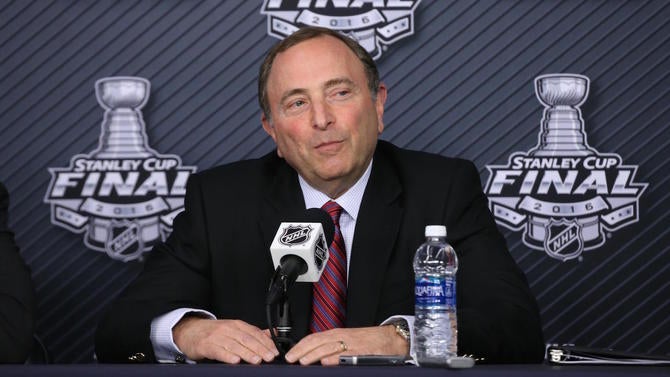
Senator Richard Blumenthal of Connecticut expressed his disappointment in NHL commissioner Gary Bettman's response to a letter he sent seeking answers on the effects of concussions in hockey. In his written response to Sen. Blumenthal, Bettman continued to deny a link between concussions and chronic traumatic encephalopathy, better known as CTE.
Blumenthal's initial letter was sent to the league in late June. In it, he sought answers to multiple direct questions regarding CTE, concussions, fighting, player safety and other related topics. The senator considered Bettman's previous public statements on the matter as "dismissive."
"As the premier professional hockey league in the world, the NHL has an obligation not only to ensure the safety of your players, but to also engage in a productive dialogue about the safety of your sport at all levels--from youth to professional," Blumenthal wrote in his initial letter to Bettman (via SI.com). "Furthermore, given the number of NHL teams who play in arenas financed in part or in whole by taxpayer funds and the hundreds of thousands of American children playing hockey, government oversight into the safety of your sport is appropriate, and a matter of public health."
Bettman was asked to respond by July 23, which he did with a heavily-footnoted 24-page letter to Blumenthal.
The New York Times obtained and published the letter in full earlier this week, putting Bettman's comments on display.
In the response, the commissioner continued to deny links between hockey and CTE. He also repeatedly blamed the media and lawyers representing former NHL players in a class-action suit against the league for fear mongering.
The ongoing lawsuit against the league alleges the NHL failed to warn players of the short and long-term effects of repeated concussions and head trauma, failed to adequately care for players with such injuries, all while promoting the more violent aspects of the game. With that still ongoing, Bettman's response is not at all surprising and it's really not all that different from things he's said before. The main difference is that this is a lengthy response to a sitting U.S. senator than a few soundbites from various media scrums over the years.
The core quote of Bettman's response that has reignited the debate on CTE, was this (via NYT):
"The science regarding CTE, including on the asserted 'link' to concussions that you reference, remains nascent, particularly with respect to what causes CTE and whether it can be diagnosed by specific clinical symptoms. The relationship between concussion and the asserted clinical symptoms of CTE remains unknown."
Bettman cited multiple medical documents including the 2012 "Consensus Statement on Concussion in Sport" that multiple doctors signed onto expressing that there was no scientific proof to demonstrate a causal link between concussions and CTE pathology.
The commissioner also expressed in his response that the NHL is different from the NFL. The importance of drawing that contrast is tied to NFL executive Jeff Miller saying that there "certainly" was a link between football and degenerative brain disorders during a congressional roundtable in March. That was the first definitive admission of such a link by the NFL.
In his conclusion, the commissioner also pointed out that longtime enforcer Todd Ewen, who took his own life last year, was discovered to not have any instances of CTE. Bettman, as he does throughout the letter, once again blamed the media and plaintiffs' counsel of fear mongering:
"This, sadly, is the type of tragedy that can result when plaintiffs' lawyers and their media consultants jump ahead of the medical community and assert, without reliable scientific support, that there is a causal link between concussions and CTE. Certainly, a more measured approach consistent with the medical community consensus would be a safer, more prudent course."
Bettman's response did not go line by line in addressing each of the questions posed, but did provide a fairly comprehensive picture of where the league stands currently on the main issues raised by Blumenthal.
The commissioner's response was not to the senator's satisfaction, however. Blumenthal issued some thoughts on Twitter:
Disappointed @NHL continues to deny link between concussions & #CTE. I will continue to press for real answers: https://t.co/NRvyqSgRvK
— Richard Blumenthal (@SenBlumenthal) July 28, 2016
#Hockey is a fast-paced & exciting sport w/int'l popularity. That's why @NHL should be looking for real ways to improve safety-not oppose it
— Richard Blumenthal (@SenBlumenthal) July 28, 2016
.@NHL has an obligation, not only to its players, but to countless parents & children to uncover real dangers of consistent head injuries.
— Richard Blumenthal (@SenBlumenthal) July 28, 2016
As of now, at least six NHL players have been discovered to have had CTE. Meanwhile, many of the plaintiffs involved in the class-action suit have claimed symptoms consistent with CTE. While it is true that it has not been scientifically proven that one necessarily leads to the other, common sense should raise a lot of red flags, which is essentially what Blumenthal was getting at in his initial letter.
On top of that, genuine concern for the well-being of the athletes being described as "fear mongering" is among the most offensive things the commissioner has said or written publicly on this matter. It also fuels the optics of dismissiveness that inspired Blumenthal to prod Bettman for answers in the first place.
While the NHL is not going to admit any such link while in the midst of a contentious legal battle, the commissioner's on-the-record statements only shows that the research on CTE can't be advanced fast enough. There are still so many things we don't know and while the NHL has made some improvements to its rules to better protect players, it doesn't look like they're willing to go the extra mile just yet.
As renowned neurosurgeon Dr. Charles Tator of the Canadian Sports Concussion Project told the Globe & Mail:
"I think they could be doing more," Tator said of Bettman and the NHL. "That's for sure. ... We need to continue this research. It's really necessary to do it. We owe it to the next generation of players to get this sorted this out. Another generation shouldn't go by without this being solved."