2016 Fantasy Football Draft Day Dilemmas: Touchdown Regression Losers
Some top players are facing touchdown regression that could cause them to under-perform their ADP. Heath Cummings names some likely suspects at each position.

•
5 min read

Touchdowns are important. Paramount you might even say. For both football and Fantasy Football. It would be difficult to overemphasize the importance of this year's touchdowns.
Now, last year's scores? That's a different story.
Chris Towers wrote last August how fickle touchdowns can be from year to year. Whether it was 10 rushing touchdowns, 12 receiving touchdowns or 30 passing touchdowns, Towers found that huge touchdowns seasons were generally followed by less-huge touchdown seasons.
With that being said, ADP tells us that a whole lot of people count on huge touchdown numbers repeating themselves. If you're talking about a running back like Adrian Peterson, that's fine. One of the best backs of all time who consistently sees 300+ touches is probably going to continue to score a lot of touchdowns.
A simpler way of saying it is that high volume stars will consistently score touchdowns. What I'd like to talk about are last year's Fantasy stars who scored at an exceptionally high (or at least surprising) rate. These players are all being drafted more based on last year's touchdowns than last year's volume or production. That's going to be a problem.
QB
Blake Bortles is the poster boy for touchdown regression. You know this already if you've read anything I've written about him.


This is a prime case of whether you judge a quarterback by Fantasy points or everything else. Bortles played 16 games and had an outstanding touchdown rate, so he finished last season as a top-four quarterback. For some, that's evidence enough to draft him ahead of better quarterbacks like Eli Manning, Tony Romo and Philip Rivers in 2016.
Looking at the rest of the story paints a different picture. There is nothing within Bortles' completion percentage, Y/A or tape that suggests he should be amongst the league leaders in any passing category. Bortles was a mediocre quarterback with an All Star cast of wide receivers who played from behind a lot in 2016.
If all things remain equal, I would expect the Jaguars signal caller to see his touchdown production fall in the neighborhood of 20 percent. In 2015 that would have dropped him into Ryan Fitzpatrick range. Many people believe that the Jaguars will be better in 2016 with an improved defense and running game. If that's the case, I'd be worried that Bortles production will fall even further.
Honorable Mention: Cam Newton, Russell Wilson
RB
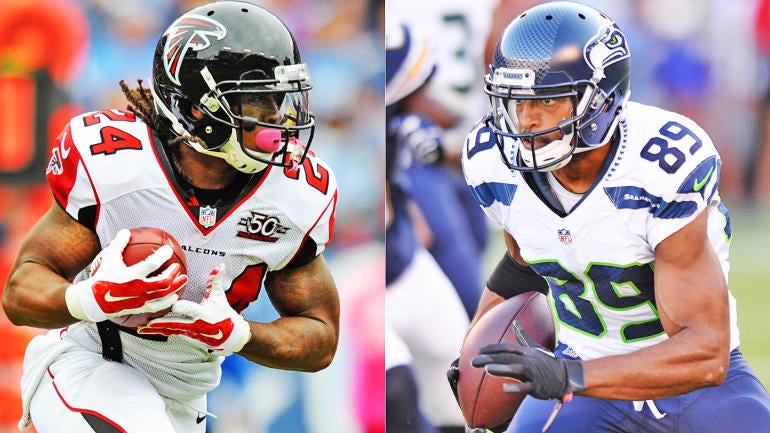
While Bortles is a bit of an obvious choice, I would expect more push-back on Devonta Freeman. After all, he had the second most touches in football last year. Didn't we just say that high volume means touchdowns are sustainable?


In one sense, yes, if Freeman sees 337 touches again in 2016, I would expect him to score plenty of touchdowns. Before we get into how many touches Freeman should expect, let's first remember how he did what he did in 2015.
In the first six weeks of the season, Freeman had 138 touches and scored 10 times. Clearly unsustainable. Of course, he was also very efficient. Freeman averaged 4.7 Y/A on the ground and caught 78 percent of his targets and averaged 9.3 Y/R. He was an All-World back. Then he came back to earth.
After Week 6, Freeman received 200 touches and scored four touchdowns. That was probably a little bit unlucky, but the fact is he was also very bad. Freeman averaged 3.5 Y/A on the ground and less than seven yards per reception. The fact is, if Freeman isn't better than he was in the second half, he won't score touchdowns no matter how many touches he gets.
The Falcons have already been talking about getting Tevin Coleman more touches, which will also cut into the odds of Freeman repeating last year's production. I would guess he ends up closer to 250 touches than 330 and his touchdowns to drop into the 8-10 range. His prowess in the passing game may keep him top 10 in PPR leagues, but he's a borderline No. 1 RB in standard leagues.
Honorable Mention: Jeremy Hill, Danny Woodhead
WR
What Doug Baldwin did in the second half was equal parts incredible and unsustainable. The question isn't whether Baldwin will regress, but how much?


Baldwin was kind of the Bizarro Freeman of wide receivers. He did almost all of his damage between Weeks 9-15 with 63 percent of his receiving yards and 86 percent of his touchdowns coming in those seven weeks.
Now it's possible that something clicked in the second half for Baldwin and Russell Wilson. If you wanted to project receptions and yards based on Baldwin's second half, I think you would at least have an argument. But there's no way I'm trusting that touchdown rate. Mostly because the best wide receivers in the NFL don't catch touchdowns at that rate, and Baldwin is not the best wide receiver in the NFL. I'm not even sure he's the best wide receiver on his own team.
I would anticipate everything regressing for Baldwin, just not all the way back to his 2014 totals. If you give him 75 catches and 1,000 yards again, I would project his touchdown total is just about cut in half. That should make him a borderline No. 2 WR in Fantasy leagues in 2016.
Honorable Mention: Ted Ginn Jr, Allen Hurns
TE
Tyler Eifert was a good reminder last season that you don't get to pick when the regression happens. All throughout the season, I assumed Eifert's touchdown rate was due to slow. He never did. I'm betting that changes in 2016.


I called Blake Bortles the poster boy earlier in this article, but Eifert just as easily could be. In fact, he's probably more deserving. Eifert became the first player since the merger to score 13 touchdowns with less than 55 receptions and less than 650 receiving yards. In fact, only one player has ever caught 12 touchdown passes with those numbers -- Julius Thomas in 2014.
Like Eifert, Thomas has been plagued by injuries and that's the main excuse we gave him in 2015. Still, we knew he wasn't keeping up that TD rate, and neither is Eifert.
The ankle injury has driven down Eifert's ADP, so he isn't quite as risky as he once was. I wouldn't expect 16 games from him, but let's assume he gives us 13 games like he did in 2015. Even with a slight uptick in volume, which isn't guaranteed, I would expect Eifert will fall closer to 7-8 touchdowns. Combined with his injury risk, that makes him a mid-range No. 1 tight end with upside and plenty of risk.
Honorable Mention: Jordan Reed, Richard Rodgers