
MLB Hot Stove: Here's why Angels could rise to playoff contention in 2017
The Halos aren't great, but they might be better than you think

By
Dayn Perry
•
4 min read

The current shoals being navigated by Angels GM Billy Eppler are treacherous ones.
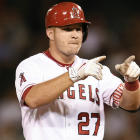
On the one hand, you've got one of the weakest farm systems in the game and a major-league club that finished 14 games below .500 in 2016. On the other hand, you've got the best player in baseball -- Mike Trout -- who's in his prime and gives the Halos the strongest one-man foundation in the game.
The defensible decision that Eppler and ownership has made is to try to contend around Trout. This brings us to the next layer of complications.
Those barren minor-league rungs mean the Angels can't pull off blockbuster trades to improve the current roster. As well, the dubious past investments of Arte Moreno mean there's not room in the operating budget to chase frontline free agents.
Eppler, then, must make improvements at the margins. That's precisely what he's done this offseason.
Not that bad in 2016?
First, the baseline may be higher than you'd think just by eyeballing the Angels' fourth-place finish. Last season, the Angels played to a run differential of minus-10, which scales to an 80-win season rather than their actual total of 74 wins. Those 74 wins are obviously a factual matter, but a team's "run differential record" says more about their future outlook than does their record in the standings.
To be fair, if you drill down a bit deeper to the batted ball level, then the Angels look as bad as their actual 74-88 record, but consider the run differential approach to be one bit of evidence that their 2017 baseline may be a bit better than it seems at first blush.
Giving Trout help
Obviously, Trout has established himself as something close to a 10-win player, and that, as mentioned, is the best possible starting point for a roster. Elsewhere in the lineup, Eppler managed to eke out a couple of significant potential upgrades.
Last season, Los Angeles of Anaheim left fielders combined to hit just .204/.271/.313. It goes without saying that that's miserable production from a bat-first position. The winter addition of Cameron Maybin directly addresses that deficit. Even if Maybin doesn't produce as he did in 94 games for Detroit last season (120 OPS+), he'll still provide the Angels with a substantial upgrade at the plate, on the bases, and in the field.
Speaking of in the field, Danny Espinosa is the Angels' new starting second baseman. He's got a shot at improving upon the .620 OPS that the Angels got from their second-sackers in 2016, but mostly it's Espinosa's defensive skills that will be a boon. Assuming Espinosa and shortstop Andrelton Simmons are healthy, the Angels will boast one of the best defensive middle infields in the game this season.
As well, Martin Maldonado profiles as the new primary catcher. Last year, Angel catchers didn't hit, and Maldonado may improve upon their bestowals. Mostly, though, Maldonado is a much better defender than the Angels' two primary catchers from a season ago -- Carlos Perez and Jett Bandy -- especially in terms of framing.
The Angels also figure to have improved depth in 2016, mostly because of the additions of Ben Revere and Luis Valbuena. Valbuena's power may be especially useful if Albert Pujols' recovery from December foot surgery doesn't go as hoped. Revere, meantime, provides a good hedge against injury to Maybin.
Pitching finally trending upward
On the pitching front, the Angels first and foremost will benefit from not giving 31 starts to Jered Weaver, who last season gave up 106 runs in 178 innings.
Matt Shoemaker's increased emphasis on the splitter and his K/BB rebound bode well for his value going forward. Also bear in mind that ace Garrett Richards made just six starts last season. His partially torn UCL seems to be healed, and he's looking for a full, if conservative season in 2017. That will obviously be a huge boost.
The Angels are also poised to get full seasons from Tyler Skaggs and Ricky Nolasco, each a credible mid- to back-end option, while Jesse Chavez has been added for depth. As well, Andrew Heaney could return from Tommy John surgery in time to give the Angels some stretch-drive innings.
In the bullpen, better health from Huston Street and Cam Bedrosian will certainly help matters, and the addition of Andrew Bailey makes a lot of near-term sense. The well-regarded Kenyan Middleton also figures to arrive at some point in 2017, and he figures to be an asset.
Playoffs?
All of this isn't to say that the Angels will be a great team in 2017 or even a serious contender for the division title. However, thanks to that second wild-card berth in each league and the general environment of increased parity, the bar for contention has never been lower.
The Angels, you can argue, were better than their record in 2016, and Eppler has done a fine job of improving the roster on the cheap this winter. This won't be as good as the 2014 team that won 98 games, but Angels fans may once again enjoy some meaningful baseball late in the summer.
They may even bear witness to a playoff team.