Legalized sports betting presents the NCAA with an amazing opportunity, not a problematic hurdle
Concerns about point-shaving and/or game-fixing are natural, but the NCAA has a chance to be progressive

•
4 min read
The NCAA is aware of the dangers legalized betting present to college athletics and is in the process of determining what it can do to stymie them.
"An internal team of subject matter experts will explore how best to protect game integrity, monitor betting activity, manage sports data and expand educational efforts," the NCAA said in a press release on its initiative.
Of course, when it comes to game integrity and monitoring betting activity, sportsbooks in Las Vegas have been doing that gritty work for decades. In fact, it's because of Las Vegas' vested interest in keeping the games on the up and up that previous point-shaving scandals in college sports have come to light.
And it's also why, in the eyes of many who monitor betting activity, there aren't annual stories of game-fixing in the United States.
Now the NCAA has legitimate reason to put the work in as well.
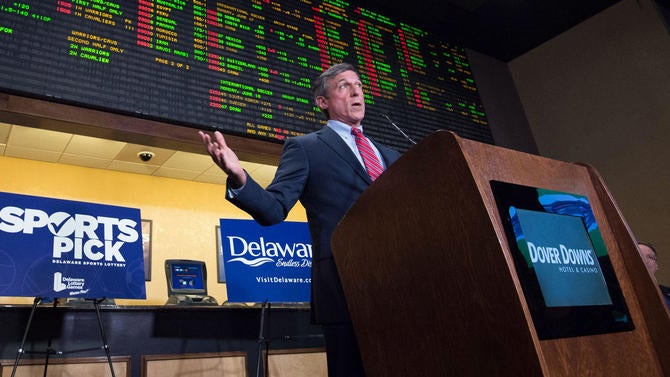
The United States Supreme Court's decision in May to overturn the Professional and Amateur Sports Protection Act of 1992 opened up a new era for legalized gambling. The NCAA has been presented with an opportunity to evaluate and, more importantly, be enterprising with its ideals and potential legislation. Many states are expected to enact legalized gambling legislation in the coming months and years. The Supreme Court's decision was so impactful -- and generally well-received -- that the NCAA lifted its ban on holding championship events in states that allow legalized sports betting.
That's the first positive sign. Will there be more?
[Did you know CBS Sports has a picks and predictions site? It's called SportsLine! Visit now]
What comes next from the NCAA is a big unknown. But there is opportunity here. The NCAA has already stated its support of the Supreme Court's decision. How it keeps its own house in order will be a major effort in the years to come. It would be disastrous, for example, if stories emanated in the years to come about how NCAA players, coaches, officials or others were influenced -- if not on the take -- thanks to increased interest and activity in gambling.
But that's not seen a likelihood.
"Our highest priorities in any conversation about sports wagering are maintaining the integrity of competition and student-athlete well-being," NCAA president Mark Emmert said in May. "Sports wagering can adversely impact student-athletes and undermine the games they play. We are committed to ensuring that laws and regulations promote a safe and fair environment for the nearly half a million students who play college athletics."
The NCAA's working group on this is an internal effort, which means the organization is ostensibly not reaching out to experts in Las Vegas or elsewhere who have dealt with these matters, as a profession, for years if not decades. For those who critique the NCAA for its closed-off approach to many issues, this will once again provide easy fodder. Why not try to bring in as many people close to this issue, people outside of your organization, to get at the heart of the problem?
It's the same critique that's been applied to the Rice Commission on College Basketball, which for the most part neglected to include those most familiar with how college basketball recruiting works.
And for the skeptics who wonder if the NCAA or its conferences will make money off players' backs because of a betting "integrity fee," that doesn't seem to be the case.
"While some have advocated that leagues or schools financially benefit from new state laws, including integrity fees levied on sports wagering revenues, the NCAA instead has decided to focus its attention on the substance of education, the protection of student-athletes and a standard approach to game integrity through consistent national guidelines," the organization said in its statement.
Many experts in the industry anticipate legalized sports betting to be a boon for college athletics and beyond. The NCAA Tournament -- and thus, college basketball -- stands to grow even bigger.
This is an interesting moment for the NCAA, which is constantly battling poor PR and often losing in the court of public opinion. The issue of legalized sports betting is one with a lot of progressive thought behind it. Now that the United States Supreme Court has made its call, the NCAA has a window to make decisions that are not only practical, but also progressive.
Perhaps an integrity fee, if it could even be applied, could be of use. It could be provided back to the players. Think of the goodwill, and tremendous publicity, that would provide the NCAA.
A new age of sports coverage and fan interaction is underway. It would behoove the NCAA to not protectively wrap its arms around this -- but to embrace legalized sports betting and see it as an opportunity rather than an issue.