2020 Fantasy Baseball Draft Prep: 10 sleepers for runs in Rotisserie and categories leagues
Who targets runs late in a Rotisserie draft? Here are some suggestions for those who do.

By
Scott White
•
1 min read
Runs aren't something I directly target in 5x5 leagues. Yeah, they represent one of the five hitting categories, but my general approach to hitting in those formats is to balance home runs and stolen bases while continually feeding my batting average. The runs and RBI tend to work themselves out.
But maybe you notice while your draft is unfolding that most of your hitters have suspect on-base skills or are projected to hit in the middle or lower third of the order. It would be a strange sort of accident, but it's possible. And in that case, you may feel compelled to make a play for runs.
So what kind of hitters should you target? Well, I just spelled it out: high on-base guys who hit high in the order. You'll notice most of these 10 choices meet that criteria.
We analyzed league-winners and runs/strikeouts sleepers Wednesday on the Fantasy Baseball Today podcast. Subscribe to the podcast here.
Only hitters with an ADP of 160 or later, according to FantasyPros, were considered.

Sleepers for runs
If the two keys to scoring a lot of runs are getting on base and batting high in the lineup, Bryan Reynolds has both of those covered, if less conventionally than others. He doesn't walk at an especially high rate, but his batted-ball profile is uniquely attuned for batting average (hence making him a sleeper for that category as well), and the result was a .377 on-base percentage last year. If he does that batting in the two-hole, even for a bad Pirates team, he should sustain a 90-plus-run pace.
| ||||||||||||
It wasn't a fluke that Adam Eaton scored 103 runs last year but the inevitable result of him finally staying healthy for a full season. In fact, his .365 on-base percentage was a fairly significant step back from his .394 mark over the previous two injury-plagued years. The reason he goes so late in drafts is because he's not a big contributor in either home runs or stolen bases, but he's not a zero in them either. If runs are a glaring need for you, he won't set you back much elsewhere.
| ||||||||||||
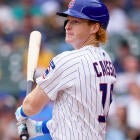
Look at how many runs Mark Canha scored last year even though he didn't become a full-timer until about halfway through the season. From that time, though, he had a .415 on-base percentage, which only Mike Trout, Christian Yelich and Alex Bregman outperformed over the full season. Maybe Canha will never be quite that good again, but he has a lot of wiggle room with that OBP. It almost doesn't even matter where he hits in the lineup.
| ||||||||||||
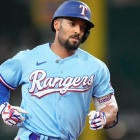
I would simply like to say "look how many runs he scored last year," because if you're getting a top-50 run-scorer outside the top 200 -- and with some home run and stolen base contributions as well -- you're doing pretty good. But it's worth showing why Shin-Soo Choo is well equipped to do it again, and it's because he has consistently been a high on-base guy, reaching at a .371 clip last year and .369 in his five years with the Rangers. They seem to like him in the leadoff spot.
| ||||||||||||
As Andrew McCutchen's abilities have eroded over the past few years, his skills have improved, setting up what could be a productive final act as primarily an on-base guy. It was working for him out of the leadoff spot before suffering a torn ACL last year. His 162-game pace in the runs category was 123.6, which would have been the fourth-most in baseball.
| ||||||||||||
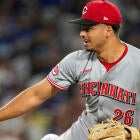
For a player who has long exhibited some of the league's best on-base skills, Joey Votto's run totals have been curiously low, and it may be that I'm not factoring foot speed enough into my run calculations. For now, though, I'm sticking mostly to on-base ability and lineup spot. In terms of the former, there's a decent chance Votto rebounds from his not-so-bad .357 mark last year, given that his career OBP is .421, and the current plan is for him to continue batting second in what should be an improved Reds lineup following the additions of Nick Castellanos and Mike Moustakas.
| ||||||||||||
Luis Arraez is like Bryan Reynolds in that his on-base ability is tied mostly to a high batting average projection, and his batted-ball profile is about as perfect as it gets for batting average. His strikeout and line-drive rates both would have ranked first last year if he had the at-bats to qualify, and it led to him reaching base at a .399 clip. The Twins have arguably the deepest lineup in baseball and had him batting at the top of it by the end of last year. It makes for lots of big bats to drive him in.
| ||||||||||||
I already mentioned the Reds' improved lineup, what with Nick Castellanos and Mike Moustakas signing free agent deals, but Shogo Akiyama wasn't a nothing acquisition himself, in fact projecting to hit leadoff on most days. He bats left-handed, which gives the Reds an excuse to sit him against lefties, but it'll probably depend on how he performs. And while you shouldn't expect the home runs to carry over from Japan, he hit no less than .296 with no less than a .385 OBP in his final five seasons there.
| ||||||||||||
The platoon question is also in play for Tommy La Stella, who we already know will sometimes sit for utility player David Fletcher. But he may not sit against all lefties. He didn't last year, and it could be right fielder Brian Goodwin who sits more often instead. While La Stella's power surge last year is rightfully cause for skepticism, he has always made contact at an elite rate -- and usually with good on-base skills. Whenever he plays, he'll be in prime position to score bunches of runs batting ahead of Mike Trout, Anthony Rendon, Shohei Ohtani and Justin Upton.
| ||||||||||||
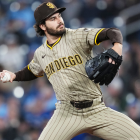
Though he's another left-handed batter, the Padres were sounding mostly on board with playing Trent Grisham every day even before the DH spot came into play for the NL. He may have a difficult time working his way up the lineup, particularly if the Padres like Fernando Tatis in the leadoff spot, but Grisham has demonstrated the sort of elite on-base skills that could make him a run-scoring machine. He consistently had around a 15 percent walk rate in the minors -- or Carlos Santana-level -- and he had a .407 OBP between two minor-league stops last year.
| ||||||||||||