Ex-Ferrari racing chief steers UN toward preventing road fatalities
Jean Todt is a Ferrari racing legend. His new mission? Helping the United Nations save millions of lives by creating new global road safety rules and regulations.
By
Pamela Falk
•
5 min read
While world governments grapple with issues of war and human rights, the United Nations has turned its attention to a simple and straightforward way to save lives: road safety.
With 13 million deaths in the last decade and 3,500 fatalities per day attributed to vehicular accidents, the U.N. General Assembly passed a mandate to steer the world towards resolutions that will ensure fewer lives are lost in crashes.
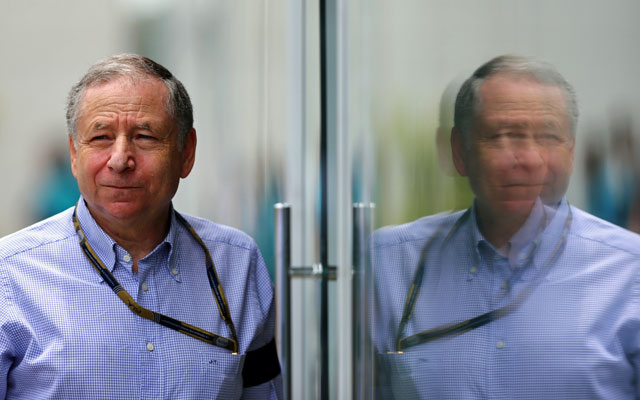
Leading the pack is the new U.N. Special Envoy for Road Safety, Jean Todt. The former CEO of Ferrari, Todt was associated for decades with high-speed racing before being appointed to his post last year by U.N. Secretary-General Ban Ki-moon.
The idea to name Todt the global leader in an effort to stop road deaths sprang from a conversation that Todt and Ban had about the shocking number of people who are killed or hurt each year. Nearly 1.25 million people die and 50 million more are injured in road accidents, making them one of the top 10 causes of death worldwide.
“I told [Ban] that, every 30 seconds, someone dies on the road, and 90 percent [of those deaths occur] in developing countries," Todt told CBS Sports in an exclusive sit-down interview at U.N. headquarters. "[Ban] pondered it, left, and a week later came back with a proposal to make preventing road deaths a priority."
Though there have been global road safety programs and efforts in existence for a decade, the prevention of crashes had never made it to the global agenda. While fatal high-profile road deaths like those of Princess Grace Kelly, Princess Diana, James Dean and Paul Walker have commanded short-term press attention, there has been no global follow-up to reduce deaths in a programmatic way.
One year into his mandate, Todt, who is also president of the International Automobile Federation (FIA) and a founder of a Paris hospital for brain and spinal injury, has traveled the globe and put together a dream team of executives -- from General Motors, Renault-Nissan, FedEx, the International Olympic Committee, Coca-Cola, the Russian Automobile Federation and Michelin -- government transportation ministers, bankers and celebrities.
Alarming statistics
Together with U.N. agencies, including the World Health Organization (WHO), the new Special Envoy’s office has put together staggering figures about death on the roadways.
• Accidents are the No. 1 cause of death for ages 15-25
• Low- and middle-income countries have only half of the world’s vehicles but account for 90 percent of such deaths
• 49 percent of people who die in traffic accidents are pedestrians, cyclists and motorcyclists
• 500 children die in vehicle crashes every day
By region, the numbers paint a picture of roads without traffic signs, cars without safety belts and drunk drivers still getting behind the wheel. Developing countries where there are the most auto accident-caused deaths: the Dominican Republic, the Democratic Republic of the Congo and Thailand. The United States is third behind China and India in citizens fatally injured by motor vehicles.
“You should see the road to Rangoon [the capital of Burma-Myanmar]," Todt said. “They call it 'Suicide Street.'”
Road safety campaigns work
“When I was young, we didn't use seat belts,” Todt told CBS Sports, “but now everyone does.” He uses this notion to support his thesis that dramatic change is feasible.
Todt meets with the United States' American Automobile Association (AAA) along with city transportation leaders, including those from New York City.
Big cities see the impact of traffic deaths the most, Todt said.
In New York, being struck by a vehicle is the lead cause of injury-related death for children under 14 and the second-leading cause for seniors. On average, vehicles seriously injure or kill a New Yorker every two hours.
These facts prompted New York City Mayor Bill de Blasio to launch Vision Zero, an action plan which lowered in city speed limit and stepped up enforcement and penalties.
“Speeding is one of the leading contributors to crashes, which is why our Vision Zero program has targeted more enforcement at these dangerous drivers and why we made reducing our citywide speed limit to 25 miles-per-hour a major priority,” Wiley Norvell, a spokesman and transportation expert in Mayor de Blasio’s office, told CBS Sports.
Like his predecessor Mike Bloomberg, who focused on shrinking sodas and banning saturated fats, the current mayor sees the potential of an important non-partisan public health gain in road safety.
As part of the worldwide campaign, Todt wants to make braking for safety a global goal.
Todt has established a 10-point manifesto to cut the number of traffic deaths in half by 2020. It focuses on ambitious plans to do more than change global driver behavior: build better infrastructure on roads, lower speed limits, require safety measures in new cars (airbags and anti-lock braking systems) and raise money to accomplish all of this.
“One of my worst memories was about four or five years ago [when I was] in Benin, Africa, and I wanted to see an emergency room in the hospital. When I arrived, there were 50 bodies on the floor, bloodied,” Todt recalled.
When Todt asked why they were on the floor, he was told that they were injured in car crashes but not being helped yet because the hospital was “waiting for a relative with money [to appear in order] to start working on them.”
“So you have to give back,” Todt said, “and that is what I am doing with road safety.”
Todt noted that the current daily body count is “like 10 jumbo jets full of people” crashing every day. “I have tried to change gear,” the former racecar driver and special envoy said.
Todt has an interest in improving racecar driving safety in addition to civilian road safety. Formerly the team principal of Scuderia Ferrari, Ferrari's racing division which won 14 Formula One world titles during his tenure, he is now at the forefront of changes to the regulations for Formula 1 racecar driving. The new Formula 1 rules, he believes, have to be changed.
“Formula 1 is the pinnacle of motorsport -- it has to be the pinnacle of safety," Todt said.
Despite some race-world grousing, Todt’s push for Formula 1 safety has made progress. Time will tell whether he can make a similar difference on a global scale.