Pacquiao, trainer Roach have taken each other to new heights
The day Manny Pacquiao walked into Freddie Roach's gym looking for a trainer, both of their careers changed forever.
By
Jason Keidel
•
10 min read
Full Mayweather-Pacquiao coverage
Nearly 15 years ago, a pixie popped into a Las Vegas gym. No one stared, cared, or even blinked. The gym's owner, curator, and avatar thought the young man was more ready to ride a horse than put on gloves, much less become the most popular fighter on the planet.
Manny Pacquiao, who could barely speak English, was of such little renown that he literally had to solicit good trainers. Then he slipped out of his street clothes, and into character.
"He stepped in the ring and my fighter couldn't touch him," says Freddie Roach, who snatched up the fighting dynamo by end of day. "Then I had him work the mitts, and I knew he had something special."
Roach, proud papa of the modest Wild Card Gym, had poured all his money into the the sweaty, concrete block, against the advice of his mentor, who said gyms drain your soul and savings, giving back little more than the provincial pride of ownership.
Pacquiao was on the back-end of an American tour to find his teacher. He hopscotched the United States, starting in New York City, until the happenstance, the serendipity, the accidental bond that now makes the most heralded duet in boxing.
"No one wants a small guy you don't know," Says Roach, who marveled at Pacqiao's raw but colossal skills. "He had a huge left hand. He had speed and power. Most guys have one or the other. He had both."
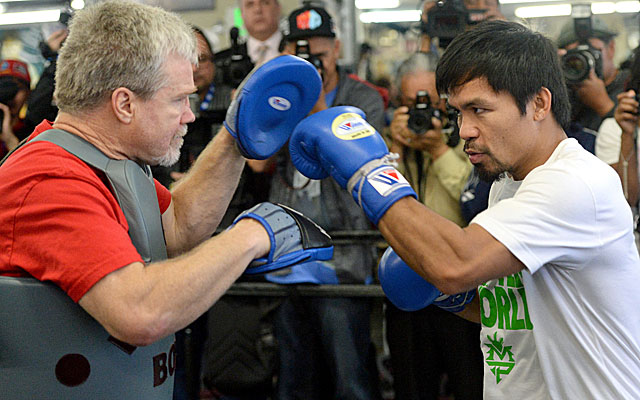
What transpired that day is a bond that catapulted both into the one-percent of sport and finance, an orbit that neither man anticipated just an hour earlier. A drawer of championship belts late, Pacquiao is about to earn around $100 million for his fight with Floyd Mayweather Jr on May 2 -- not far from the gym where this blessed bond began.
When thumbing through the most talented tandems in sports, you think of teammates or rivals. Montana to Rice. Mantle and Maris. Borg vs McEnroe.
But only in boxing, between boxer and trainer, is the synergy so singular and essential to success. There are no replays, red flags, or second chances that can mitigate the efforts of the fighter and the man in his corner.
Pacquiao and Roach aren't the typical boxing tableau, where some avuncular graybeard takes the class chump and chisels him into world champ. They are of different countries, tongues, and have an Odd Couple chasm in demeanor. But the result is very familiar.
"I always said, you never know when the next Muhammad Ali will enter your gym," says Roach.
No one will ever approach Ali's gravitas, in or out of the arena. But hyperbole aside, Pacquiao is clearly one of the icons of his era, with a skill set that doesn't need to be defended. "People talk about how fast his hands are," says Roach, "but his feet are even faster."
Talent is vital, and more tangible. But what about the old-world codas of training, coaching, and friendship? How much of the athletic excellence you see on TV is spawned by ability and how much comes from the gym?
Roach recalls a change in style that became a portal to Pacquiao's ambidextrous power. "I told him to eat with his right hand, do everything with it," says Roach, who didn't want the southpaw too dependent on one punch. "Then we had the David Diaz fight, and that's when he first knocked someone down with a right."
Roach kneels at the altar of Eddie Futch, the boxing Yoda who molded many of the greats, from Joe Frazier to Riddick Bowe. Bowe fondly referred to Futch as "Papa Smurf" because of his diminutive size and gravely cadence.
There isn't a better mentor than Futch, who was embedded in the sweet science for 60 years. And there isn't a better consigliere for Pac Man than Roach, who has the requisite bio of boxing experience and endured the real-life rigors of a post-pugilism life.
The fighter himself, Roach's Rembrandt, his Ali, doesn't come with the generic boxing bravado you'll find in most camps. With his black mane, modest goatee, and soft voice, you don't expect the perpetually-smiling Pacquiao to be the beast he is in the ring. But it speaks to the ancient duality of the fighter -- part man, part monster. Some can't keep the two apart outside the ring, but Pacquiao isn't one of them.
"He knows how to reach me as a teacher," Pacquiao said of Roach, to CBSSports.com. "He is very direct and his approach to strategy is simple. He never yells at me in the corner to get my attention."
Pacquiao recalls their embryonic days together with equal clarity. "I was very naive when we first met," says Pacquiao. "I had never even had a fight in the U.S. I was the WBC flyweight champion before we met. But I owe a great debt to Freddie in becoming the fighter I am."
A possible wrench thrown into the inherent barbarism of boxing is Pacquiao's newfound dedication to religion, which Roach refers to as his Born Again state. "We had to sacrifice a little of his killer instinct," says Roach. "I told him that if he had more of it against Marquez he would have finished him off before the knockout."
But Roach sees a new fire in Pacquiao leading up to the fight with Floyd Mayweather Jr. "If he gets Floyd hurt I think Manny will finish him off," Roach says. "This is the first fight where he doesn't like the opponent. He won't say that. But I can see it."
Pre-fight machismo? Maybe. Roach is confident and outspoken, but he only speaks for himself in such bold hues. If anyone is hardwired into the Tao of Pacquiao, it's his trainer.
And the bond goes way beyond the ring. "Manny was in a very bad contract situation early in his career," says Roach. "So I got him lawyers and got him out of it. If someone is harming my fighter, I'm going to help."
But the teaching has its limits."The other day, he wanted to buy a new house," says Roach. "It was like $12 million. "I asked him if he really needs that. He has a nice house already."
A man, no matter his loyalties, wants his castle. "I think he bought it, anyway," says Roach. "He's a father and husband. He's become a better person. He doesn't gamble. He doesn't even sing that much anymore."
But Roach is singing to prosperity. According to an article in Yahoo! Roach spent $20,000 to charter a plane to Canastota, NY, for his 2012 induction into the International Boxing Hall of Fame - double the amount of his biggest payday as a fighter. But 20 grand is tip money in Manny Pacquiao's world.
Despite his epic success, Pacquiao's sense of loyalty never wavers. "He took me under his wing," Pacquiao says of Roach. "And he was always checking up on me even outside of training hours. And all I had to offer in return was my friendship and loyalty."
Unlike many fighters, who wilt under the elastic moods of management, Pacquiao didn't leave Roach after they hit their first boxing speed bump. "After I lost to Erik Morales in 2005, Freddie apologized to me for not having me prepared," says Pacquiao. "He then looked to improve himself before taking on the task of making me a better fighter."
Pacquiao mused over the singular focus on his off-hand. "It took awhile. Freddie told me his goal was to get all the best out of me," Pacquiao says, before recalling his Karate Kid moment against Diaz. "And I believe I am the fighter I am today because of Freddie."
Bob Arum, CEO of Top Rank and Pacquiao's promoter, lords over the business outside the ring. While he's seen the BFF bond between trainer and fighter before, he realizes this kinship is special.
"Freddie fought for me for many years," says Arum. "He was not super talented but he was very competitive."
When pondering the bond between Pacquiao and Roach, he's sees the entire era in a snapshot. "Early on, Manny didn't speak English," says Arum. "So when Roach gave him instructions they had someone translating."
But their bond isn't based on a common lifestyle or belief system. "They come from different worlds," says Arum. "Manny is very spiritual. Especially now. Yet Freddie is an atheist."
So what is it beyond the obvious mechanics and mitts of training? "Chemistry is essential," says Arum. "The Spurs don't win without Popovich. The Bulls don't win without Phil Jackson. Same with Freddie. There's a tremendous understanding from each side. They talk in bits and pieces while working together. They've sealed off the training camp so that the strategy can stay confidential between Manny and Freddie."
Sometimes it takes an outsider to reveal the obvious. "About six months ago, I was in the Philippines watching Manny play basketball," says Roach. "And a guy walks up to me and asks who I am. I said I was a father figure before but more of a friend now."
But the stranger disagreed. "Then he told me to watch Manny whenever he made a shot. He kept looking at me to see my reaction." Roach laughed at the memory. "So maybe it hasn't changed."
Father. Advisor. Trainer. Whatever hat or handle Roach carries, it fits well with his prodigy. Pacquiao says it's been so long since he's had another trainer, he can't remember what it was like to work with anyone other than Roach.
And for those who wonder if Roach's physical maladies preclude him from the daily hardships of his gym, Pacquiao assures us it's not a topic. "Almost never," Pacquiao responds when asked. "He had a back issue earlier in camp but that seems fine now."
You've seen the sad montages of Roach trembling at some dais, struggling to keep his arms in check. Parkinson's doesn't play favorites, even if you're weeks from the most lucrative bout in boxing history. But, to a man, neither man thought of mentioning anything but each other and their co-opted goals.
"Their team functions as a unit," says Arum. "Floyd Mayweather has been trained by his uncle and father, all of whom have big personalities. I know and like Floyd and his family. I worked with them for over ten years. Roger is a good trainer. Unlike Freddie, Roger was a world class fighter. He doesn't have the necessary incentive to take a secondary role to Floyd."
Arum sees potential conflict between the robust egos. "The father and uncle and son have a very complex relationship," he says. "You have to understand the dynamic. Floyd Sr was in prison, it's something that influenced Floyd's early years, making it somewhat dysfunctional. Some of that tension always bubbles up to the surface."
The implication, of course, is that Pacquiao and Roach are the good ship harmony by comparison. Pacquiao hasn't always been a saint. We know of his debt to the IRS, the rumors of drinking and gambling. Hence the sobriquet of Born Again. Maybe his religious epiphanies are meant to be all-encompassing -- a refreshed mind, aura, and aptitude.
Born Again. Perhaps it's equal parts religion and metaphor. The two men needed each other in 2001, and despite the material hallmarks of their success, you could say they need each other more now than ever, with each man on the back-nine of a resurgence, and a remarkably journey.
However this ends, no one will dispute their ringside symbiosis. Pacquiao wasn't great before he met Roach, and Roach wasn't revered until he met Pacquiao.
Do they still tweak the nuclear arsenal of Manny Pacquiao? "He trusts me completely," says Roach. "When I come up with something new, I show him the move. And if he doesn't like it, then we adjust it to the point where he does."
Both fighter and trainer are understandably averse to sharing ring secrets leading up to May 2. Suffice it to say they are in an eternal state of experiment, communicating more in grunts and gestures than monologues, a language that lends itself to boxing.
"That's why I call him Master Freddie Roach," says Pacquiao. "He is the master teacher."