The Yankees were eliminated from the playoffs Wednesday as part of a loaded slate in Major League Baseball's 2025 postseason.
The Tigers mounted a comeback against the Mariners in the day's opening game, keeping their season alive and forcing an ALDS Game 5 on Friday night. The Cubs staved off their own elimination with a Game 3 win over the rival Brewers, and the Phillies blew out the Dodgers to avoid an NLDS sweep.
Those Yankees, however, were unable to put up enough offense behind rookie righty Cam Schlittler and are instead headed home for the winter. The Blue Jays, who won 5-2, are headed to the ALCS, where they'll play the winner of that Tigers-Mariners series.
Winner: Vlad Jr. and the Blue Jays
We needn't overthink this. The Blue Jays are going to the ALCS for the first time since 2016 and that makes them a winner. They also rolled through the AL East rival Yankees to get there. The Blue Jays went 11-6 against the Yankees between the regular season and postseason, and trailed for only five innings in the four ALDS games. It's hard to believe these two teams finished tied atop the AL East, isn't it?
Vladimir Guerrero Jr., after some quiet postseasons in the past, had a whale of an ALDS, going 9 for 17 (.529) with three home runs. He drove in nine runs in the four games. Vlad Jr. agreed to a 14-year extension in April, committing essentially the rest of his career to Toronto, and they broke through with an ALCS trip this season. A great year and a great night for Guerrero and the Blue Jays.
What's next for Yankees after MLB playoff elimination? Aaron Judge's team faces questions as drought continues
Mike Axisa
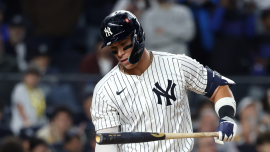
Loser: Aaron Judge
Why? Because he had a monster ALDS -- 9 for 15 (.600) with two doubles and a homer -- while his teammates no-showed. Yankees other than Judge went 25 for 123 (.203) at the plate, and the pitching/defense allowed 34 runs in the four games. Judge was Atlas in the ALDS. He carried his team. He did everything he possibly could have done and the rest of the Yankees let him down.
Judge will turn 34 in April and, as good he still is, another year of his prime came off the calendar without a World Series ring. He's running out of time to win a championship and the Yankees are running out of time to win a championship with Judge as a major contributor. He did all he could in the ALDS and in Game 4. He just didn't have nearly enough help.
Winners: Phillies pitching gameplan and offense in tandem
When the Phillies announced Aaron Nola as the Game 3 starter, plenty of eyebrows were raised. Nola has been a frontline starter many years and has plenty of playoff experience, but he also had a 6.01 ERA this season. Sure, he had a great start in his last outing, but it was against the lowly Twins. That's a far different task than these Dodgers.
Nola got through two innings for the Phillies and was removed, revealing their plan -- which some suspected -- of bringing lefty Ranger Suárez on as their true bulk guy in this game. Though Suárez gave up a home run on the first pitch he threw, that was all the damage he allowed. He worked four innings, allowing just that one run on five hits while striking out four.
Phillies closer Jhoan Duran was ready to work two innings to close the thing down, too.
The plan worked very well. So well, in fact, that the Phillies were able to sit Duran down and now he's well rested for Game 4.
They were able to bypass Duran because the Phillies' offense provided eight runs.
The Phillies worked some good at-bats early against Dodgers starter Yoshinobu Yamamoto, even some that were aggressive early in the count. In theory, the strategy would seem to be to make Yamamoto throw a ton of pitches in order to tire him out and get into that leaky Dodgers' bullpen. Instead, the Phillies hit him hard enough to get him out of the game after just 12 outs and get some looks at that beleaguered Dodgers' bullpen. Sure enough, they tagged Clayton Kershaw for five runs in the eighth inning, effectively putting the game away.
Oh, and a monster Kyle Schwarber bomb is always part of a well-laid plan:
Schwarber later homered again, giving him 23 in his postseason career. That's the third-most all time behind Manny Ramirez (29) and Jose Altuve (27).
Losers: Home teams in this series and the Dodgers bullpen
We'll start with the Dodgers' bullpen. It's been so bad down the stretch. The Dodgers used Game 4 starter Tyler Glasnow in relief in Game 1 and have temporarily moved rookie starter Roki Sasaki into the role of playoff closer. Still, they can't rely so heavily on just a few starters in relief. We saw reliever Blake Treinen look awful in Game 2. There were issues in the eighth inning in both games against the Reds in the Wild Card Series.
This time around, Kershaw was crushed. He threw a scoreless inning in the seventh, but he was bailed out after allowing the first two batters to reach with two lineouts flanking a catcher pickoff. His next inning, he was torched for five runs, his 10th career postseason game in which he allowed at least five.
Through three games, hometown fans have departed each in disappointment. The Phillies blew a 3-0 lead in Game 1 to lose 5-3. They tried to storm back from a 4-0 deficit in Game 2 but fell short and lost 4-3. The Dodger Stadium crowd here in Game 3 was excited at the possibility of seeing a sweep, just like in the Wild Card Series. When Tommy Edman hit a solo shot to take the lead, 1-0, in the bottom of the third inning, it probably seemed like the party was on. The Phillies had other ideas and ran off eight unanswered runs.
And now the Dodgers lead the best-of-five series, two games to one, with the road team winning each game. We've seen a five-game series in which the road team won every single game before: the 2012 NLDS, when the Giants lost two games at home to the Reds before going to Cincinnati to win three. Of course, in recent years we've seen two examples of the road team winning every game in a seven-game series. The Rangers-Astros did so in the 2023 ALCS and the Nationals-Astros in the 2019 World Series. The Astros lost both of those. That's a lot of home losses.
This series pales in comparison thus far, but we've seen three road wins nonetheless.
Winner: The Cubs' bullpen
It was hardly spotless work, as the Brewers mounted threat upon threat after Cubs starter Jameson Taillon departed. However, in five innings of work, the Chicago bullpen permitted only one run against the offense that during the regular season ranked second to only the Dodgers when it comes to runs scored. They also pulled off that high-leverage work despite having been worked extremely hard by manager Craig Counsell during these playoffs. Key outs by Caleb Thielbar and Brad Keller in the eighth with traffic on the bases were especially critical. Keller went on to record a four-out save.
Michael Busch makes MLB history and keeps the Cubs alive with NLDS Game 3 win vs. Brewers
Dayn Perry
Loser: Quinn Priester
Priester, after being acquired from the Red Sox and making adjustments to his pitch mix, positioning on the rubber, and arm slot, looked like a remade ace. The Cubs, though, treated him most harshly in Game 3:
It took Priester 39 pitches to record those two outs, and all four of the runs the Cubs scored in Game 3 were charged to him. On top of that, Priester's failure to finish even one inning caused the Brewers' bullpen to be worked hard ahead of an uncertain pitching arrangement for Thursday's Game 4.
Game Score is a quick-and-dirty Bill James metric that measures a pitcher's dominance or lack thereof in a given start (50 is average and anything 90 or higher is an absolute gem). Priester in Game 3 had a Game Score of 29, which by that measure is his second-worst start of the 2025 season. Unfortunate timing, that.
Winners: The Tigers lineup
Goodness gracious did Detroit ever need an offensive outburst like this.
The Tigers entered Game 4 hitting .165/.246/.233 with one home run, nine total runs scored, and 35 strikeouts in 103 at-bats. In short, they had been miserable. Credit that in part to the Mariners' outstanding pitching staff, but even they allowed a .241/.305/.396 slash line during the regular season. Likewise, no one would have confused the Tigers with an elite offensive team. At the same time, they ranked in the top half of the league in-season in both runs scored and park-adjusted offense.
Through the first four innings of Game 4, the Tigers were held to no runs on two hits. When the Mariners took a 3-0 advantage, it was reasonable to think that might be enough to win. Yet the Tigers started to show signs of life in their half of the fifth inning. Dillon Dingler drove in a run with a double, chasing starter Bryce Miller from the game in the process. Pinch-hitter Jahmai Jones then drove in another run, and Javier Báez another to tie the game at 3-3.
The Mariners placed two runners with two outs in their half of the sixth, but they were unable to convert either into a run. Although there was no way of knowing it at the time, that ended up being the last half-inning where the result was much in doubt. The Tigers plated four runs of their own in the bottom of the sixth, with Riley Greene and the aforementioned Báez lifting the second and third home runs of the series for the Detroit offense. Gleyber Torres added the fourth an inning later. Just like that, the Tigers had an 8-3 lead. That would prove to be more than enough.
To put Detroit's Game 4 into perspective, consider that the Tigers tallied as many runs (nine) as they had in the previous three games combined. They also nearly matched their number of hits (13 vs. 17) and surpassed their number of extra-base hits (seven vs. five).
Where that leaves the Tigers' bats for Game 5 is anyone's guess. These things aren't easy to predict on a day by day basis. But, if nothing else, Detroit's lineup finally feels like a part of the series.
Loser: Seattle's collective blood pressure
Face it: this is going to be a long few days in the Pacific Northwest.
Through the midway point of Game 4, the Mariners looked primed to win and advance to their first ALCS since 2001. Then it all fell apart. Now, the M's have a date with left-hander Tarik Skubal, a Seattle native and the best pitcher in the American League, on Friday to determine which team will move on.
You can empathize with any fan currently going through it. Remember, the Mariners are one of five MLB franchises to never win a World Series. Seattle's particular history is far worse than that statistic lets on. The Mariners have never won a pennant -- heck, they've never even been within a win of claiming a pennant -- despite existing for nearly a half century.
So, yes, as far as baseball goes, Seattle is going to be a most anxious place for the next few days.