The 2025 MLB playoffs are officially underway. The playoffs got started Tuesday with four Game 1s in the best-of-three Wild Card Series. The Tigers took the first game of the day behind ace Tarik Skubal to the mound, beating the Guardians 2-1. Detroit is hoping to get some revenge against Cleveland after coughing up the AL Central title in September.
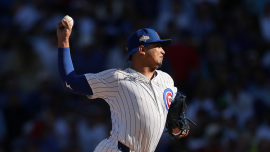
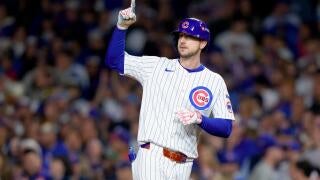
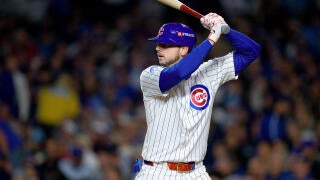
The Cubs took their own series lead over the Padres, beating San Diego 3-1 in another pitching-centric battle.
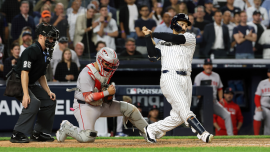
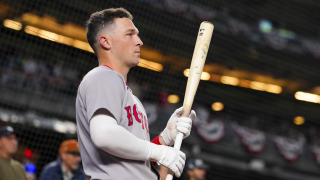
In the evening game, ace Garrett Crochet delivered a huge start for the Red Sox, who seemed like they were coasting to an easy win before the Yankees loaded the bases with no outs in the bottom of the ninth inning. Aroldis Chapman pulled off a masterful escape act and Boston won Game 1 3-1.
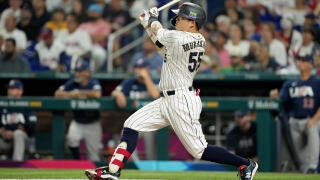
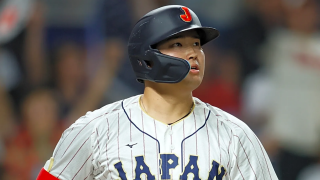
The Dodgers and Reds finished out the day with the most offensive Game 1 thanks to home runs from Shohei Ohtani (2), Tommy Edman and Teoscar Hernández (2). Los Angeles won 10-5.
These best-of-three sets, all played at the stadium of the superior seed, will determine who advances to the more traditional structure of the playoffs, beginning with the Divisional Series. The Blue Jays, Mariners, Brewers and Phillies all received first-round byes this year and will get their playoff journeys started on Saturday.
Here now are winners and losers from the first day of the playoffs.
Winner: Dodgers pitching situation
The biggest concern with the Dodgers across the entire second half of the season was the bullpen. They entered the playoffs with six starting pitchers, plus the return of Roki Sasaki. Clayton Kershaw is inactive for the Wild Card Series, but the Dodgers still only need a max of three starters, so Tyler Glasnow, Emmet Sheehan and Sasaki have beefed up the bullpen. The idea was that the starting pitching would work deep enough into games to take pressure off Dave Roberts having to pull the right levers with the bullpen.
Snell went out and threw his longest ever playoff game, working seven innings. The offense provided enough cushion that Roberts was comfortable enough to let Snell finish the seventh despite allowing a two-run rally and Snell was efficient enough that he still only threw 91 pitches in his seven, mostly dominant, innings of work.
When Roberts went to the underbelly of the bullpen in the eighth inning, they gifted the Reds three runs. A lesser mind might worry that this means the Dodgers will have bullpen issues all postseason. No, these were the guys who pitch when the Dodgers have a 10-2 lead, not when they're playing in a close game. The good arms were saved.
The concerns moving forward haven't been eliminated or anything, but the Dodgers are in good shape overall. -- Matt Snyder
Loser: Playoff format (and the Mets)
I said this heading into the playoffs, not in a mean way but in a matter-of-fact way: The Reds are not a playoff-caliber team and shouldn't be here. They scored five runs Tuesday, sure, but it was almost entirely because the Dodgers relievers forgot how to throw strikes, not because of the Reds' offensive prowess. We go through a marathon of a 162-game season in order to figure out the best teams and therefore don't need quite as big a playoff field as other sports to determine which team is worthy of being champion. Going 83-79 in the regular season is not worthy of entry into the tournament.
The defending champions illustrated the point quite well with a monster beatdown of the Reds on Tuesday. We're in this position because of two reasons:
1. There shouldn't be six playoff teams per league. See above. Four was plenty but five was fine with a one-and-done Wild Card Game. Six is just too many. I really hope the people who wish to expand the field would come to their senses.
2. The Mets fell apart. Had the Mets just played reasonable baseball for the last several weeks of the season, there might've been a chance for some competitive baseball in this series. The way the Mets looked early in the season, this could have been a real playoff game. Alas, with their collapse, neither the Mets nor the Reds deserved to be in the playoffs. -- Matt Snyder
Winner: Red Sox for testing Judge's arm
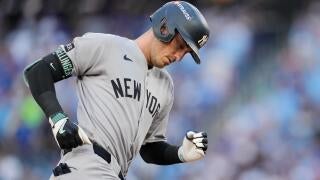
Yankees captain Aaron Judge missed 10 days with a flexor strain in late July/early August and was limited to DH duty for his first 27 games upon his return from the IL. Even after returning to the field, Judge's throwing was clearly limited, either because he was under orders not to overdo it or because his arm is compromised. His usual plus arm was nowhere to be found.
This is no secret, of course, and the Red Sox made sure to test Judge's arm in Game 1 on Tuesday. In the seventh inning, No. 9 hitter Nick Sogard turned his single back up the middle into a hustle double by forcing Judge to make a good throw, which he did not (could not?) do. Here's the play:
Statcast clocked the throw at 73.2 mph. Prior to the injury, Judge's average competitive throw (i.e. throws made with urgency) was 90.4 mph, which is near the top of the league for right fielders. In 15 games back in the field in September, Judge topped out at 85 mph and made only three throws over 75 mph. His usual arm strength hasn't been there.
The Red Sox are well aware of that. Sogard challenged Judge and turned his single into a double, then scored what proved to be the game-winning run on Masataka Yoshida's pinch-hit two-run single. -- Mike Axisa
Yankees sunk by missed opportunities in Game 1 as Red Sox escape with Wild Card Series lead
Mike Axisa
Loser: Fried's wasted gem
The Yankees did not sign Max Fried to start Game 1 in October. They signed him to start Game 2, but with Gerrit Cole missing the season with Tommy John surgery, Fried was elevated into the ace role, and he delivered. The gangly left-hander threw 195.1 innings with a 2.86 ERA during the regular season, numbers that should earn him a few down ballot Cy Young votes.
Fried pitched very well in Game 1 Tuesday night, holding the Red Sox to three singles and a double in 6 ⅓ scoreless innings. He beat the speedy Jarren Duran to first base to record his final out of the night.
Fried is the first pitcher to throw five scoreless innings in his postseason debut for the Yankees since Hall of Famer Mike Mussina in 2001. That Mussina game was a notable one. It was the Derek Jeter "Flip Play" game in Oakland.
Alas and alack, New York's shaky bullpen wasted Fried's excellent postseason debut with New York. Luke Weaver replaced Fried after that Duran play and allowed all three Red Sox batters he faced to reach base. A 1-0 lead was quickly turned into a 2-1 deficit. The Yankees ranked 23rd in bullpen ERA and 21st in bullpen WAR this season. It has been a sore spot all year, and Fried's outing will go down as a footnote, if not forgotten. -- Mike Axisa
Winner: Craig Counsell
One can of course laud the Cubs' manager for his aggressive hook of Game 1 starter Matthew Boyd and his skilled deployment of his revamped bullpen. This, though, is about Counsell's larger playoff narrative. Since he guided the Brewers to the NLCS in 2018 and before Tuesday's Game 1 went final, Counsell's teams had gone 1-8 in playoff games. It's 1-9 if you count Milwaukee's NLCS Game 7 loss to the Dodgers in 2018. That's an uncomfortable trend for a manager widely regarded to be among the very best in his guild. As such, the Cubs' 3-1 win and Counsell's skilled lever-pulling that helped get them there was most welcome. And that's before you consider it now puts Counsell one more win away from facing his old team in the NLDS. -- Dayn Perry
How the Cubs' newly lights-out bullpen carried Chicago to a Game 1 Wild Card Series win over the Padres
Dayn Perry
Loser: Padres' missed scoring chances
Hindsight is the handiest of convenient tools when a game is decided by a close margin, and that's of course applicable here. On that front, the Padres can think back on their missed scoring opportunities in Game 1. In the second inning, when they scored their only run, Xander Bogaerts wound up on third base with no outs after his RBI double, thanks to a throwing error by Cubs center fielder Pete Crow-Armstrong. Cubs starter Matthew Boyd was able to strand Bogaerts with a grounder-pop-up-grounder sequence. Teams in such spots have almost an 83% chance of scoring one or more runs, but the Pads came up empty.
Their next big chance came in the fourth inning, when Manny Machado got things started with a leadoff walk. At that point, Pads cleanup hitter Jackson Merrill bizarrely chose to lay down a sac bunt – in, again, the fourth inning of a 1-0 game. A Bogaerts single, however, gave the Padres runners on the corners and one out. That amounts to better than a 65% chance of scoring at least one run, but alas and alack that wasn't what happened. A Ryan O'Hearn pop out and a Gavin Sheets fly out snuffed out the possible rally.
That the Cubs pushed across an insurance run in the eighth took a bit of the sting out of those missed chances, but Game 1 could've been different had the Padres executed in those critical spots. -- Dayn Perry
Winner: Tarik Skubal
Not that Skubal needed to redeem himself after his final regular-season start against the Guardians went south, but he did it anyway on Tuesday. He surrendered just one run in 7 ⅔ innings, all the while striking out 14 batters and generating 26 swinging strikes.
In short, Skubal looked like someone who is about to win his second consecutive Cy Young Award.
Skubal also looked like someone who now possesses a nice place in modern postseason history. His 14 strikeouts tied for the eighth most ever in a playoff game, and were the most since Gerrit Cole punched out 15 batters during the 2019 ALDS against the Rays. -- R.J. Anderson
Loser: Contact play believers
The contact play -- that is, sending a runner from third on any batted ball -- has its share of fans within the game because the math tends to work out in most situations. The Guardians ran it, seemingly to good success, all summer. Unfortunately when it doesn't work, it really doesn't work.
That was the case on Tuesday, when José Ramírez, who led off the bottom of the ninth inning with a grounder that resulted in a three-base error, broke for home on a ball Kyle Manzardo hit back to pitcher Will Vest. Ramírez, who represented the tying run, was quickly tagged out by Vest for the inning's second out.
Would it have made a difference if the Guardians had a runner on third with two outs instead of a runner on first with two outs? Probably not (though it did eliminate the possibility of the tying run scoring on a passed ball or wild pitch). Still, you can forgive anyone who, in the moment, felt that it did. -- R.J. Anderson