Nationals vs. Dodgers score: Stephen Strasburg shuts down L.A. in tense NLDS Game 2
The Nationals have evened the NLDS at 1-1

By
Dayn Perry
•
4 min read
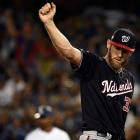
Coming off just two days of rest since he worked three shutout relief innings against the Brewers in the NL WIld Card Game, Nationals right-hander Stephen Strasburg shut down the Dodgers on Friday night. Strasburg worked six innings of one-run ball in Game 2 of the NLDS, and largely because of his gem the Nationals prevailed by a score of 4-2 (box score) and pulled even at one game apiece in the best-of-five series.
Showing the importance of this contest, Nationals manager Davey Martinez called upon ace Max Scherzer for a high-leverage relief outing against the best offense in the National League. Scherzer was up to the task and then some, as he struck out the side in the eighth. Scherzer previously made a playoff relief appearance for Washington in the 2017 NLDS. Daniel Hudson worked out of a bases-loaded jam in the ninth for the save.
Across the way, Dodgers lefty Clayton Kershaw got hit hard early but salvaged his outing, as he allowed three runs over six innings. For Washington, Anthony Rendon had two hits including a double, one walk, and one RBI.
Now the series shifts to Nationals Park in Washington for Game 3 on Sunday -- stream via fuboTV (Try for free).
Why the Nationals won
When Strasburg's on, he's one of the more enjoyable pitchers to watch. He throws a pocketful of pitches, and every one of them is typically nasty. Despite the short rest, he was indeed on in Game 2:


He didn't give up a baserunner until Will Smith's humpback liner single to left-center with two out in the fifth.
Strasburg was especially on in terms of command of his offspeed and breaking stuff. Strasburg's fastball and two-seamer each averaged 94.5 mph on Friday night, and he also leaned heavily on his curve and changeup. That changeup came in especially handy against a Dodger lineup that had five lefty bats in it (six if you count Kershaw).
Strasburg's changeup doesn't have a great deal of velocity separation relative to his fastball (his cambio averaged 88.3 mph for the night and touched 90), but when you have two-plane movement like Strasburg does you can get away with it. Regard:
Stephen Strasburg, Disgusting 89mph Changeup (release/spin axis). 😯 pic.twitter.com/uQW58cLfq6
— Rob Friedman (@PitchingNinja) October 5, 2019
As it reaches the plate looking like a fastball, Stasburg's changeup drops as it runs to his arm-side. He threw 18 of them on the night, and Dodger hitters swung and missed at six of them (an absurdly high percentage). Overall, Strasburg on the night induced 20 swings and misses out of the Dodgers -- the team that during the regular season had the second-lowest swinging strike percentage in the NL.
Let's also note, with a nod to the small sample size, that Strasburg has been completely dominant in the postseason. After his effort in Game 2, he now has a 0.64 ERA in 28 postseason innings (four starts and one relief appearance) with 38 strikeouts against four walks and no home runs allowed. And there's this:
Stephen Strasburg is the only pitcher in @MLB history to have 10+ Ks in 3 of his first 4 #postseason starts. pic.twitter.com/GYzlRNSCSE
— MLB Stats (@MLBStats) October 5, 2019
Strasburg's gem on Friday night in L.A. went a long way toward saving the Nationals' season.
Why the Dodgers lost
It sounds unsparing given that he wound up with a quality start, but Kershaw's struggles in the first and second innings made the difference (and it could've been worse). Howie Kendrick notched an RBI single off him in the first, and an Adam Eaton single and a Rendon double plated two runs in the second.
As we're honor-bound to say of pitchers who are bad early in a game but become less bad later on, Kershaw settled down. Well, he settled down to the extent that he stopped allowing runs. He still was hit hard, though. Kendrick and Eaton just missed homering, and Kershaw benefited from multiple loud outs in the sixth, which allowed him to work around a Victor Robles line-drive double. On the night, Kershaw allowed an average exit velocity of 96.2 mph. That's versus Kershaw's average allowed exit velo of 87.2 mph during the regular season.
In all Kershaw allowed three runs in six innings while walking one and hitting two batters (after hitting just two batters during the entire regular season). It hardly numbers among Kershaw's postseason disaster starts, but it wasn't enough on this night.
Highlight of the game
Let's give a nod to the intensity of that bottom of the ninth. Hudson yielded a leadoff double to Justin Turner, and then with two out Davey Martinez ordered up a controversial intentional walk of Max Muncy then came an unintentional walk of Will Smith to put the go-ahead run on base. Finally, though, Hudson won the eight-pitch battle with Corey Seager:
And that's a very tense and necessary win for the Nats.
Quotable
"We weren't expecting that," said Dodgers manager Dave Roberts of his counterpart's decision to use Scherzer in relief.
Indeed it was a surprise, so let's roll some relevant color-television footage in honor of the moment:
Reliever Max Scherzer. pic.twitter.com/UnsC2DrkNF
— MLB (@MLB) October 5, 2019
Up next
Game 3 will be in Washington on Sunday. First pitch is scheduled for 7:45 p.m. ET. Hyun-Jin Ryu is scheduled go for the Dodgers, and it seems likely that Scherzer, after throwing just 14 pitches in Game 2, will start for the host Nationals. On that note:
Dave Martinez said he’ll wait and see how Max Scherzer feels Saturday before naming a Game 3 starter. If it’s not Scherzer, it will be Anibal Sanchez
— Eric Stephen (@ericstephen) October 5, 2019
There is perhaps a universe in which Max Scherzer would say he can't go in Game 3, but that universe is very probably not this one.