
Austin Ainge says the Jazz won't tank, and they won't need to in a loaded Western Conference
The Jazz can get a high draft pick in 2026 without putting their thumb on the tanking scale

By
Sam Quinn
•
4 min read
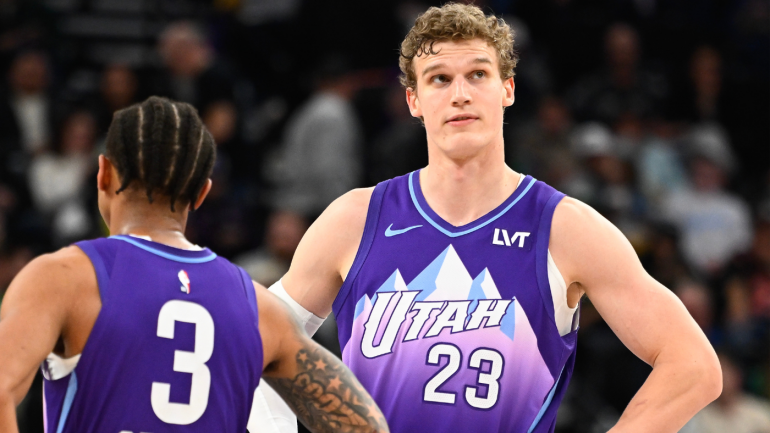
No team in the NBA has been more intentional about its draft position over the past several years than the Utah Jazz. In both the 2022-23 and 2023-24 season, they wiped away competitive starts by shipping out veterans at the trade deadline. Last season, they were fined $100,000 for violating the NBA's player participation player because they sat former All-Star Lauri Markkanen out, which they did frequently. Aside from their desire to add top young talent, Utah has had an obvious motivation for this brazen tanking. They've owed a protected first-round pick to the Oklahoma City Thunder that they haven't wanted to lose.
That will still be the case next season, as the Thunder will get Utah's first-round pick if it lands between No. 9 and No. 30. However, according to new Jazz president of basketball operations Austin Ainge, Utah will not take active steps to protect that pick next season. When asked in his introductory press conference on Monday if the Jazz would engage in the sort of minutes manipulation that lost them so many games last season, Ainge responded simply "you won't see that this year." That message has been taken to mean, broadly, that the Jazz do not plan to tank next season.
It's an admirable sentiment, but a meaningless one devoid of context. There is a difference between standard tanking and what the Jazz did last season. Standard tanking is building a bad roster. What Utah did was more like super-tanking, taking a bad roster and actively making it worse through lineup manipulation in a brazen effort to wind up with the NBA's worst record. What Ainge is seemingly saying here is that he has no plans to engage in the latter.
But the former? That's almost certainly in play because it's where the Jazz are right now. They don't have to do a thing to ensure that they're bad next season because their roster is already bad, and more importantly, it is bad in a conference that currently has no other bad teams. The Western Conference is so good and so deep that merely by existing within it, the Jazz are basically ensured a high draft pick so long as they don't intentionally improve the roster. They aren't going to tank because they don't have to.
The Jazz have given away so many veterans and drafted so many young players that they are going to be bad no matter what. How many teams in the Western Conference can say the same? Look at the teams that missed the Play-In Tournament in the West last season. New Orleans was ruined by injuries. If the Pelicans stay healthy, they are better than the Jazz. The Spurs have Victor Wembanyama, who also assures a better record than Utah so long as he is healthy. Portland won only 36 games last season, but went .500 in its last 50 games. The Suns have no incentive to be bad because they control none of their own first-round picks.
Ultimate NBA summer trade guide: 100 players, split into 11 tiers, who could be dealt during 2025 offseason
Sam Quinn

One or two teams will inevitably struggle because of injuries, but Utah has the lottery advantage of playing 52 games against this loaded conference. That's an advantage most of the NBA's bad teams do not have. Teams like the Wizards and Hornets and Nets only get 30 games against the West, and more importantly, they have more games against one another that somebody has to win. That's a significant enough advantage to get away with playing Markkanen more and, simply, trying harder.
Let's go back to that protected pick the Jazz owe the Thunder. The Thunder need that pick to land at No. 9 or later in order to get it. The Jazz can guarantee the pick stays with a bottom-four record. If they finish at No. 5, their odds of keeping it are roughly 99.4%, and if they land at No. 6, they are still at 90.7%. The seventh-worst team in the NBA last season won 30 games. So ask yourself this: do you think the Utah Jazz, trying their hardest, are good enough to win 30 games? The answer, in that Western Conference and with that team's dearth of veterans, is still probably no.
That seems like a more plausible projection for next year's Jazz. They will be bad because they are already bad. They just won't be 17-win bad because they won't stick their thumb on the scale with quite as much force. They'll still probably wind up with a high draft pick, they just won't make an all-out push for the league's worst record. Frankly, it would be irresponsible if they won any more than that. Forget about losing their own pick for a moment. They're ostensibly competing with the Thunder in the longer term. The last thing they should want is to hand a 68-win team another top young prospect.
So expect standard tanking out of the Jazz next season because that's the path of least resistance. It's easiest to be bad when you're already bad. The Jazz are already bad, and they're motivated by that outgoing pick to remain bad at least for the time being. They probably just aren't planning to be so bad that they go 2-20 in March and April again. That's a level of bad that goes beyond having a bad roster and involves making intentionally bad choices. For now, at least, Ainge seemingly has no intention to push Utah's tank that far again.