Deron Williams' curious demise, and where he goes from here
Deron Williams has fallen from perhaps the best point guard of a generation to a fairly, and at times barely, serviceable player. What happened?

By
Ken Berger
•
6 min read

The curious case of Deron Williams began with a coup of a trade pulled off by the then-New Jersey Nets in 2011 and ends ... how, exactly?
Williams' body and impact have been in steady decline since he was shipped out of Utah as a proactive strike against his impending free agency. But the intrigue surrounding one of the league's most enigmatic talents continues to grow.
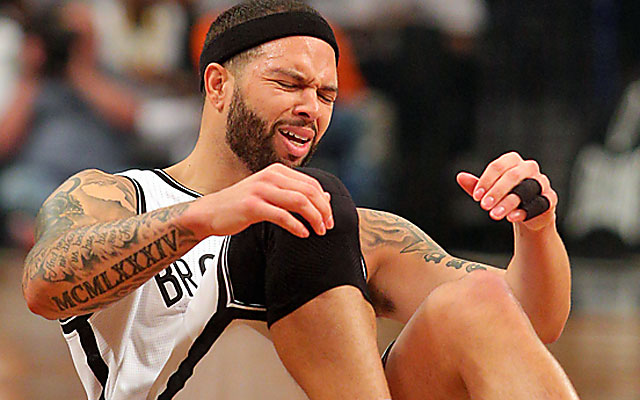
Do you remember when it seemed Williams was on the fast track to the Hall of Fame, when he could do things like this? Yeah, nobody else does, either. And the story of what happened, and what sort of arc Williams' career will track in Dallas, is no less mystifying than his lethal crossover used to be.
The Mavericks, stung by the reversal of free agent DeAndre Jordan, harbor no delusions that Williams will ever reclaim his once rightful and perennial All-Star status. With a low-risk deal for $10 million over two years -- on the heels of the $27 million buyout that mercifully ended his ill-fated tenure in Brooklyn -- the Mavs are merely hoping for serviceable.
That's how far the 31-year-old Williams has fallen. For a player once so dominant and electrifying that he stood toe-to-toe with -- and, at times, towered over -- Chris Paul in the debate over who was the best point guard in the NBA, serviceable is now the goal.
"I don’t think he'll be an All-Star again because of how good the West guards are," one longtime executive told CBS Sports. "I don’t think he's a top-15 point guard right now, but I think he can eventually get there."
Williams' stunning decline in New Jersey and Brooklyn over the past four-plus seasons puts him squarely in the discussion of the NBA's biggest $100 million busts in the modern era -- along with the likes of Shawn Kemp, Allan Houston, Gilbert Arenas and Rashard Lewis. But even more so than any of those guys, the case of Williams' demise, or at least the suddenness of it, remains mystifying. We know about the ankle problems, the fallout in Utah, all of that. But to fall this far so quickly? According to league sources dialed into Williams' ill-fated time under the bright lights in New York, the point guard's journey from elite to scrap heap was both physical and mental -- a tale of superstar wanderlust gone terribly wrong.
"He played a lot better with less than he did with more, when he was more of a focal point," former Nets assistant GM Bobby Marks said.
No one put Williams on blast more candidly than his one-time Brooklyn teammate, Paul Pierce, who torched the three-time All-Star in an infamous interview with Jackie MacMullan back in April.
"Before I got there, I looked at Deron as an MVP candidate," Pierce said. "But I felt once we got there, that's not what he wanted to be. He just didn't want that.
"I think a lot of the pressure got to him sometimes," Pierce said. "This was his first time in the national spotlight. The media in Utah is not the same as the media in New York, so that can wear on some people. I think it really affected him."
Pierce's analysis, issued before he left the Washington Wizards to reunite with Doc Rivers in LA with the Clippers this past summer, is at least partially true, according to sources familiar with Williams' decline in Brooklyn. Advancing in years, Pierce and former Celtics teammate Kevin Garnett looked to Williams to lead and push a team that had championship aspirations. Instead, Pierce said, it was he and Garnett who "ended up doing all the pushing."
In fairness, it wasn't simply what was inside Williams' chest or between his ears that failed him in Brooklyn. It was the lower extremities, the aforementioned faulty ankles, that played a role, too.
The massive expectations that came with the Nets' historic payroll and luxury-tax payouts during the D-Will era didn't help, either -- nor did the Nets' ever-spinning coaching carousel. Over five seasons in Newark and Brooklyn, including the end of the '10-11 season following the trade, Williams played for four coaches: Avery Johnson, P.J. Carlesimo, Jason Kidd and Lionel Hollins. If Williams thought that he didn't need coaching from the great Jerry Sloan, one can imagine how sideline instability may not have made for the best environment in his new home.
"The coaching rotating door really hurt him," a person close to Williams said. "You had a different style offense and defense every year."
Faced with a leadership vacuum, Williams retreated.
"Your point guard is your quarterback and your leader, and I don’t think he ever embraced that," one of the people familiar with his Nets tenure said. "He was happier when the limelight was off him."
Limelight or not, one factor that cannot be ignored in Williams' swift decline is his health. At the height of his powers, Williams' game was all about physical dominance, lateral quickness and straight-line speed to the basket. None of those things is possible without healthy legs.
The trouble surfaced in 2012 training camp, when Williams arrived fresh off an Olympic gold medal with Team USA in London weighing about 220 pounds -- at least 10 pounds more than his ideal playing weight in years past. One person involved with Team USA described Williams as aloof and moody during the Olympic run -- much like Kobe Bryant, only without the credentials to back it up.
One ankle sprain was followed by another, and another, until Williams shut it down at the All-Star break to do a weight-loss cleanse and have platelet-rich plasma therapy on his ankles. Lighter and healthier, Williams returned to his old form over the season's final 28 games -- averaging 22.9 points and eight assists on 48 percent shooting.
"He was at an All-Star level for about 30 games," one executive said.
But with a star-studded roster and record $90 million luxury-tax bill the following year, the Nets lost in the second round to the Miami Heat as Williams struggled again to stay healthy. For the first time since his rookie season in 2005-06, Williams spent time coming off the bench.
With Pierce gone in '14-15 and Williams having at least delayed his physical decline, that should've been the season when he was poised to recapture his star status. Instead, he was sent to the bench again and had only one more shining moment for the Nets -- 35 points, seven assists and three steals on 7-for-11 shooting from 3-point range in an overtime victory over the Hawks in Game 4 of their first-round series this past season.
Brooklyn lost the next two games, and the series, and by that point, Williams knew his time in the New York spotlight was over.
"I think he already had one foot out the door," a league source said. "When you don't work out somewhere and you're looking for the exit door, you’re not going to be as productive at work. I think he had it in his mind that this was not going to work out, and after the season, there’s got to be a different plan here."
There was. And in a strange way, Williams' departure from Brooklyn mirrored the way he was shipped out of Utah.
Ahead of the 2011 trade deadline, word was spreading among league executives at All-Star weekend in Los Angeles that Williams -- a year-and-a-half before his free agency -- already was angling to team up with Amar'e Stoudemire with the Knicks. Williams denied it -- famously confronting the author of the story that broke the news, yours truly -- during a post-All-Star Game media session.
The Jazz must've had the same information, because four days later, Williams was a Net -- setting off a chain of events that has left us wondering to this day:
What happened to Deron Williams? And can he rise again?