From Allen Iverson to Big Baby food: Journey down the rabbit hole
Need to kill time on this lovely Friday? Let's take a journey down the rabbit hole and get from Allen Iverson's scoring to Big Baby food.

By
Zach Harper
•
12 min read
Friday is upon us and ending the work week in as little time as possible seems like the play here, right? You want to get to the weekend of football and now we've got the baseball playoffs knocking down our door every night, inviting themselves in to hangout. You've either been around the water cooler for a trip or two at this point or you're waiting for this historical literature class to end because your professor will not stop talking about old writing while making sure his ponytail game is tight.
I've gone on a trip to find some fun stuff from the past and make some connections in a tangential way. Let's click some YouTube links and read some stuff as we get the weekend to appear a lot quicker than it normally does. Let's kill some time together by taking a journey down the internet rabbit hole.
THE 2003 SIXERS-HORNETS SERIES GAME ONE
NBATV is full of fine professional basketball programming and will often show "Hardwood Classics" to give us a reminded of great games from the past. While watching some television on Thursday (as I've been known to do with all of the days that end in Y), I came across a replay of the first game of the 2003 playoff series between the Philadelphia 76ers and the New Orleans Hornets. This isn't a legendary game in terms of the quality of play, necessarily, because it happened in that early-to-mid 2000's era when we really need to romanticize the play on the court because the reality is we had beer goggles on at the time.
Where this game is significant is Allen Iverson went off like a collection of fireworks and dynamite in Wile E. Coyote's living room. In the 98-92 victory for the Sixers, Iverson scored 55 points, which is a Sixers' playoff record. Two years after twice breaking Billy Cunningham's Sixers' playoff record of 50 points in a game in the same week, Iverson broke his own record of 54 in this victory. But this game is even more impressive than dropping 55 points on 21-of-32 shooting. Iverson also had eight assists for 17 points, which means he generated 72 of the Sixers' 98 points in a playoff game. That's kind of absurd. You can view some of that sweet, sweet Iverson footage right here:
This game was the best, most efficient Iverson volume scoring performance we've ever seen from him. He had two higher scoring games in his career, both coming in the regular season. He scored 60 points on 17-of-36 shooting (47.2 percent) and 24-of-27 from the free throw line in 2005. He scored 58 points on 21-of-42 shooting (50.0 percent) with 14-of-14 from the free throw line in 2002. But this 55 points on 21-of-32 shooting (65.6 percent) and needing just 10-of-11 from the charity stripe is the best high volume shooting we've seen from Iverson.
While we could spend days on Iverson videos and clicks all over this internet, I want to take us in a different direction. That Hornets team was a fascinating combination of talents. It basically looked like a video game franchise mode roster I would have put together for myself in the early 2000's just to have fun with old players. Derrick Coleman, Baron Davis, Kenny Anderson, Courtney Alexander (I was foolishly big on his scoring ability coming out of Fresno State), and Stacey Augmon filled that roster. But the most important piece of it all was Jamal Mashburn.
JAMAL MASHBURN WAS A SERIOUS PROBLEM
While Iverson was the star of that 2003 playoff game, the standout performance may have actually been Mashburn. I know that's crazy to say about a game that featured one player scoring 55 points and the other guy scoring 28 points, but while Iverson was torching his opponents, Mashburn was the only one capable of keeping the game close. Baron Davis had a horrendous game and nobody else could consistently get buckets against the Sixers. Mashburn used his strength and low block play to get buckets and earn precious trips to the free throw line.
The most frustrating thing about Mashburn's career is that we didn't see more from him. His body wouldn't allow him to remain healthy throughout his career, and it robbed us of a guy who was a constant match-up problem. You just couldn't find a consistent defender to put on him. He was the ultimate tweener forward, one who was more production than fantasy in terms of creating those mismatches. So often, we see the 3/4 tweener and pretend the problem of fitting in isn't there, but with Mashburn he fit regardless of whom you put on him.
Coming into his career, people weren't quite sure where he would fit on the floor, but you knew you were getting a scorer. He dropped over 20 points per game his sophomore and junior years at Kentucky, and after a frustrating rookie season (in which he still averaged 19.2), Mashburn scored 24.2 points per game in his second season. Only 26 other players have scored at least 24 points per game in their second season in NBA history. You just knew you were getting a player with him.
The problem with Mashburn ended up being his health. He had various injuries, especially to his knees, over the years and it kept him out of nearly one-fourth of his possible career games. He played in 611 regular season games, missing 177 games over an 11-year career. However, when he was on the court, he was a problem for the opposition.
It's hard to know if the patience or the footwork of Mashburn was the most impressive part of his game. He was so strong and such a load on the low block that you couldn't get an advantage. If you were bigger than him and felt you could block the shot, he's just pump fake or jab step you to death before you bit. He had the patience of a scarf-wearing hipster waiting in line at an Apple store six days before the release of the new iPhone.
If you had a smaller guy to counteract Mashburn's quickness, he'd just punish you with his incredible strength. He had phenomenal body control around the basket. And if you brought the double team against him, he navigated splitting the double team in the post with the grace, body control, and footwork of Catherine Zeta-Jones navigating security system lasers.
How strong was he in the post? At the end of the video above, he hits a game-winning 3-pointer by posting up near the top of the arc and hitting the defender with that fake half-spin into a fadeaway from 23 feet.
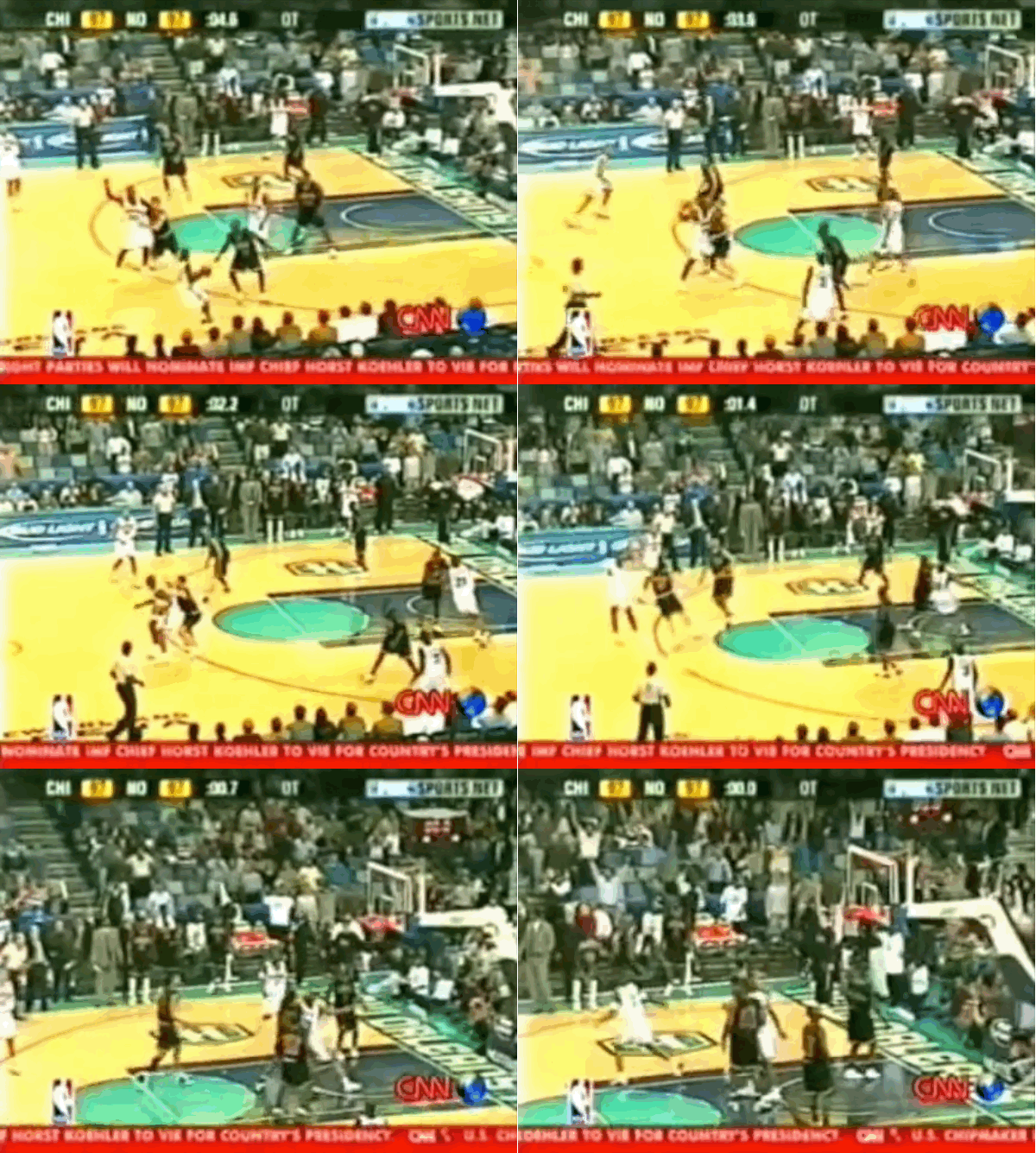
I'm not pretending that's a good shot to take but my god is it fun.
For his career, Mashburn finished with averages of 19.1 points, 5.4 rebounds, and 4.0 assists. Only 18 players in NBA history have done that and that's definitely a list of names any player would like to be on. Mashburn twice had 50 points in a game and both times were met with remarkable efficiency. You can watch big highlights of his 50-point game against the Bulls here in 1994 (Jim Jackson goes for 38!) and his 50-point game against the Grizzlies in 2003 (when the last two came on a game-winner in overtime) here.
You can also watch a really fun playoff duel between Mashburn and Tracy McGrady from the 2003 playoffs in which both players dropped at least 40 points.
Mashburn wasn't just a player though. He is also a fantastic businessman.
JAMAL MASHBURN FULFILLED HIS DREAM OF CARRYING A BRIEFCASE
Mashburn's playing career was cut shorter than it needed to be because of his failing knees, but he never failed off the court with business. In a 2010 interview, Mashburn talked to Dime Magazine about his post playing career, flu vaccines, and his dream of carrying a briefcase because he always wanted to know what was inside them. From Dime:
Dime: So what have you been up to since you retired?
Jamal Mashburn: Lot of things. I started with ESPN four years ago. Lots of people don’t know but I was a communications major in college. I didn’t anticipate doing what I studied in college, but when I finished my basketball career it made sense. I’ve always been in business and own franchises of Papa John’s, Dunkin’ Donuts and Outback Steakhouse, as well as car dealerships. I own over 34 Outbacks, 37 Papa John’s and dealerships in Kentucky. I’ve always wanted to carry a briefcase. It’s just something you want to do growing up in NYC. When I was younger, I always wondered what was in them.Dime: What’s in your briefcase these days?
JM: What’s interesting about that is that I just have pens and papers. As I got older, I found out it’s not actually carrying the briefcase that matters, but the intellectual experiences. The briefcase for me is a symbol of my education in the traditional and nontraditional sense. I’m confident in what I know, and it’s been great journey and transition. Through the years, I’ve been approached by a lot of pros as a consultant to help with their transition.
First of all, he owns a lot more restaurants than you and I do combined, unless you're reading this, Mr. P.F. Chang. And that was just back in 2010. He could have expanded his business portfolio quite a bit in the last four years, or he could have cashed out, sold those restaurants, and swimming in a pool of money like Scrooge McDuck.
Secondly, it's incredible that he carries a briefcase, which he's always wanted to do, and it turns out he just has pens and papers in them. I guess we're not going to find the same gold aura coming from his briefcase as we saw with the case in Pulp Fiction. But good for Mash on fulfilling that goal.
JAMAL MASHBURN'S ENDORSEMENT GAME IS COMPLICATED
Mashburn was never a huge endorsements guy in terms of being flashed all over television to push products. He got a huge contract from FILA when he came out of Kentucky, but other than that "interesting" looking shoe, he wasn't inundating the basketball product game. That FILA endorsement deal did manage to net him a Ferrari back when he was still a young adult, but there was one little detail he needed to work out first. Mashburn couldn't drive a manual transmission. From NPR:
The mission of Broke, directed by Billy Corben, is to explore the factors — and there are abunch — that lead to professional athletes, widely known for their very high salaries, to have such a dismal record when it comes to post-career financial security. Nothing more than a collection of talking-head interviews with former players and a few other experts in finance and sports, the film starts with the obvious.
The root of the problem, most of the speakers seem to agree, is that players most often turn pro by their very early twenties, right out of college if not before that. They generally have no business experience. Unlike people who inherit their wealth or make it in business, they don't necessarily have natural connections to people who are used to handling a lot of money. When you hand a 22-year-old a few hundred thousand dollars, it's most likely going to be spent. That is not an age in which you typically find excellent long-range planning skills, after all. (Former NBA player Jamal Mashburn talks about an endorsement deal with Fila that netted him a Ferrari as a signing bonus when, he says, he couldn't even drive stick.)
While FILA had trouble with endorsing athletes who ended up having injury problems (Miss you, Grant Hill), this is a pretty good incentive to give the athlete you sponsor. Learn how to drive a stick and you can drive this Ferrari. That's not a bad trade-off at all.
One commercial that stands out with Mashburn is from around 2002-03 when the Hornets' franchise was moved from Charlotte to New Orleans. Long before they became the Pelicans, they were immersing themselves in NOLA culture. Part of that ended up becoming an American Express commercial in which Mashburn and teammate Elden Campbell are getting familiarized with New Orleans by going to a voodoo shop that apparently takes credit cards.
They should have made a web series (you know, if they had those a decade ago) of Mashburn and Campbell learning all about the NOLA culture. And how about those acting chops from Mash? He delivers the "I don't think we have to" whisper line flawlessly. No wonder he was so solid on ESPN as a studio analyst.
SPEAKING OF ELDEN CAMPBELL, HE HAD HIGHLIGHTS
Elden Campbell was a pretty solid big man in the decade of the 90's. He never made an All-Star Game but during a nine-year run with the Los Angeles Lakers, Campbell averaged 10.4 points, 5.8 rebounds, and 1.7 blocks in 25.0 minutes. In fact from 1990 to 1999, Campbell scored the most points out of any Lakers' player. Vlade Divac was second. Perhaps this is why we saw a gap in championships by the Lakers from 1988 to 2000.
He has a couple of fun highlights though. In the 1996 playoffs, Campbell drew the impossible assignment of playing against Hakeem Olajuwon. Olajuwon was coming off of back-to-back championships, so he was pretty locked in as a player. However, Campbell did manage to grab a couple of highlight moments, one on each end of the floor, against the Hall of Fame center.
As fun as those were, it might not be the same level of payoff that we got when Campbell stole a pass to his successor in the Lakers' interior Shaquille O'Neal during the 2004 NBA Finals. Campbell knocked away an entry pass intended for Shaq, and the backup Pistons' big man ran the floor and threw down a really awkward dunk as Slava Medvendenko tried to chase down the 35-year old center.
Sheed loves it!
WE'VE JUMPED TO SOUP
I was hoping we'd grab more Elden Campbell commercials but a search on the old YouTube machine instantly yields a lot of Campbell's Soup commercials. And this terrifying one with Richard Sherman's mom (or a lady playing his mom, I'm not quite sure) and the Seattle Seahawks super fans popped up near the top of the search. What follows is something I certainly wasn't prepared to watch, especially with "Sea Monster" being so prominently displayed.
THIS IS A TWO-MINUTE LONG COMMERCIAL! And while it's fantastic in an internet sense, it served an even higher purpose than trying to get us to buy beer, cheddar, bacon soup. It somehow and magically brought us to Glen Davis cooking segments when you search for "NBA soup."
BIG BABY FOOD
There was a point in which NBA big man "Glen Big" Baby Davis was doing cooking show segments. It was called "Baby Food with Glen Davis and Holly Clegg." You get to learn all kinds of recipes that Big Baby endorses. The meals include pizza rice, hamburger dip, southwestern soup, and chicken lasagna. You really need to watch each of these videos. Big Baby brings the energy and the banter along with Holly Clegg doing a little bit of awkward flirting.
Be sure to add these recipes to your weekend food binges when you're watching football. Thanks, Big Baby!