Green Means Go: Why Memphis pulled the trigger on the Jeff Green trade
An in-depth look at Jeff Green and what he brings to a Western Conference Contender in Memphis.

By
Matt Moore
•
11 min read
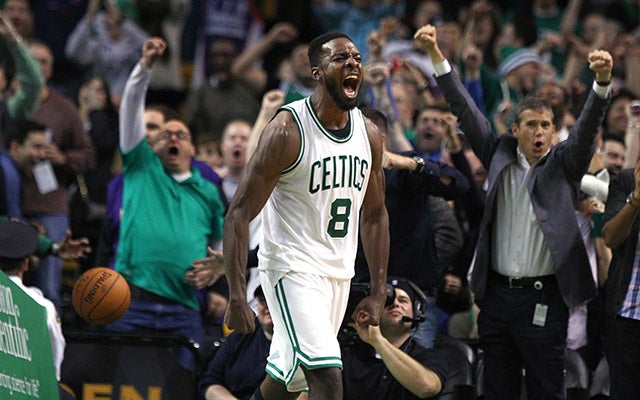
The Western Conference arms race rages on. Just weeks after the Dallas Mavericks traded for point guard Rajon Rondo and the Houston Rockets claimed Josh Smith off the wavier wire, and mere days after the Oklahoma City Thunder took a swing on Dion Waiters, the Memphis Grizzlies entered the mix. Memphis acquired Boston Celtics forward Jeff Green on Monday after working the entire weekend on a three-team deal that sent Tayshaun Prince and a protected first-round pick to Boston, and Quincy Pondexter to New Orleans.
In total, the Grizzlies give up a veteran defender in Prince, a versatile forward in Pondexter, and a protected first-round pick that could become very lucrative in 2019 depending on how the future goes.
We've already broken down the basic grades for the trade, and how Boston fared as they continue their rebuild.
Let's look at Memphis' acquisition of Jeff Green and what it means for a Western Conference contender.
THE PRICE PAID
Prince was acquired in the Grizzlies' trade of Rudy Gay two years ago. What gets lost in that deal was that it was assumed Memphis had to get equal return for Gay's value. In getting Prince, Ed Davis (now with the Lakers) and Austin Daye, they didn't, clearly, whether at the time or in hindsight. But Memphis wasn't looking to get equal return. They needed to find a lower usage player so that they could get the ball to Zach Randolph and Marc Gasol more, and empower Mike Conley more.
That's what that trade accomplished, and it's a huge part of why Memphis made a run to the Western Conference Finals. It wasn't about what the players they were getting back could do, it's about what the trade allowed their other players to do.
Prince needed to be a defensive plus and able to knock down catch-and-shoot corner 3s. That's it. That's what he was acquired for. Defensively, Prince is still a plus. He's a savvy veteran who knows how to play, won't break assignments and won't try and do too much offensively.
But Prince shot a combined 2-of-11 on corner 3s in the playoffs the past two years, and 4-of-11 from the wing. Meanwhile, he shot 27-of-84 from mid-range. Forget the percentages (which are still alarming). Eighty-four mid-range shots for a team with two low-post presences is troubling spacing. Some of it comes down to the simple matter of Prince not being able to get his shot up quickly enough.
This is tough, because while Green is an upgrade and Prince has very limited value at his age, none of this is Prince's "fault." He was massively underrated during his stellar career with the Pistons and a huge part of their, again, underrated success. Prince went from being underrated to past his prime way too fast. He can still be helpful, particularly for a team that has enough shooting. But Memphis needed an upgrade.
Pondexter was a massive help in the 2013 playoff run, helping with defense on Russell Westbrook, Blake Griffin, Kevin Durant, and Chris Paul. He was instrumental in the Grizzlies' playoff run. But he never came back as the same player after a season-ending injury, and just wasn't of enough value with where the Grizzlies are in the frontcourt (factoring Jon Leuer) to not be included in the deal.
The pick, obviously, is a concern. Trading picks is how you not only compromise your future ability to improve in desperate situations, but honestly, the bigger cost is in PR. Teams get mocked for having to give up good picks in bad years because that's when you need them, and it makes you look short-sighted. Think of Charlotte with the pick they sent to Chicago for Tyrus Thomas, or the Knicks in pretty much every other year.
But Memphis' evaluation of the pick is a little complicated. For one, it won't be conveyed until at least 2019 because of a previous pick which is currently in the hands of Denver (after being sent to Cleveland). Both picks are protected but the most likely scenario is that the Grizzlies give up a pick in 2017, two years from now, and then two years later.
If Marc Gasol leaves this summer, Zach Randolph turns into a pumpkin, the team is then forced to trade Mike Conley to save his soul, and the entire thing turns into a rebuilding project... then yeah, Memphis is in trouble. They'll owe picks they'll need and it will be disappointing and frustrating for fans. This is assuming they don't win the NBA title this year, which, while possible, can never be counted on because you need luck in any given year and the Grizzlies play in the Western Conference Death Match.
But Memphis didn't make this deal to rebuild. They did it to take their shot. Forget Green's value as a replacement player to what they gave up. They are attempting to do everything possible to win now because they have a window. Rebuilding projects are always hard. Sometimes it takes teams two or three different configurations to get the right combination to contend with. Memphis has one, and they are going all-in to win right now with a team that is very much good enough to do so.
It should also be noted that the picks are still protected against being top-six at best in the case of the Denver pick and top-11 in the event of the Celtics' pick. So if the Grizzlies go to pieces, they're not losing a top player. This is not, in fact, the Otis Thorpe trade that cost them Carmelo Anthony.
They are willing to risk being bad later and having to figure out a way to manifest picks (which they can) then, in order to have a shot at being truly great now. The pick trade is a risk, but it's not a bad decision when you consider it within the context of where the team is at.
Now, was it worth what they got?
GREEN MEANS GO
These statements are, generally speaking, true to the average NBA-informed person:
• Jeff Green is talented, in that he has the physical abilities and skill set to do a wide-range of things well under given circumstances, for at least a reasonable percentage of time.
• Jeff Green is capable, in that teams do not target him as the weak link as they do with say, Matt Barnes in Los Angeles or Josh Smith basically anywhere.
• Jeff Green is disappointing, in that for all his physical gifts, skills, and talents, he has never been able to convert those things into meaningful, significantly above-average contributions for a team, offensively or defensively. This is true by both advanced metrics and the eye test. Green doesn't pass either.
• Jeff Green is frustrating, in that you always feel he can do so much, and yet never seems to do enough.
Green is polarizing, which is really weird for a guy who is considered to be a quality teammate, has never had off-court issues, isn't full of braggadocio or smug, had to return from heart surgery and did so, and has never been depended on or thought of himself as the team's best player. But people feel very passionate about Jeff Green, mostly for the negative. His supporters like what he brings to the game, his every-once-in-a-while scoring adventures, his athletic gifts, his patience, and how smooth his game is.
His detractors obsess over his pitiful rebound rate, the fact that if you were to invent a basketball encyclopedia, his picture would be next to the term "tweener," and that he's not "good" in any one given area. Not a great defender, but a good one. Not a good rebounder. Not a gifted playmaker. Not a good shooter. A stretch four who doesn't stretch, an oversized three without a post game.
Get excited, Memphis!
But here's the deal. Memphis wasn't trading for any surefire wing upgrades. They're not moving Prince and Pondexter along with a protected first for James Harden, or Klay Thompson, or even Tobias Harris. They had to find a player for a team willing to give him up, who has the ability to do what they need, and that wouldn't cost them any key pieces of what is already a stellar team.
There are always "ifs" attached to trades. If Prince had been able to knock down corner threes, he'd still be a huge part of what Memphis does. If Dwight Howard had gotten along with Kobe Bryant, he'd probably still be a Laker. That's a necessary component, there are no sure things when you take a player out of one environment and put him in another.
That said, Green looks like a smart investment for the Grizzlies. The first thing Green has to do is defend well. That's been a problem this year; Boston was 4.3 points per 100 possessions worse defensively with Green on the floor. But when engaged, he's a plus wing defender. He can capably defend against big combo forwards (think Andre Iguodala in Golden State, Blake Griffin in LA, or Boris Diaw in San Antonio). He has good length and lateral quickness, and in good communicative systems, can maintain good spacing on the weak-side.
Green won't have to guard the opponent's best perimeter player, that'll likely be Mike Conley or Tony Allen. And he won't have to guard larger beasts inside, Memphis has an army of big dudes to do that. It's the in-between weapons he'll be used on. You're taking what has been his team's best or second-best perimeter defender the last few years and making him the fourth-best defender. That's big.
NOW ABOUT THAT OFFENSE
Offensively, it all comes down to choices. Here's a look at Prince's shot chart vs. Green's this season.
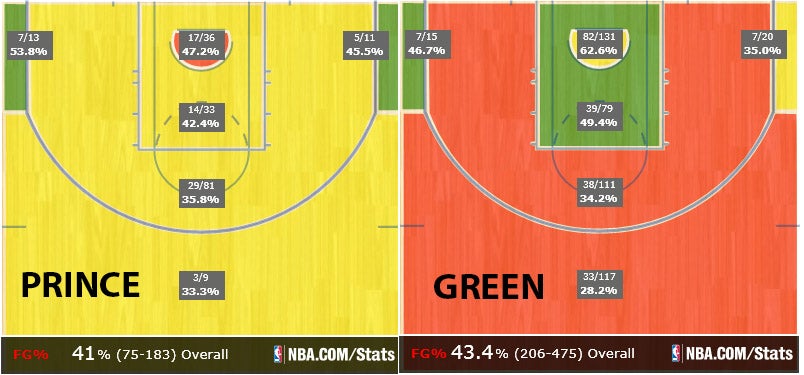
That looks rough. All that red in the mid-range space.
But look at where they shoot from. To help, here's a look at their shot distributions. This isn't their percentages, just how often and where they shoot from.

Prince takes 20 percentage points more mid-range jumpers than Green does. Green takes a way higher percentage of threes, and is seven percentage points higher in shots in the restricted area. To put it simply: Green takes better shots overall, and more shots of what Memphis needs. A guy that can cut and attack the rim and shoot threes.
Now look what happens if we just ignore the mid-range.Green will still take mid-range jumpers, but that's not exactly what Memphis is bringing him in for, or at least it's not what they should be.
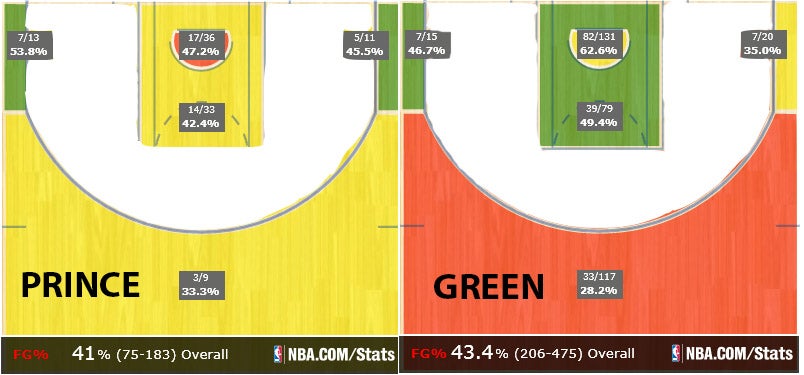
So that's much better. Of particular note: Green shoots 15.2 percentage points better in the restricted area. Here's where it gets complicated.
Green shoots an abysmal 29.5 percent on catch-and-shoot opportunities. That's a red flag. He also shoots just 34 percent on shots where a defender is four or more feet away from him, per NBA.com. And that above-the-break 3-point percentage, 28.2 percent, yikes.
But on significantly fewer shots, he shoots 40 percent on corner 3s. That's key. Memphis has four significant rotation players, including Prince, shooting over 40 percent from 3-point land. But with the offensive talent, Green will get better looks. If he can just keep that pace, while bringing all the other upgrades, he'll be a perfect fit.
Green will play mostly at small forward, likely coming off the bench to augment the wing and letting Vince Carter operate at a more comfortable and less-taxing reserve two-guard slot. But he holds the most value for Memphis as a small-ball four option. If Randolph gets in trouble, the team can turn to Jon Leuer who has played well and has a lot of versatility and good range, but isn't a great cutter and is better against bigger players. If a team has success going small against the Grizzlies, coach Dave Joerger can use Green as a small-ball stretch four, providing more spacing while retaining a cutter. Rebounding gets obliterated in such scenarios, but if you want to make an omelet, you have to get murdered on the boards sometimes.
A RUDY GAY TANGENT THAT WILL BE BRIEF I PROMISE
Jeff Green is not Rudy Gay. Please stop. Gay has been great in Sacramento and is a good NBA player that needs to be with the right coach and right system but who wasn't the best Memphis could do offensively. He's a good NBA player. But he's high-usage and ball-dominant. Jeff Green is low usage and not ball dominant. His usage rate has been up in Boston thanks to their rebuilding efforts, but Green won't be coming into this Memphis team thinking he's going to handle the ball and be the star. That isn't happening. There is no comparison in personality, play-style, tendencies, or function. Stop.
TO MAKE A LONG STORY SHORT (TOO LATE)
Trades, again, are complicated. This is a gamble by Memphis because it adds a rotation player to a team that honestly has 14 guys who deserve playing time. Green will be under pressure; it's a contract year and a playoff team just made a major move to add him. It can fall apart and Green's detractors will cry "I told you so." But Memphis has its best chance at a title in its entire franchise existence. Green may not be the missing piece, because Memphis may not be missing anything. They might win the title if they get favorable matchups and might lose if the other teams are simply better and/or the Spurs are the Spurs.
But you can't look at the trade and think of it as anything rather than a team sensing an opportunity for its moment and taking its shot. Memphis found a high-percentage, open look from the corner to win the game. Let's see if it goes in.