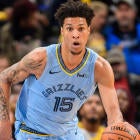

Grizzlies' Brandon Clarke is defying expectations by posting historic shooting numbers as a rookie
The NBA didn't believe he could shoot. Now he's setting rookie shooting records

By
Sam Quinn
•
5 min read
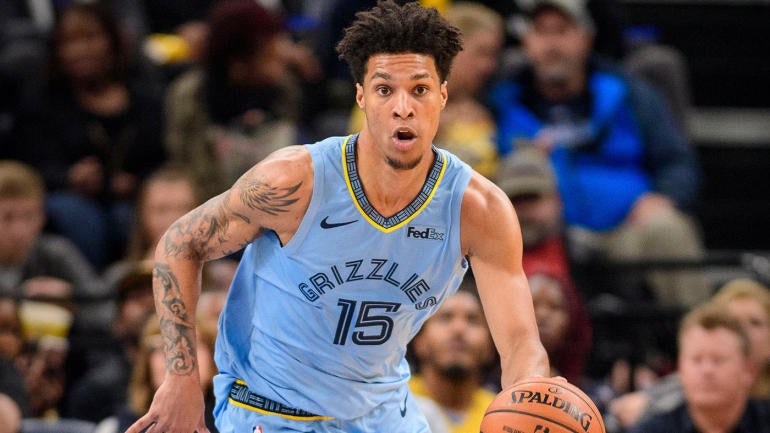
Taylor Jenkins governs Brandon Clarke's shot selection through a very simple rule. "When you're open, shoot it," the Memphis Grizzlies coach says of his ascendant rookie's newfound 3-point shot. Clarke was resistant, at first. "At the start, I was kind of struggling with that," he told CBS Sports. "I was passing up open 3s just to drive, it's just kind of me learning how that can hurt us really if I'm not taking open 3s."
It was an understandable stance, given his own history. "I mean, it's just kind of like, new to me really," Clarke said in what is statistically an understatement. He attempted only 24 3-pointers in three collegiate seasons at Gonzaga. "Obviously the range is deeper. In college last year I wasn't really shooting many 3s." That's probably because his jump shot used to look like this.
His mechanics are hardly textbook. His release point is still low, and there is an occasional hitch, but he has long since found a consistent form that works for him.
Still, the league remained skeptical despite his freakish athleticism and elite collegiate defense. While most mock drafts pegged Clarke as a lottery pick, concerns over his offensive limitations lingered into draft night. If he wasn't big enough to play center and didn't shoot well enough to play power forward, what exactly would he be at the professional level? It was a question 20 teams decided they'd rather not answer, leaving Clarke to wait and wait.
"I was just stressed out, anxious, really curious about which team I was going to," Clarke said, adding that he wasn't even sure if he would land in the first round before the phone rang at No. 21. "But I'm just really grateful that I fell to the spot that I did." In the Grizzlies, Clarke found a team ideally suited to accentuating his strengths and minimizing his weaknesses.
The fit, in theory, would allow Clarke to ease into the NBA offensively. Jaren Jackson Jr., last season's No. 4 overall pick, shoots well enough at center to afford the Grizzlies a measure of flexibility in dedicating minutes to non-shooters. But that flexibility exists only to a point. The modern NBA is unforgiving when it comes to defending players who can't space the floor. They are left alone so the defense can attend to those they deem threats. Every shot Clarke didn't take created a harder one for a teammate.
So he started shooting. He has already blown by those 24 collegiate attempts with 35 so far in his rookie season, but more importantly, they're going in. Clarke is shooting 45.7 percent from behind the arc this season, and with time, that volume is only going to grow. "I'm trying to get more and more every game," Clarke says. "So I'm sure that as the season goes on, and as my career goes on, I'll be shooting plenty more 3s." Doing so is unlocking every other element of Clarke's game.
"I just feel like guys aren't sagging off of me as much," Clarke explains. "Which is nice, because it makes my drives easier." Losing the ability to sag is rather problematic for defenses because Clarke is essentially the Kyrie Irving of 6-foot-8 Canadians. His finishes in traffic are absolutely breathtaking.
The typical antidote to a player as dangerous behind the arc as he is at the rim is to grant him all of the space in between, but that is where Clarke is at his best. He makes 54.3 percent of his shots between 3-10 feet of the hoop, and 63.2 percent between 10-16 feet. His floater is automatic no matter how closely contested it is.
There are All-Stars who don't have such a diverse portfolio of shots, and defending all of them is impossible. The numbers bear that out. Clarke is shooting 64.5 percent from the field this season. He is the first rookie in NBA history ever to do so with at least eight shot attempts per game. Even lowering the parameters yields mostly centers that only dunked. Clarke's shooting all across the floor defies practically anything ever seen in NBA history, rookie or otherwise.
He is already in the 90th percentile or higher league-wide in terms of efficiency in spot-up shooting, transition scoring and pick-and-roll finishing, per Synergy Sports. That last area is where Clarke is at his most dangerous, and according to one of his point guards, he is already well ahead of schedule.
"He makes my job easy," Tyus Jones says. "He's got really good timing in the roll, which is something that usually takes guys some time to develop, but he's got really good timing, sitting in the pocket, knowing how fast to roll, how slow to roll, as a point guard it makes my job a lot easier."
That kind of skill and finesse would be valuable in a normal player. Now imagine pairing it with the sort of supercharged athlete who can do this.
It creates a pick-and-roll trio unlike any in recent memory. Clarke and Jackson's mutual versatility makes the pair nearly interchangeable, and with a point guard in Ja Morant that matches their athleticism and brings expert passing vision to the table, there is no easy answer to actually guarding the three of them when working in concert. How are these poor defenders supposed to handle three inside-out scoring threats like this at the same time?
The long-term answer is that they probably can't. Clarke has grown so far beyond his initial expectations so quickly that it has completely recalibrated Memphis' future offensively. A franchise that was, until recently, known for grit and grind now has one of the most exciting frontcourt combinations in all of basketball.
As it develops, Jenkins will have to loosen the guidelines he's held Clarke too. Defenses have already stopped giving him wide-open 3s. It won't be long before he draws enough respect for them to build game-plans around stopping everything else. Fortunately for Clarke, there isn't exactly a textbook method of stopping a 65 percent shooter. If he keeps this up, he'll earn the right to shoot whenever he'd like.