John Collins' return won't save the Hawks this season -- because they don't need saving
Atlanta is way too early in its rebuilding cycle to warrant the criticism it has received

By
Sam Quinn
•
5 min read
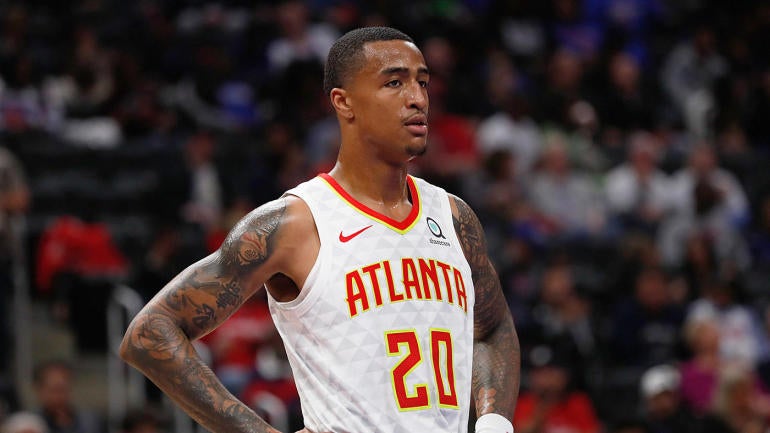
Calling John Collins the savior of the 2018-19 Atlanta Hawks would be an overreaction. Teams that win 29 games were never saved, but statistically speaking, he was at least their pathway to competence. They started 3-15 without him last season and finished 24-34 after his return from an ankle injury. Collins had the team's best net rating among actual rotation players at minus-1.4, and when he sat, Atlanta was outscored by 8.2 points per 100 possessions, the third-worst figure on the team. Last season's Hawks were rarely good, but Collins was the difference between mediocre and bad.
This season's Hawks could use a dose of mediocrity, especially after Collins was suspended 25 games in early November for a failed drug test. At 6-24 they are tied for the NBA's worst record with the Golden State Warriors. Their peripheral numbers paint an even grimmer picture. They are currently 27th or worse in both offense and defense. The Hawks have allowed three of the seven highest-scoring games this season where they have yielded 143 or more points each time. When Trae Young sits, they are scoring only 91.6 points per 100 possessions. The difference between that figure and the NBA's worst offense this season (the Warriors at 103.3 points per 100) is bigger than the difference between the worst offense in the league and the second-best offense (the Houston Rockets at 114.4).
The team's response to this performance has been predictably poor. Chris Haynes of Yahoo Sports detailed the lack of leadership in Atlanta's locker room after its humiliating 143-120 loss to the Knicks, and head coach Lloyd Pierce confirmed it while refusing to place that burden on Collins.
"I don't want to put John in a position that when he comes back, he solves our communication, our energy, our effort," Pierce said at Madison Square Garden. "John's a great energetic player, but still a young player. He communicates, and he's bouncy and he gives us a pop, but it's a total thing. It's everybody. I would love to say that one guy is our leader. I'd love to say that Vince [Carter] is our leader. Vince is on his way out, and so his leadership is his presence. These guys know as we move forward, somebody's got to step up, and right now, it should be all of them trying to step up a bit more, communicate with each other a bit more, spend time with each other a little bit more. When John comes back, he's going to be a part of that, not the solution to it. I know we're all excited for him, but I don't want to put that type of pressure on him. We have to get better at communicating and interacting with one another."
Like it or not, though, that pressure appears to be on Collins. A recent report from Shams Charania of The Athletic explained that a team official recently told Young that the Hawks would be getting him more help soon, implying brewing dissatisfaction from the second-year superstar as the losses mount. Haynes' report indicated that while Pierce was not on the hot seat at the time, that "could all change next week." Next week is here, and Collins, set to return from his suspension Monday, is the only help that has arrived for Young.
His presence will surely make a difference. As CBS Sports' James Herbert wrote before the season, Collins is a model teammate. He's also an enormously impactful player. The Hawks -- currently 28th in the NBA in rebounding rate -- should climb pretty quickly with Collins back in the fold. He led the Hawks last season in terms of rebounds per game (9.8), rebounding rate (17.1 percent) and box-outs per game (6.3). He is by no means a good defender, but the guy he is replacing in the starting lineup once argued that "they don't pay players to play defense," so at the very least, there is some addition by subtraction coming by virtue of benching Jabari Parker.
That swap changes the entire complexion of Atlanta's pick-and-roll offense in both its traditional high-screen form and the Hawks' preferred double-drag variant. Atlanta rollers scored 1.18 points per possession last season, per Synergy Sports. This season? They're down to 1.04, and the difference in explosiveness between Collins and, say, Alex Len has been jarring.
There are other culprits here, just as there are with just about every Atlanta problem. Double-drags require shooting big men, and the Hawks have felt the loss of DeWayne Dedmon nearly as much as Collins. But his return will help, if only incrementally, which should be the expectation to begin with.
For all of the goodwill that came with them into this season, the Hawks won only 29 games last season. Their net rating suggested they had played at a level much lower -- somewhere in the low-to-mid 20s. Their franchise player is in his second season, and as easy as this is to forget right now, Kevin Durant won only 23 games in his sophomore campaign. Anthony Davis got 34, and Stephen Curry won 36.
Even when a top draft pick goes exactly as planned -- as the Young selection has -- full-scale rebuilds of the sort Atlanta has undertaken take time. That is what makes the atmosphere surrounding the Hawks recently so discouraging. They are acting like the sort of jaded, veteran organization that they haven't had time to become.
When was the last time news of a second-year player's dissatisfaction with his roster became public? Typically, these are the sort of stories that come as a superstar nears free agency. Young isn't even halfway through his rookie contract.
Pierce is in a similar boat. He may or may not be Atlanta's coach of the future, but the answer probably isn't coming in the near future. Even with Collins back in the fold, the Hawks still lack any semblance of perimeter defense. They don't have a backup point guard. Virtually all of their spacing comes from two players.
These design flaws were at least in part intentional. This Atlanta roster wasn't built to compete now. It was built to create growth opportunities for the young players who, ideally, will help the Hawks compete later. And if doing so granted them another high draft pick? Then all the better.
If anything, Atlanta has been victimized by its own success. If Young looked anything like a normal second-year point guard, he would be held to the standards of a second-year point guard. Collins wouldn't be asked to be a savior if he hadn't done at least a little bit of saving last season. External expectations are pushing the Hawks into problems normal rebuilding teams don't have to face.
And that's a shame, because the Hawks are exactly where they need to be. They have a number of young players who figure to one day lead Atlanta into contention. They are loaded with assets and cap flexibility to supplement them. And when this team does eventually find its way into the postseason, nobody is going to care about a couple of extra losses that came along the way.