Knicks trade deadline preview: How New York can balance both present and the future
The Knicks are good now, but want to be great later

By
Sam Quinn
•
7 min read
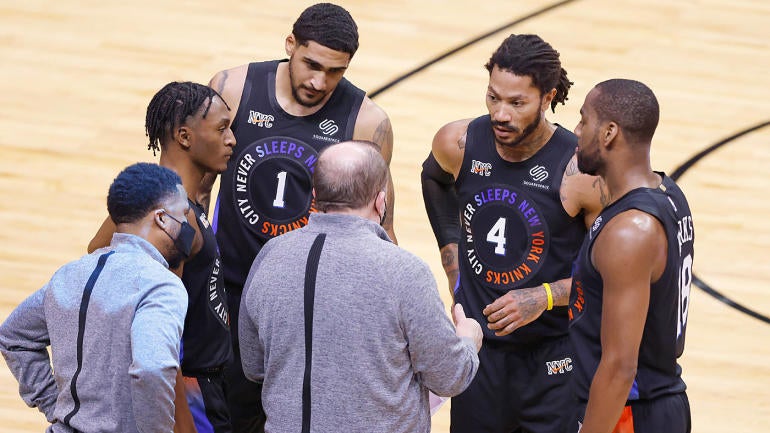
The New York Knicks badly want to believe that their surprisingly successful first half is sustainable. You don't trade a valuable second-round pick for a 32-year-old Derrick Rose without believing that the playoffs are an attainable goal, but does their performance warrant such confidence? Probably not.
The Knicks have the No. 2-ranked defense in basketball, but it relies on some of the most outrageous shooting luck in recent NBA history. When teams play against the Knicks, they make only 33.9 percent of their wide-open 3-pointers. That is the lowest figure any team has posted since NBA.com started tracking the statistic. Aside from Mitchell Robinson's fractured hand, the Knicks have been one of the NBA's healthiest teams, and they've been mostly untouched by COVID-19. They have so far been one of the few teams in the league whose 3-point percentage has actually gone up in the clutch.
The Knicks likely aren't quite the team that they hope to be, but perception is reality at the deadline. They want to remain competitive. In the process, they have to remember that the future is what really matters. What's happening now might not be sustainable, but they're trying to build something that is. Here's how the Knicks can balance those two competing agendas.
Needs
Shooting: New York's 23rd-ranked offense has a number of flaws, but its shot profile is the biggest one. The Knicks rank 29th in 3-point attempt rate despite ranking 12th in 3-point percentage. Some of this falls on Tom Thibodeau's shoulders, but the roster isn't doing him any favors. New York has survived on outlier seasons that will likely regress. Julius Randle is a career 32.1 percent 3-point shooter, but he's over 40 percent this season. Kevin Knox has seen similar improvement (though, given his age, it appears more sustainable), RJ Barrett has been on a hot streak since mid-January and Derrick Rose has hit a staggering 45.5 percent of his attempts in his first 10 games as a Knick. When these numbers normalize, the Knicks are going to need more shooting on their roster to compensate.
Playmaking: New York's shooting problem is compounded by its lack of a floor general. It ranks 28th in catch-and-shoot 3s, and that shouldn't be surprising considering it ranks 25th in total passes and 19th in miles traveled on offense, according to NBA.com tracking data. In other words, while the offense is more competent than it was pre-Thibodeau, it stills get stagnant. Randle has shown remarkable growth as a passer and Barrett has upside in that regard, but Immanuel Quickley is a shooting guard in a point guard's body, and if the Knicks want to maximize the scorers they already have, finding a traditional primary ball-handler would help a good deal.
A star, eventually: None of this matters if Randle is New York's best player two or three years from now. After all, in a season he might never replicate, he barely has the Knicks hovering at .500. If they're going to make the leap from cute story to consistent contender, they need an All-NBA player. Maybe they find a way to turn someone on the roster into that kind of star. Maybe they pursue that player in free agency or trade for him. But the Knicks are still a star away from being taken seriously, and that should inform every move they make at the deadline.
Assets
- Untouchables: N/A
- Probably staying: Julius Randle, RJ Barrett, Immanuel Quickley, Mitchell Robinson, Obi Toppin, Derrick Rose
- For the right price: Alec Burks, Kevin Knox, Frank Ntilikina, Reggie Bullock, Nerlens Noel, Elfrid Payton
- Let's make a deal: Austin Rivers, Ignas Brazdeikis, Taj Gibson
- Tradable first-round picks: 2021-2027 (own), 2021 (Mavericks, unprotected), 2023 (Mavericks, top-10 protected)
- Tradable first-round swap rights: 2021-2027 (own), 2021 (Mavericks, unprotected), 2023 (Mavericks, top-10 protected)
- Tradable second-round picks: 2021 (Detroit), 2022-2027 (own), 2023 (Detroit), 2023 (Utah), 2024 (more favorable of Cleveland or Utah), 2026 (Minnesota)
Cap notes
- The Knicks have roughly $15 million in cap space. They have more than three times as much space as anybody else, and the Hornets are the only other team below the cap at present. That gives the Knicks flexibility at the deadline as both a buyer and a facilitator. Don't be surprised to see the Knicks rent out their space to a needier team for an asset or two, but if all else fails, they can always leap ahead of the buyout line by trading for bad contracts before they get released.
- The Knicks are technically hard-capped at the apron ($138.928 million) by virtue of the Rivers sign-and-trade. They are more than $40 million beneath that line, so it is not going to come up.
- If the Knicks do use all of their cap space, it's worth noting that they haven't touched their cap room mid-level exception (roughly $4.8 million initially, but pro-rating by the day). That can be used to sign a buyout guy.
Expiring contracts
- Ntilikina will be a restricted free agent with full Bird rights. The Knicks can offer up to the max in order to retain him and can match any offer made by another team.
- Rose and Bullock are unrestricted free agents with Early Bird rights. They will be able to offer Bullock up to 105 percent of the average player salary (whatever amount the non-taxpayer mid-level exception turns out to be) or 175 percent of their present salary, whichever is greater. For Rose, it will be the latter. For Bullock, it could be either.
- Burks, Noel, Gibson and Payton will be unrestricted free agents with Non-Bird rights. The Knicks can pay any of them up to 120 percent of their 2020-21 salary, before dipping into cap space or exceptions.
Possible trade targets
- Low-end -- JJ Redick: Their need for shooting aside, the added bonus of the Knicks absorbing Redick's $13 million salary in a trade would be keeping him away from the Nets. With Redick's family residing in Brooklyn, it's easy to picture him reuniting with Blake Griffin and DeAndre Jordan if he secures a buyout from the Pelicans. The Knicks could needle their crosstown rival while improving in a key area in one fell swoop.
- Medium-end -- Victor Oladipo: The sort of superstars the Knicks would probably prefer to pursue simply aren't available at the moment, so why not roll the dice on a low-risk, high-reward target like Oladipo? The Knicks could use their draft pick surplus to take a flier on Oladipo for the rest of the season before deciding whether or not to try to re-sign him in the offseason. Even if the odds of Oladipo recapturing the magic of 2018 are slim, the mere chance that he might is worth the gamble if the price is low enough The New York Post's Marc Berman has issued two recent reports on New York's interest in Oladipo.
- High-end -- Zach LaVine: Is LaVine available? Probably not, but the clock is ticking. LaVine's Bulls are ninth in the Eastern Conference, in the same messy middle tier as New York, and he will reach free agency in 2022. If Chicago isn't confident in its ability to contend by then, or if it simply wants to extend its rebuild, Arturas Karnisovas will at least explore the market. Thibodeau coached LaVine for a year in Minnesota, giving the Knicks a bit of inside intel other teams lack. The price would be steep, but it could be worth it. Even the most optimistic outcomes for players like Barrett and Quickley might not be as appealing as one of the NBA's premier scorers.
Possible buyout targets
- Guard -- JJ Redick: At this stage of his career, Redick will probably prioritize contention over cash, but hey, you never know. Say the Knicks use $5 million of their cap space in trades. That's still $10 million left over to spend on the buyout market. Would Redick say no to even a prorated portion of such a hefty sum for a few months of work? It's worth asking.
- Forward -- Nemanja Bjelica: Now here's someone who might take New York's money. Bjelica hasn't made nearly as much as Redick in his career, and if his poor shooting this season scares off trade suitors, the Knicks could use some of that space to sign Bjelica in the hope that he can recapture the stroke that made him so lethal for most of his career. Like LaVine, he played for Thibodeau in Minnesota.
- Center -- DeWayne Dedmon: If the Knicks were going to add another center beyond Gibson, they likely would have done so immediately after Robinson's injury. If, for whatever reason, they decide to do so now, a 3-and-D option is the only route worth pursuing, and despite the fact that he has gone unsigned all season, Dedmon would be their best shot at that sort of contributor.