Let the Timberwolves explain why there's still hope for their awful defense
This was supposed to be a guaranteed strength for a Thibodeau team

•
7 min read
MINNEAPOLIS -- Sitting at 9-5 after this week's smothering of the San Antonio Spurs in their best defensive effort of the season, the revamped Minnesota Timberwolves are in third place in the stacked Western Conference one month into the season. By just about any measure, that's an unmitigated success for a team with so many new players -- Jimmy Butler, Jeff Teague, Taj Gibson, Jamal Crawford -- still figuring out how to play together.
Yet by one measure in particular, Tom Thibodeau's squad is also the most befuddling team in the NBA: defense.
Thibs is one of the league's top defensive coaches, and when he took over a young team last season, it was assumed that the Timberwolves would see immediate growth on the defensive end. Not so. In 2015-16, Minnesota had a 107.1 defensive rating, good for 27th in the NBA, and in the 2016-17, it had a slightly worse 109.1 defensive rating, good for 26th in the NBA.
But an explanation was built in for why this team so often looked lost on defense last year: They were young, and they were getting used to Thibs' system. Massive talents like Andrew Wiggins and Karl-Anthony Towns would certainly grow in time on the defensive end, as they already had on the offensive end.
This season in Minnesota has seen a major roster overhaul. Butler, acquired in a trade that jettisoned defensive liability Zach LaVine, is one of the best two-way players in the NBA, not to mention the perfect personality to encourage a complete culture change for the franchise. Gibson was one of Thibs' stalwart defensive big men in Chicago and at age 32 still has plenty of gas left in his tank. Most importantly, Wiggins was someone who, coming out of college, had been projected to become an elite, Scottie Pippen-like perimeter defender, and Towns' defensive potential was considered above average at worst. And so, in the budding stars' age 23 and 22 seasons under a defensive genius, something was certain to click.
That has not happened.
Fourteen games in -- nearly out of that small-sample-size area coaches speak about for the first 20 or so games of the season -- the Timberwolves have a 108.4 defensive rating, good for 26th in the NBA. The four teams below them: the lottery-bound Sacramento Kings, the lottery-bound Phoenix Suns, the lottery-bound Dallas Mavericks and the Cleveland Cavaliers, who beat the Wolves for the title of most befuddling team in the NBA but who also have LeBron James, so, whatever.
The only Western Conference team that's allowed more points per game than the Wolves is the Suns, who simply don't play defense at all. Minnesota actually has a negative net rating despite their quality record.
You may think a deeper dive into these defensive metrics would reveal a cleaner explanation. You would be wrong. The Timberwolves have a stellar 98.5 defensive rating in the first quarter of games; keep that up for four quarters and they'd have the second-best defensive rating in the NBA. But the Wolves defense does not age well. In second quarters, their defensive rating dips to 112.5, second-worst in the league in second quarters. In third quarters, 109.8, 25th in the league. In fourth quarters, 113.0, again second-worst in the league.
"I thought the defense was really good in the Utah game," Thibodeau said this week of a 109-98 road win over the Jazz. "I thought our closeouts were better, help, ball pressure, tracing the ball was better. And I liked the first quarter at Golden State a lot. What I haven't liked is us not sustaining it over 48 minutes. That's something we have to continue to work on."
On Wednesday night, I went to the Target Center for a game against one of the most fundamentally sound teams in the league, the Spurs, to try and get some answers for one of the most confounding questions in this young NBA season. Basically, what in the hell, guys?
"By a margin, we're a much better defensive team than we were last year," Towns told me after I recited a few defensive stats. "You can have all the defensive numbers you want to throw at me right now statistically, but at the end of the day, if you look at our record, that's the real number that matters, and I think that tells the true story of us being a better defensive team than last year.
"We're trying to stop the bleeding as soon as possible. We make conscious efforts on defense. It's a focal point of our game plan to go out there and have our defense win the game."
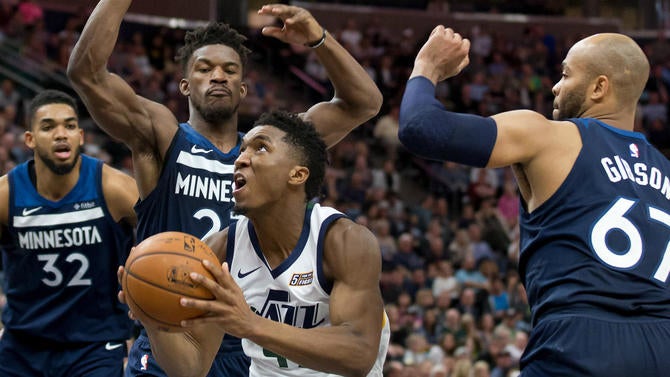
To a man, every player I spoke with believed that the ugly defensive numbers the Timberwolves have tallied so far this season do not reflect the team's improvements on defense so far. More importantly, they don't reflect a defensive ceiling that's much higher this year compared to one season ago.
"No, I don't, honestly," Crawford told me. "I think there's obviously levels we can go to. There's more for us. We're in the first month of the season. I hope we're not peaking right now. But once our defense jumps up, we'll go to another level or two."
I could see those improvements on Wednesday night. Let me throw in a few caveats, of course: The Spurs were on the second night of a back-to-back. The Spurs were still without Kawhi Leonard and Tony Parker. The Spurs have not exactly been an offensive juggernaut so far this year, with an offensive rating that's 17th in the league.
What the Spurs still are is, well, the Spurs. And to hold these Spurs to a season-low 86 points and hold a surging LaMarcus Aldridge to a team-high 15 points is impressive no matter the circumstances.
What you see with the Wolves is a team with two stellar, consistent defenders in Gibson and Butler who are surrounded by players who can't seem to put together a full 48 minutes of defensive focus. It's not as if you can't see the potential in this team becoming at the very least an average defensive team. In spurts -- like at the beginning of the game, when the Wolves came out of the gate like a team hell-bent on getting stops -- they look excellent on defense. What Wiggins told me about this team having a different feeling on defense this season, even if the numbers didn't bear it out, rang true.
"We got stretches where our defense is really good, and then we have stretches where it's not," Wiggins said. "So we know we can do it. It just takes effort. It doesn't take half the game. It takes the whole game."
You could see the moments where they lost defensive focus. Wiggins not closing out on a Manu Ginobili 3. The Spurs getting loads of too-easy offensive rebounds. Rudy Gay slipping around Butler for a backdoor pass that led to an easy bucket. And over the course of 48 minutes, these little defensive miscues can add up. And sometimes that can add up to confounding losses, like the Wolves' weekend loss to the Suns, where they blew a fourth-quarter lead and gave up 35 points apiece to T.J. Warren and Devin Booker.
"For us, little things – if you miss enough little things it can create a big mess," Crawford told me. "I know we're prepared. I know nobody's going to be more prepared than we are. It could be transition this night, it could be helping the helper that night, but it's just a combination of things. And we've been good in stretches as well. Once we get those little cleanups we'll go to another level."
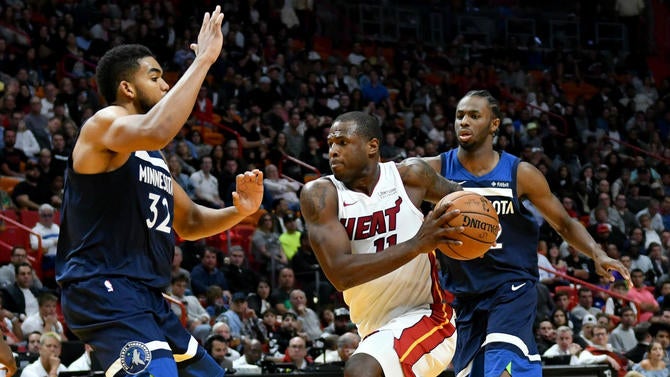
Does it make me a Wolves apologist that I believe him? I don't think so. This team is still jelling together, and they're still jelling under Thibs. It's not like they are a non-stop disaster on defense; their disasters come sporadically, and those sporadic disasters add up.
We're one month into the season, and, yes, the Wolves' defense is bad. But by March, while they're certainly not going to become Brad Stevens' Boston Celtics on defense, I believe -- and more importantly, the players and coaches believe -- that this defense can become a competent group. And even a league-average defense could lead the Timberwolves to achieve or even surpass the high expectations put on their shoulders this year.
"There's not any one particular thing because it's all tied together," Thibodeau told me when I asked if there was one part of defensive execution his team needed to correct. "You start with your individual fundamentals and then you build out to your team schemes. Usually it's the repetition of doing it over and over and doing it correctly, and then having the opportunity to do it in the games. You look at a lot of things. If you're practicing it the right way, you'll eventually get it."
One thing that you're guaranteed out of Tom Thibodeau teams? They're going to practice it the right way. And if they don't, they're going to keep running it back until they do.