
Mark Cuban hints at freedom to pay luxury tax under new ownership, but the truth will likely be complicated
Cuban sold the Mavericks but will reportedly remain in control of basketball operations

By
Sam Quinn
•
3 min read
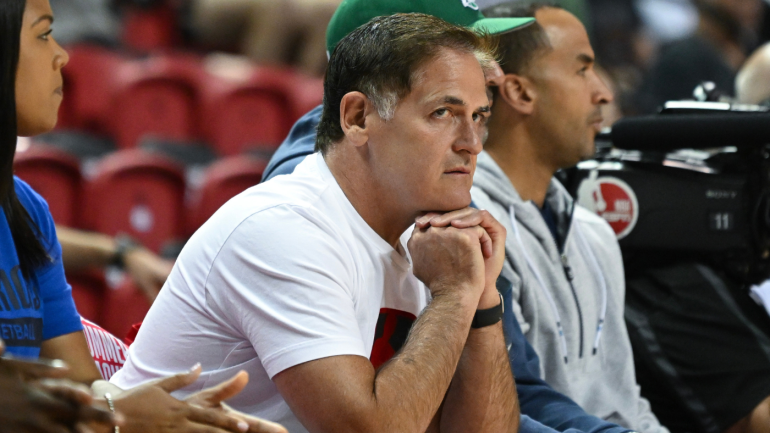
There is no officially accepted title for the head of basketball operations within a specific team. It used to be the general manager. More recently, teams have upgraded to president of basketball operations partially as a means of inflating titles and keeping promising young executives in place. Some front offices have nominal heads in one of those roles, but others in lesser or even consulting roles wield greater influence due to their relationship with ownership. No two front offices are identical. But the situation Mark Cuban has designed for himself is still among the strangest the NBA has ever seen.
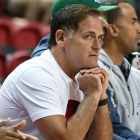
Earlier this year, Cuban sold his majority stake in the Mavericks to Miriam Adelson. As part of the sale, Cuban will reportedly retain control over the team's basketball operations... except, according to Marc Stein, the sale agreement does not outline a specific role for Cuban, and Patrick Dumont will be the team's governor. Cuban himself addressed the sale on Wednesday and tried to explain why the unique arrangement makes sense. "They're not basketball people," Cuban said.
Of course, new owners rarely are. They still tend to want to bring in their own people to run their teams. For now, it appears as though Adelson and Dumont won't do so, and that was part of the logic behind the partnership. The Mavericks want to build a new arena and casino district. This is the domain of the Adelsons, who run the Sands corporation in Las Vegas, so a theoretical partnership with Cuban made plenty of sense. Yet this novel agreement raises questions no other team sale ever has. The simplest relates to money.
Cuban hinted that the Mavericks would be able to pay the luxury tax moving forward under Dumont and Adelson. "They basically said do what you gotta do, I want to win," Cuban said. But who exactly sets the budget here? What happens if Cuban wants to make a move that adds salary that the team's majority owners aren't interested in paying? Would Cuban have the freedom to operate with the sort of aggression that, say, Mat Ishbia has in Phoenix even though he isn't the one cutting the checks? In all likelihood, there's a line somewhere. There's a difference, after all, between paying the tax and reaching the level of largesse that the Warriors and Clippers have operated with over the past several years. That is especially true under the rules set forth by the new CBA.
And then, of course, there is the matter of the existing front office infrastructure in Dallas. The Mavericks have a nominal president of basketball operations in Nico Harrison. The organizational chart was clear when Cuban owned the team. Everybody reported to him. What happens if Harrison and Cuban disagree over a potential roster decision? Does it simply come down to whoever has ownership's ear at the moment?
The answers to these questions may present themselves over time. We may never know the whole truth, and that truth might change with time. If there is no contractual language binding the Mavericks to Cuban, there's theoretically nothing stopping ownership from hiring its own head of basketball operations eventually. Even if Cuban remains in the role, there's just no telling what exactly it will entail. Though he has been a successful and involved owner for over two decades, Cuban has never reported to anyone in a basketball setting. His background in basketball is as an owner, not a scout, player or analytics expert.
None of this is inherently good or bad for the Mavericks. It's just different in ways that we can't exactly foresee. Each NBA front office operates differently, but we've never really seen one operate in the way in which the Mavericks are expected to move forward.