Michele Roberts calls media availability 'invasion of privacy'
NBPA executive director Michele Roberts wants to limit media availability for players even more.

•
2 min read
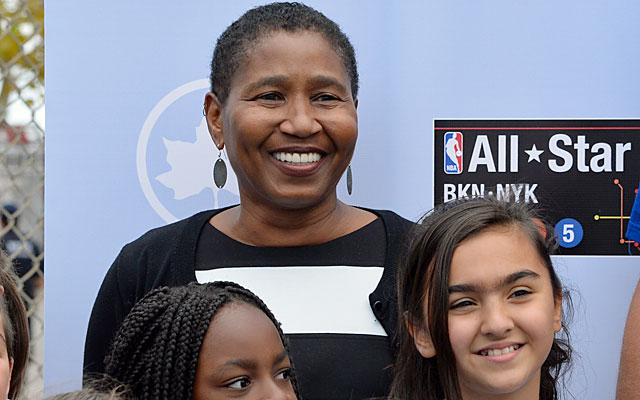
NBPA executive director Michele Roberts told ESPN's Kate Fagan that she'd like to "tone down" required media availability for players. The quote:
"Most of the time I go to the locker room, the players are there and there are like eight or nine reporters just standing there, just staring at them," Roberts said. "And I think to myself, 'OK, so this is media availability?' If you don't have a f---ing question, leave, because it's an incredible invasion of privacy. It's a tremendous commitment that we've made to the media -- are there ways we can tone it down? Of course. It's very dangerous to suggest any limitation on media's access to players, but let's be real about some of this stuff.
"I've asked about a couple of these guys, 'Does he ask you a question?' 'Nah, he just stands there.' And when I go in there to talk to the guys, I see them trying to listen to my conversation, and I don't think that's the point of media availability. If nothing else, I would like to have a rule imposed, 'If you have a question, ask it; if you don't, leave.' Sometimes, they're waiting for the marquee players. I get that, but there is so much standing around."
This is tricky territory, and as a member of the media it's obviously in my interest to have more access. But let's try to take look at this. Some thoughts:
1. As Fagan notes, the NBA shortened pregame availability from 45 minutes to 30 minutes before the start of this season. Some teams are eliminating shootarounds, which also decreases the amount of times players have to see reporters. While there are rules about players being available pregame, a lot of players simply don't go to their lockers during that 30-minute window. Others put headphones on and look down at their phones. As someone who is generally trying to get work done in that time, it's frustrating to think the union might push to put even more limitations on access.
2. Roberts has a point about standing around, but it's hard to get around that particular problem. Perhaps the best way is to have the stars of the game speak at a podium in a separate room -- that's what happens in the playoffs, and that's what the Clippers do all the time -- so the reporters who just need quotes from the big names don't crowd the locker room. Thing is, if you need to speak with a particular player, you don't really have a choice but to stand and wait.
(This isn't limited to basketball -- the topic came up this week in an interesting Twitter conversation between Dodgers pitcher Brandon McCarthy and writer Molly Knight.)
3. Reporters used to fly with teams and watch practices. We're never going back to those days, but there are also way, way more media outlets than there were even a decade ago. The whole Marshawn Lynch saga has started a broader conversation about what should be expected of athletes, and recent incidents involving Thunder superstars Kevin Durant and Russell Westbrook have made it a discussion in the NBA. Roberts is quite clearly taking the position that the status quo is too demanding, and it's easy to see the union making this an issue in collective bargaining.