NBA 2K16 Review: MyCareer mode as absurd as it is addicting
If you want to build the perfect player on NBA 2K16, you're going to have to overcome tragedy to do it.

By
Zach Harper
•
12 min read

The release of the NBA 2K franchise's latest installment is always highly anticipated. It's been the best selling basketball video game for years and it's a huge part of the NBA culture. Players in real life are dedicated to using their down time to try the digital world of the NBA. With 2K Sports' ever-expanding MyCareer mode, anybody has had a chance to scan their likeness into the game and try to build up their MyPlayer to becoming an NBA legend.
In NBA 2K16, things were taken a step further with the introduction of "Livin' Da Dream," a storyline attached to MyCareer mode courtesy of Spike Lee. If you're familiar with Spike's many films during his incredible directing career, then you may be able to anticipate a lot of the stories and plot points thrown your way. If you haven't familiarized yourself with what Spike does with his stories, the early parts of MyCareer may blow your mind.
In last year's version of this mode, your digital self went undrafted and had to impress in a workout to earn a 10-day deal. Then you'd try to keep impressing NBA teams before carving out your spot in the NBA. The newest edition is quite different. You're introduced as a high school prospect and your family is as much a part of the story as the basketball early on.
It's possible you'll end up feeling like Steve Martin in "The Jerk," but you're a Harlem-native with a twin sister named Cece. Your nickname is Freq (pronounced freak) and it's short for Frequency. You earned that nickname in your mother's womb because of the way you kicked and moved around, which is apparently something you can differentiate between kids when you're having twins.
You even have an Antoine Walker-esque shimmy and shake celebration that's called the "Freq and vibe."
You're also introduced to the character of Vic (short for Victor), who is your longest non-related friend. And that's where the story really gets complicated. (WARNING: There are spoilers from here on out, which sounds like an insane thing to warn about a basketball video game.)
High School
Early in this mode, you're navigating the stardom of high school. You get to play three games of your career (one in your home gym, one in an opposing gym, and the state championship in a bigger arena) after choosing between three different high schools.
I was a Parkside Dragon and quickly after my first game (they only give you two-minute quarters so it doesn't take much time), I'm approached by three different real colleges. It's similar to the recruiting monologues in "He Got Game" when coaches are speaking into a camera to tell Jesus Shuttlesworth about their college. Georgetown tells me about their NBA tradition, Villanova tells me about how their style of play is similar to the toughness of streetball, and Louisville is promising me the possible titles and awards available.
Arizona hits the NBA alumni angle hard as well after my second game, and Kansas throws around flashy names like Wilt Chamberlain, Kirk Hinrich (seriously, he's the second guy they name), Andrew Wiggins and Paul Pierce as the reasons to be a Jayhawk. Connecticut lets me know this isn't their "first rodeo" with recruiting stars and the fit should work because "navy blue runs deep."
Michigan offers up the tradition of the Fab Five and breaking Glen Rice's records, but eventually UCLA woos me with the promise of sun and their "banner of excellence" -- whatever that means. With Vic recording on a camcorder that they imply he stole, I deliver my decision to the world that I'm tired of New York snow and want the warm beaches while I study.
U-C-L-A! Fight! Fight! Fight!
College Season
In college, you're given four games to play with each game consisting of two five-minute halves. While your play on the court matters (you'll get to face off against Kelly Oubre when you face Kansas or Frank Kaminsky when you face Wisconsin), the real story comes from the announcers telling your background during the game and the headlines on the loading pages letting you know that your draft stock is falling.
They call you a Top 5 pick prospect before your first game. No matter how you play (because I dominated the first game), your stock takes a dip. At a certain point, they wonder if you'll stay in the Top 10 or even the first-round altogether. However, in the fourth and final game, I beat Wisconsin in the National Championship game, which presumably saves much of my future selection placement.
Before the draft, you're introduced to agent Dom Pagnotti, who is trying to convince you to jump ship (you don't actually get to decide; you're out of college after your freshman year). You may remember the name Dom Pagnotti -- he's the agent from He Got Game. In fact, they brought back that particular actor to do the voice for his character. Your parents are on speakerphone while you and your sister talk to Dom.
Dom starts doing the Freq'ing and Vibin' celebration. He's preaching how much money you can get and the concerns about getting injured in college. Your dad is preaching education while your mom lets you know to stay true to your decision. But you don't get a decision because staying another year would be boring. You're headed to the NBA, but not before your new agent informs you that your best friend Vic is bad company to keep and you should cut ties with him. That's where we really start going.
My NBA career
The insanity of your rookie season is the real story you're unraveling with this mode. While you may wonder how you build up your character on the court (that comes later), you're learning about the debacle that is his life off the court. Everybody around you is trying to tell you how to be a professional.
I get drafted 13th by the Phoenix Suns (who still ended up with Devin Booker too and I'm not sure if they got to pick two guys at 13). In your rookie season, you get to play eight games and they pick the games for you (you finally get to choose how long they are). You'll face various tests from your conference, a homecoming they mention when you go to Brooklyn for a road game, and a match-up against LeBron James at some point.
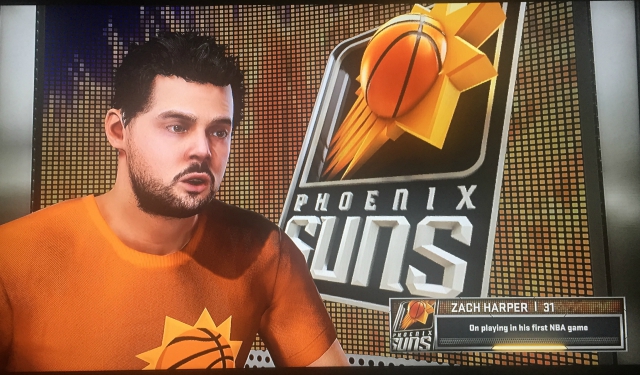
If you had dreams of turning your rookie self into the Rookie of the Year, you're not in control of that. You get just the eight games.
Here are the storylines that you experience with a new cut scene after each of your eight allotted games, and I'm not making this up:
• Your girlfriend, Yvette, is feuding with your twin sister Cece, who is also feuding with your agent over control of your image.
• Everybody wants you to cut ties with Vic.
• After your first game, the team owner bans Vic from traveling with the team and going to games because he's such a bad influence. The owner mocks the way you talk, and after he unearths a TMZ-like video of Vic drunkenly talking about an alleged incident in front of a cop car, we find out that the owner once had a card-counting gambling friend who died, and you are urged once again to part ways with Vic.
•One game into your career, your agent wants to put you in movies and turn you into a marketing darling. Remember the "platinum and diamonds" speech from Dom in He Got Game? It's in here.
•Vic wants to remind you you're from the streets and should act accordingly.
• Vic is secretly a rapper named Boss-Key-Yacht and wants you to fund his album.
• Oh by the way, when you were in high school, you killed a guy while fighting him in a stairwell and Vic covered it up. He reminds you of this so he can force you to let him use your car.
• The team owner threatens to release you because your refusal to part ways with Vic has made you a liability. How airtight are those rookie contracts?
Once your rookie season is over, you're a free agent (I guess not that airtight). You get to pick three teams to negotiate with and every team has a different level of interest in your services. After negotiating how much virtual currency (a.k.a. VC) you get per game (that's how you buy attribute upgrades) and how long your contract is, you celebrate with your family.
This is when you find out Vic died in a car accident and wrote you a letter before he died. Seriously, this happens.

After all of this madness, you're finally given the normal MyPlayer experience. Your second season is similar to previous installments. You play games, earn more VC through good, smart play, and buy clothes, personal gym upgrades, and better attributes with your money. The big difference in this year's version is you have to manage your off-days to how you want your career to go.
You have three basic choices to make on these days:
1. Go to practice and do drills to earn more VC.
2. Hang out with one of your 10 connections.
3. Fulfill endorsement requirements set up by your agent.
You get to pick your 10 "connections" and choosing to hang out with them gives you different rewards for various modes. As you become more popular, you'll get to connect with more important people around that world. Your endorsement appearances can lead to even more endorsements and fulfilling those requirements will earn you extra VC.
The way they tie the story of the first season into the rest of your career is by talking about it during pre-game shows and with in-game commentary. Shaquille O'Neal, Ernie Johnson and Kenny Smith will discuss how hard it must be after your tumultuous rookie season. You may be coming out of a timeout and Kevin Harlan will talk to Clark Kellogg about you overcoming the death of your good friend Vic. The main story steps aside and you get to just build the career of your player, but it's always a lingering side story.
From there, you're just trying to manage your time and build your player. Maybe you want to focus on building his brand and letting the on-court attributes build gradually. Maybe you want to skip the endorsements and risk your marketing growth to concentrate on practice or league relationships with other players. However you want to build your player is up to you.
MyGM Mode
The franchise mode of NBA 2K16 is as robust as it has ever been, and the theme appears to be connectivity. 2K Sports has been building its MyGM mode for years and adding little touches here and there. Whether you're checking the wear-and-tear on your players, handling conversations with guys wanting to guarantee they won't be traded or want more playing time, or making sure to build trust with your coaches and staff, 2K is always trying to find ways to build relationships within this mode.
This year, you're diving more into player motivation and evaluating potential assistant coaches by finding out what their goals are (does the assistant coach you're interviewing really want to be head coach?), what they think of your roster, and how they view the state of the team. You can hire staff members away from other franchises if they don't block the hire (the Golden State Warriors never let me hire Ron Adams). You have to meet demands of the important staff members and pray a better team doesn't wrestle them away.
The same logic is applied to free agency, where your status as a franchise matters. Established players are unlikely to sign with a team that is rebuilding. Teams that are "buyers" and "contenders" will likely catch their eye instead. And aside from some wonky restricted free agency (I signed Harrison Barnes to a cheap one-year deal in RFA and the Warriors didn't match) time to time, your franchise isn't getting top players if they're not a desirable location.
Market can also play a factor into this. Where your team is located may not be favorable to someone you're pursuing as a staff member or free agent. So if you want to relocate your franchise, you can do that. You need to design a stadium, design uniforms, pop in a logo, and have a good enough plan in place (downtown or suburbs, what kind of amenities, etc.) for the Board of Governors to approve it.
After two years of trying to build up the Brooklyn Nets, I decided to move them away from New York and into Seattle. I wanted to recreate the SuperSonics, and it was pretty easy. Going into the BOG vote, it let me know the New York Knicks were voting in favor of the relocation, the Philadelphia 76ers and Los Angeles Clippers were against it, and the other 26 teams were undecided. It passed with a vote of 28-2 and the only remnants of my Brooklyn roots came during those in-game interviews with players still wearing Brooklyn Nets T-shirts.
The cool thing about the move was the league automatically realigned with the Sonics in the Northwest as the Oklahoma City Thunder headed to the Southwest, the New Orleans Pelicans went to the Southeast, and the Washington Wizards joining the Atlantic. It's all connected.
Gameplay
The modes are great, but what about the game on the court? For the most part, you're going to get a suped-up version of the 2K experience you're used to. Passing is smoother, more intuitive, and you have better options. When you run a pick-and-roll, you can not only choose whether the screener rolls or pops, but you can also decide which side of the defender gets screened. Post play is now activated by holding down the back left trigger (L2 on PS4) and it's easier to put together moves out of it.
Once you get a hang for the changes in PnR, post play, and passing controls, everything else falls into place. You'll get a couple of rough patches here and there. Whether it's a good challenge or not, a rim protector being in the vicinity of the rim is likely to result in a miss. Getting around screens is both given more freedom and feels a little stickier because of it. It's hard to move sloppily past players in general if they're trying to prevent you from moving.
Everything else provides a very good representation of video game basketball. Role players matter in executing play, and stars can take over (Anthony Davis is a God). No doubt you'll kill hours playing this game and discovering new little touches all the time.