NBA free agency: We know what the Kings did this summer, and it really was good
After trading DeMarcus Cousins in February, Sacramento is trying to build something from scratch

•
6 min read

The 2017-18 Sacramento Kings are going to be drastically different from past iterations. This is not a bad thing. The Kings of the past decade are not known for competence, competitiveness or cohesion. No longer, though, should they be considered a franchise in desperate need of direction. Eight new players have joined the team this offseason, five rookies and three veterans. Of the seven returning players, four were rookies last season. This is what rebuilding looks like.
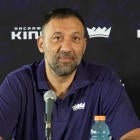
On Monday in Las Vegas, Sacramento introduced their three-headed leadership monster: George Hill, Zach Randolph and Vince Carter. With 44 years of experience between them, they talked about bringing a winning attitude and mentoring the kiddos.
"We had to learn how to win," Carter said. "We had to learn the culture and what it takes to be a professional, and it's been instilled in us and it's just second nature for us. And that's what these young guys are now trying to learn."
That kind of comment can elicit head nods and eye rolls. Adding a few old dudes to a young locker room does not guarantee perfect player development. Some vets are more concerned with their own minutes and touches than teaching players who are trying to replace them. There is an argument that the Kings should be imitating "The Process," as executed by the 2013-16 Philadelphia 76ers under Sam Hinkie, staying completely out of free agency and letting the young guys run wild -- and lose games.
Some laugh off the Hinkie plan, but it is the surest way to have an opportunity to acquire a superstar. It is extremely rare, however, for a front office to be willing to stomach the level of losing that accompanies that strategy. Given that general manager Vlade Divac's stated goal was to build a culture, he and new executive vice president Scott Perry deserve credit for the specific veterans Sacramento targeted and signed after their 32-win season. In fact, when it comes to executing a plan, few teams have had better summers. Fancy that.
Five reasons for optimism about the Kings:
Encouraging draft
De'Aaron Fox looks like the exact type of prospect Sacramento needed. He is a natural leader who actually wanted to be there. Before the draft, the 19-year-old was compared to fellow Kentucky point guard John Wall, and ideally he will be able to make those projections seem prescient. The upside is there -- the extraordinary speed, the aggressive approach on both ends -- and, even if he never becomes a star, he should be a nice building block who fits well next to Buddy Hield.
De'Aaron Fox is a blur in transition. pic.twitter.com/OCfd87IwNz
— NBA (@NBA) July 10, 2017
For the chance to draft Fox, the Kings can thank their 8-17 record after trading DeMarcus Cousins at the end of All-Star weekend. In that trade, the Kings also received the Nos. 10 and 34 picks in the draft. The former was traded for the Nos. 15 and 20 picks, which they used on Justin Jackson and Harry Giles, and the latter was used on Frank Mason III.
It's too early to know if any of these picks will be a home run, but you can see what the front office is seeking. If Giles successfully recovers from an unfortunate series of injuries, he could be the steal of the draft. Jackson gives them a versatile forward who could be ready for a complementary role right away. Mason is aggressive, like Fox, and makes up for his lack of size with effort.
Vets aren't getting in the way of anything
Let's dispel the myth that Hill, Randolph and Carter will have a damaging effect on young players. Sure, Randolph could take minutes and touches from Skal Labissiere, but is there really a problem with Z-Bo on the court about half the game to bully people on the inside and grab rebounds? At 35, he is still a threat with the ball and should be able to pass along some veteran tricks. The 40-year-old Carter can do that, too, and if there hadn't already been thousands of words dedicated to his professionalism and work ethic over the past few years, we'd rave about those qualities here.
Hill's presence means the backcourt of the future -- Fox and Hield -- won't start together right away. It should also help both players. Since Hill is not a ball-dominant guard -- he can defend multiple positions and is an excellent 3-point shooter -- he can play with Fox and/or Hield and make their lives easier. If we (generously) forecast Hield and Fox to average 30 minutes each next season, that leaves 36 minutes left in the backcourt. Instead of giving the bulk of those to Hill, who produced like an All-Star when healthy last season, the Kings could have divided them among Garrett Temple, Bogdan Bogdanovic, Malachi Richardson and Mason. They wanted to be respectable, though, so the choice was easy. Hill is the kind of player who can stabilize a team at both ends.
Look at the length of the contracts, not the salary
After the Cousins deal, Divac told the Sacramento Bee's Ailene Voisin he would be willing to step down if he was wrong about trading the franchise player. Divac argued that, in two years, the Kings would be in a better position.
"I wanted change, to start over," he said. "Acquire assets, build it right. At the same time play hard, play up-tempo, share the ball. Be a team, grow together."
What does it mean to "build it right?" There is more than one path to sustainable success, but patience certainly is one ingredient. Rebuilding teams must avoid chasing big names or quick fixes that require expensive, long-term contracts. By this criteria, Sacramento has done everything properly -- it reportedly didn't even want to offer Andre Iguodala more than a two-year deal.
Sure, $8 million may seem like a stretch for Carter at his age, but for one season, where's the harm? Randolph will make $24 million over two seasons, and USA Today's Sam Amick reported Monday that only $40 million of Hill's three-year, $57 million deal is guaranteed. Which brings us to…
The Lou Will corollary
When the Los Angeles Lakers signed Lou Williams to a three-year, $21 million contract in 2015, they weren't really going anywhere and didn't particularly need another offense-first guard. Kobe Bryant's farewell tour was about to begin, and they had just drafted guard D'Angelo Russell. A fellow who went by the nickname Swaggy P (Nick Young) was on the roster, too.
Williams had just won the Sixth Man of the Year award, though, and at that price it was a no-risk signing. He'd end up flourishing after Bryant's retirement, then was traded to the Houston Rockets for a first-round pick when Magic Johnson became team president in February.
Williams was moved because the Lakers wanted to tank and a contender wanted another scorer. In the same way, should Sacramento ever decide it just needs to bottom out, it will be free to do so. Hill is on an extremely team-friendly contract, and Randolph doesn't cost much considering he is one of the better bench scorers in the league. The vets can help the Kings on the court and in the locker room now, and they could be trade chips before their contracts expire.
Low expectations are a good thing
All this praise is essentially because the Kings finally operated like a normal team. There was no drama involving the coach. There were no widely ridiculed trades. The bar is low.
Similarly, success for Sacramento this season does not mean challenging for a playoff spot. It means development from Fox, Hield, Labissiere and Willie Cauley-Stein. It means playing an unselfish brand of basketball. This is a pretty fun roster now, and it says something that the team was able to bring in Hill, Randolph and Carter. Now, if they just play hard and don't try to skip any steps, maybe they'll be able to establish a foundation for the future.