Rockets ran into a Warriors team that is a dynasty, not a team of destiny
History will show that the fourth incarnation of Warriors-Cavs was anything but inevitable

•
4 min read
HOUSTON – When history looks back at this era of the NBA ruled by the Golden State Warriors, it may record the air of inevitability that surrounds this team and their nemesis, the Cleveland Cavaliers, meeting for the fourth year in a row in the NBA Finals.
History may note that from the beginning of the season, NBA fans bemoaned what felt like a near certainty that, in the 223 days between the Cavaliers tipping off the NBA season on Oct. 17 and the Warriors closing out the Houston Rockets on Monday night, we'd see a tetralogy for Warriors-Cavaliers. ("Tetralogy" is a trilogy plus one; I had to look it up too.)
But if history records these upcoming NBA Finals as inevitable, then history would be wrong.
Because LeBron James' eighth straight Finals was certainly no inevitability, from the first round, when the Indiana Pacers nearly knocked off the Cavs, to the Eastern Conference finals, when the Boston Celtics took them to the brink.
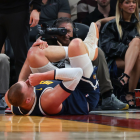
And as much as we want to look at the Golden State Warriors as a team of destiny, they were not. There was nothing inevitable about this outcome. From the moment Andre Iguodala banged his knee against James Harden in Game 3, inevitability was tossed out the window in favor of a heavyweight fight of a seven-game series.
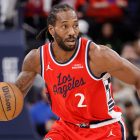
Just listen to what the Rockets' Eric Gordon, a scoring stud all series who stepped into Chris Paul's spot in Games 6 and 7 after Paul's hamstring injury, had to say in Houston's devastated locker room: "If Chris was out there, we'd be playing on Thursday."
You know what? He's probably right.
Think about it. Rockets general manager Daryl Morey has obsessed about beating the Warriors for years, and he constructed a team that clearly was capable of it: With toughness, versatility, a staunch defense, a ton of shooters, and perhaps the best backcourt in the NBA in Harden and Paul.
And then a few things went wrong: The injury to Luc Mbah a Moute late in the season made it so a key Houston defender was playing catchup throughout the playoffs. Two hard-fought wins in Games 4 and 5 made the Finals within sight – then they lost Paul to injury. And on Monday night came an all-time awful three-point shooting night from a team built on three-point shooting: 7 of 44 from beyond the arc (15.9 percent), including an NBA playoff record of 27 straight misses.
"I kept thinking that next one might go in," Rockets coach Mike D'Antoni said afterward. "We had good looks. … We did everything well, except they outshot us. They were 16 of 39, and we were 7 of 44. That's kind of the tale of it. When they make their little runs, we have to be able to hit threes to keep them at bay, and we just couldn't do it."
That, of course, might have been different with Paul, the soul of this team, on the floor. His second-half shot-making in Game 5 was the difference-maker. And while you could look at the Warriors' 29-point blowout in Game 6 or the Rockets' terrible three-point shooting in Game 7 and say Paul wouldn't have made a lick of difference in the outcome, let's be honest: With Paul out there it's a completely different game. At the moments when the Warriors flexed and the Rockets collapsed – namely, in the third quarters – the Rockets needed Paul, and what D'Antoni lauds as Paul's calmness under pressure, in order to stem the tide. They didn't have it.
So the dynasty continues.
This is what is most impressive about this Warriors burgeoning dynasty: There's been only one NBA team that's been perfectly constructed to conquer these Warriors in their with-Kevin-Durant iteration, and it is these Rockets. Morey's obsession nearly played out to perfection.
And yet the perfect antidote to the Warriors' brand of beautiful basketball needed to play four perfect games in order to topple these Warriors. They came close; Games 4 and 5 were blueprints for how Houston could end this Warriors dynasty. And then Paul pulled his hamstring, and that small margin for error became tiny. They had the Warriors on the ropes, twice: Up by double-digits at halftime in both of the final two games. In Game 7, coach Steve Kerr went into the Warriors locker room at halftime thinking he didn't even recognize his team: "It was really one of the most bizarre first halves of basketball that we've played since I've been here," Kerr said. "We were so scattered."
Yet there was, as Steph Curry said after the game, "a calmness at halftime in the locker room." Because the Warriors had played perhaps their worst offensive half of basketball all season. And yet they were only down 11.
They know how hard it is to topple their dynasty.
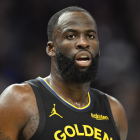
"One half of basketball," Harden lamented afterward. "Two games, Games 6 and 7. One half of basketball."
For a beat, he was quiet. Harden knew that what Kerr said about the Warriors coming "unglued" in the first half was true. Twice, the Rockets had a chance in a second half; twice, the Warriors' "talent took over," as Kerr put it.
"It's extremely frustrating," Harden said. "We had a lot of opportunities, a lot of opportunities. And even in that fourth quarter, we had a lot of opportunities, three opportunities that we were open that just didn't go down."
In retrospect, history can often seem inevitable. But that's rarely the case. It was not inevitable for Michael Jordan to go 6-0 in the Finals; it was not inevitable for the Buffalo Bills to lose four Super Bowls in a row. And so we should not look at Warriors-Cavaliers, Part IV as an inevitability. Because at several moments in the final four games of this series, it didn't seem an inevitability at all.
The Warriors, one of the most talented basketball teams we've ever seen, had to dig deep to beat these Rockets.
And that's what makes the Warriors returning to the Finals an even better story.