
Russell Westbrook is exactly who everybody -- except for the Houston Rockets -- thought he was
Houston bet on the veteran guard to adjust his playing style but that hasn't been the case this season

By
Sam Quinn
•
6 min read
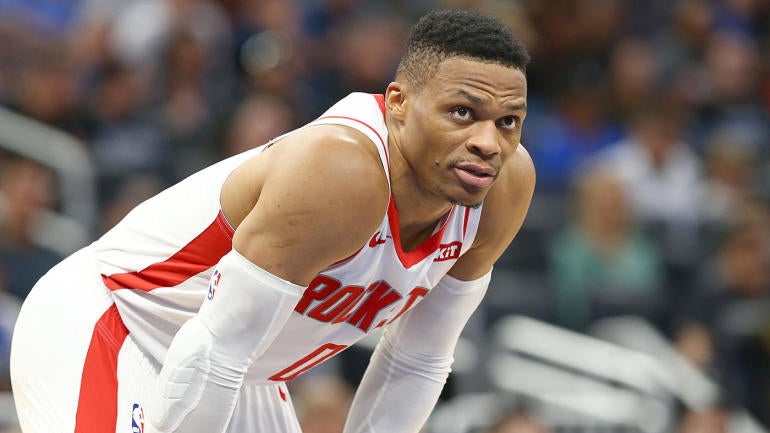
The Houston Rockets are distressingly predictable. I don't say this as someone with an anti-Rockets agenda. I say this as someone who, two months ago, was paid to make the following predictions about them that have, so far, largely come true:
- The Rockets would have a bottom-10 defense. (They are currently ranked 17th in defense, but are trending downward. They are ranked 21st in the NBA since Nov. 19.)
- The Rockets would improve from an abominable rebounding team to a league-average one. (They are 17th in defensive rebounding rate. If you assume some regression from their third-ranked offensive rebounding rate, that puts them right around the middle of the league.)
- The Rockets would dominate in transition after largely abstaining for the past several years. (They are currently ranked second in the NBA in transition possessions per game and third in transition points per game.)
- The Rockets would take fewer 3-pointers than they did last season. (Technically, this has been false so far. This year's Rockets are averaging 45.8 compared to last season's 45.4, but the spirit of the projection was that the manner in which their roster was built in combination with their years of boundary-pushing would make going any higher impossible. In a sense, that's true. Last season 52 percent of Houston's shots were from behind the 3-point line. The rest of the league has grown faster than Houston this season, and the Rockets are down to 50.2 percent so far.)
Predictability is a function of vulnerabilities. The more a player has, the more a team has, and the more a team has, the more predictable it becomes, and Russell Westbrook, for all of the good things he brings to a team, has more weaknesses than just about any superstar in NBA history. He's a bad shooter. His shot-selection is questionable to say the least. He's lazy off of the ball. He hunts for steals and rebounds on defense. He plays with a hero complex. These things have been true for Westbrook's entire career. Few expected them to meaningfully change with the Houston Rockets, except, by virtue of making the trade in the first place, the Houston Rockets.
The success of the Westbrook trade was always going to be based in some measure on his ability to change the bad things about his game without impacting the good. That hasn't happened so far.
There was, if not an expectation, then certainly a hope, that Westbrook would take the opportunity of playing alongside James Harden to develop into an off-ball cutter. That is how Dwyane Wade circumvented his shooting deficiencies to play alongside LeBron James, and given Westbrook's athleticism and finishing ability, he should have been a natural fit in doing so.
But only 10 Houston possessions all season have ended in Westbrook cuts, per Synergy Sports. On a rate basis, that is right in line with his typical numbers despite not playing alongside another guard of Harden's caliber earlier in his career. Even on the rare occasions in which he does make an effort off of the ball, he hasn't converted the opportunities into points. His 0.8 points per possession as a cutter have him in the bottom one percent of all NBA players. When Harden has managed to use his gravity to create free runs at the basket for Westbrook, he just hasn't been able to convert them.
The play design here is simple, yet elegant. Westbrook's man has to keep his eyes trained on Harden in case he has to help, which leaves the defense vulnerable to a backdoor cut. Westbrook's inability to finish off of those cuts is indicative of discomfort. He isn't used to being stationed in the corner, called into duty only when a defense has committed to stopping someone else. Usually, he just hasn't been in position to get those shots. The majority of Harden's pick-and-rolls involve Westbrook just sort of waiting for the ball.
Westbrook's body language on many of these plays is telling. While his teammates often await the ball in shooting position, Westbrook's engagement is based largely on proximity to the ball. If he isn't going to get it, his interest wanes. It adds up to make him a fairly useless supporting player in the pick-and-roll. If he isn't going to cut and he can't make his shots, he becomes practically invisible on such plays, creating an extra defender to throw at Harden.
Unsurprisingly, Harden does the bulk of his work in the pick-and-roll when Westbrook is on the bench. It is Houston's most effective form of offense. The Rockets score a positively ridiculous 122.4 points per 100 possessions when Harden plays without Westbrook, per Cleaning the Glass. When the two play together? That number falls to 111.4. There's a reason teams have felt comfortable trapping Harden the moment he crosses half-court. A 4-on-3 isn't so dangerous when two of the four are as nonthreatening off of the ball as Westbrook and a traditional center.
The decisions that Westbrook makes on the ball aren't helping matters either. As Rob Mahoney detailed for Sports Illustrated before the season, Westbrook jokingly claimed possession of what meager mid-range shot attempts the Rockets were willing to take. Statistically speaking, however, he really has made up the bulk of Houston's attempts from that part of the floor. Entering Monday, 28.9 percent of his shot attempts were 2-pointers beyond 10 feet of the basket. That figure is more or less in line with his typical numbers. No other Rocket is even at nine percent. Most are significantly lower.
Oftentimes, they'll come in bunches. After abstaining from mid-range shots for almost three quarters against the Orlando Magic, for instance, he took four in a row at one point. He had a similar stretch against the San Antonio Spurs in which he took four shots in a brief window, three of which were mid-range jumpers. These spurts tend to come when Harden is on the bench, almost as a form of rebellion. If Westbrook has to play within the system when sharing the floor with his superior teammate, he can at least take some degree of ownership over the minutes he has to himself. The Rockets are getting outscored by 10.1 points per 100 possessions in these minutes.
These tendencies have, so far, been nearly impossible to break. The same has held true on defense. Too often, he still hunts for steals and rebounds rather than playing sound, team defense.
None of this is new. That is precisely the point. Westbrook established a distinct playing style over the course of a decade in which he was largely given free rein to do as he pleased with the Oklahoma City Thunder. To expect such a unique talent to make wholesale changes so late in his career was always unrealistic.
But Houston's entire bet on Westbrook was predicated on him making those changes. A team more reliant on 3-pointers than any in NBA history needed a consistently bad shooter to become a good one. A team often devoid of ball-movement needed a non-mover to develop into a meaningful cutter. A team that once had arguably the NBA's best defensive point guard expected a less fundamentally sound player to take his place without a meaningful drop-off. Houston's contention was precarious to begin with. Without these things, it was in danger of disappearing entirely.
None of this is to say that Westbrook is a bad player. He isn't, and predictability cuts both ways. Westbrook's presence virtually guaranteed superior rebounding and transition numbers. Those have come. But those positive outcomes were as predictable as the negative. So far, the Westbrook experience has gone almost exactly as expected. Sure, the numbers will vary, and hot shooting streaks like the one he is on will come. But at the end of the day, Houston needed Westbrook to become a fundamentally different player if they planned to win a championship. He hasn't been, and unless that changes, the Rockets don't have much of a chance against the less predictable juggernauts looming in Los Angeles and the Eastern Conference.