Sixth Man of the Year Lou Williams proves he's not damaged goods
Raptors guard Lou Williams proved he's back and better than ever with his Sixth Man of the Year season.

•
7 min read
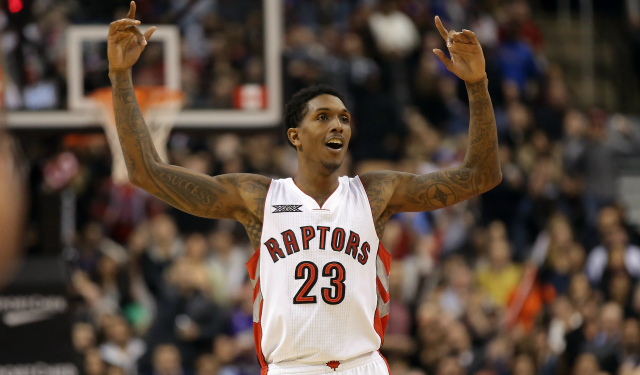
TORONTO — The day Lou Williams was traded to the Toronto Raptors, he spoke to the team’s leaders on the phone. Kyle Lowry and DeMar DeRozan were excited to play with somebody who could score off the bench, and they wanted to welcome him. Lowry said he expected Williams to be the team’s sixth man and to average 15 points per game.
Williams was coming off a difficult season. He’d averaged just 10.4 points per game in 2013-2014, his lowest mark since his second year, and he was acquired for next to nothing — his hometown Atlanta Hawks sent him to Toronto along with project big man Lucas Nogueira for a second-round pick and John Salmons, who they waived shortly thereafter. While Lowry and DeRozan were well aware of what he was capable of at his best, there were doubts around the league about whether or not he’d ever be as effective as he was before he tore his ACL.
“Nobody kind of knew what he was going to bring to the table,” Raptors head coach Dwane Casey said. “Whether it was damaged goods or whatever.”
Casey said this on Monday, shortly after the NBA announced Williams was the 2015 Sixth Man of the Year. The coach also admitted the team would have been in trouble without him. Williams ended up averaging a career-high 15.5 points per game in Toronto, subsisting on a steady diet of 3-pointers and free throws. He’s been immortalized in song — Raptors global ambassador Drake’s “6 Man” — and is beloved by his teammates, one of the most important players on a playoff team.
It’s easy to forget now that others wrote him off, but Williams hasn’t. When he was working his way back, he needed all the fuel he could get.
“I appreciate all of the people that said I was damaged goods and this and that,” Williams said. “Today is a special day to commemorate everything that I’ve been through.”
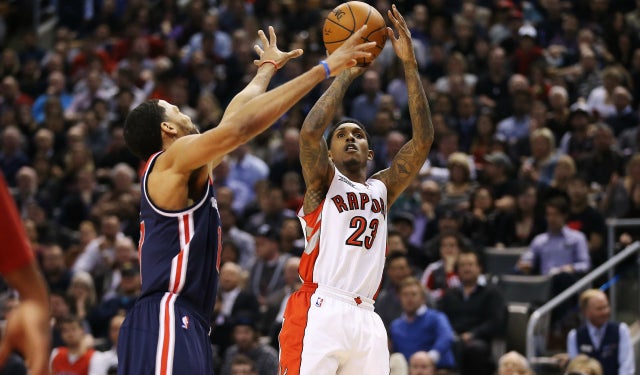
In 2011-2012, Williams finished second in Sixth Man of the Year voting behind James Harden, then of the Oklahoma City Thunder. Williams led the Philadelphia 76ers in scoring despite not starting a single game. He was a free agent that offseason, and after seven seasons in Philadelphia, he signed a three-year, $15.7 million deal to go back home to Atlanta. He planned to be there awhile.
“You have these dreams and these aspirations that everything’s gonna work out,” Williams said. “You’re going to finish your career in front of your home crowd, in front of your family and friends and people that support you along the way. And 39 games in, I tear my ACL.”
It happened on Jan. 18, 2013 in Brooklyn. It was his first major injury. Roger Fleetwood, his coach at South Gwinnett High School, told Williams that night that it was the biggest challenge he’d ever had and he needed to face it head on. Fleetwood added that, when he came back, he’d be even better than before.
Fleetwood used to pick Williams up and take him to school every day. In the car, he taught a scrawny freshman Williams everything he thought he should know about leading a team full of seniors. He became a mentor and a father figure, and still is. After the injury, though, no words of encouragement could make the road back a smooth one.
“It was scary,” Williams said. “Once I tore my ACL, I said early on that was the closest I felt to retirement. You don’t know what’s ahead — the fear of not knowing, as people say. I didn’t know what kind of player I’d be.”
Williams missed the remainder of the season and the start of the next one, sitting out of training camp under new Hawks head coach Mike Budenholzer. When he finally came back, he couldn’t beat people off the dribble and dunk like he used to do so easily.
“I can’t jump, I can’t run,” Williams said, laughing. “Those are two very important things in basketball.”
His minutes and his production both fluctuated, and it wasn’t surprising that he was traded. The odd thing, on the outside at least, was just how little Atlanta got in return. Heading into the last year of his contract, it was essentially a salary dump.
“I never really looked at it like that because Johnny [Salmons] is a personal friend of mine,” Williams said. “I’ve heard that so many times, like, ‘Is that it?’ And for me it’s different … I was just happy that I was in a position where I could go to a team that could use me.”
notice the song playing in the background haha. Thanx for the love everyone #iwantitall
A video posted by Lou Williams (@louwillville) onApr 20, 2015 at 9:33am PDT
Williams smiled as soon as the subject came up. The subject, of course, being “6 Man,” the song that name-drops the combo guard and his high school as soon as it begins.
“I didn’t know it was this big of a deal,” Williams said. “It speaks volumes about how this city and the people in this town have really embraced me as one of their own. I’m appreciative of the song. The song is cool. I have a soundtrack to go with the award now.”
It didn’t take long for Williams to feel comfortable and accepted in Toronto. On Nov. 22 in Cleveland, he came off the bench halfway through the first quarter, the team already down by 15 points. He scored a few quick points, and his teammates started forcefeeding him, telling him, “Just go, just go.” He kept making shots, even when the Cavs switched LeBron James onto him.
The end result was a career-high 36-point performance and a 17-point win. Williams called it a turning point in his season because he knew what was expected of him. He knew his teammates trusted him and wanted him to be himself. Drake posted three separate photos of Williams to Instagram that evening, and Williams won Eastern Conference player of the week a couple of days later. That’s when he established himself as the early favorite for Sixth Man of the Year.
“Drake got it right,” Toronto forward Patrick Patterson said. “He made a song for a reason. He predicted the future.”
Williams has a 27 percent usage rate with the Raptors, and if he’s on the court in an end-of-quarter or late-shot-clock situation, you can expect the possession to end with him shooting. There’s no bitterness about that, though, perhaps because of the composed way in which he carries himself.
“Lou Will is the coolest dude in the world,” DeRozan said.
He remembers looking up to Allen Iverson while a high schooler, then teaming up with him as a rookie and seeing him play through pain. He remembers Kevin Ollie grabbing him after practice and telling him to put in extra work. Now Williams is the man Casey calls an “old head,” and he’s enjoying going to his teammates’ houses to watch games. He’ll be a free agent this summer, and he doesn’t want to go anywhere.
“That would be ideal for me,” Williams said. “Just the culture that they're building here, just the identity that this team and this town has, I really want to be a part of it. I look forward to it. I don't want to say hopefully we get something done, I'm really positive that we will get something done. I don't see why not.”
Before he played a game for Toronto, he had a conversation with Fleetwood, who proved as prescient as Drake. Williams’ high school coach told him in September that he was about to have the best year of his career. He knew that Williams would do whatever it took to show people he could still play at a high level. Winning Sixth Man of the Year more than proves this, and for that reason, it wouldn’t have been the same if he’d earned the honor three years ago.
“It means tons more now,” Williams said. “To win it in my first year in Toronto, to win it right after being traded and to go through so much adversity, timing is everything. If I was ever going to win it, I think this is the perfect time.”