Shot blocking, goaltending and the NHL's goal-scoring problem
Most of the NHL's playoff games feature just four or five goals. This is viewed as a problem. What can be done to fix it?

By
Adam Gretz
•
10 min read
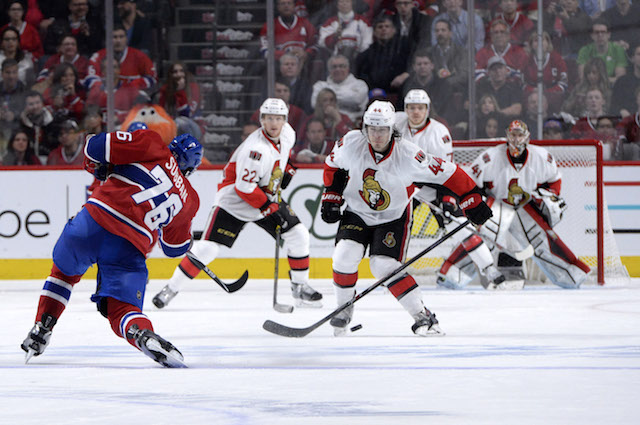
The 2015 Stanley Cup Playoffs have been one of the lowest-scoring postseasons in NHL history.
How bad is it? The average game has just 4.92 goals, a significant drop from the 5.47 mark in the regular season that was viewed as a continuing problem.
Of the 70 games that have been played through Sunday, 24 have finished with the winning team scoring only one or two goals. There were only 15 such games last postseason (for the entire postseason. We still have nearly two full rounds to go this year).
The overwhelming majority of those games have involved teams in the Eastern Conference (21), with the New York Rangers alone being involved in 10 of them, including seven games that they have won by a 2-1 score (plus two others they have lost, and a 1-0 game they lost).
Not surprisingly, this is not a popular development in the eyes of NHL fans and observers.
And that is understandable. We want to see the best players do what they do best, and just because games are close (and the majority of the games this postseason have been close) it does not always mean it is an exciting brand of hockey or a visually pleasing game to watch.
But is there anything the NHL can do to fix this?
First, let's examine the "problems," starting with the biggest perceived issue.
Shot blocking
One of the most common talking points in recent years when it comes to the NHL's scoring decline is the increased emphasis on teams packing their defense in around the net and blocking shots.
It is true that teams are blocking more shots in the NHL today than they did even as recently as 10 years ago, and it is not just about the raw number of blocked shots.
During the 2014-15 season 28 percent of the total shot attempts during 5-on-5 play resulted in a blocked shot. Compare that to the 2005-06 season, the season that was probably the last great goal-scoring season in the NHL when the league attempted to open up the game coming out of the 2004 lockout, when only 25 percent of the 5-on-5 shots attempts resulted in a block.
It's a definite increase.
But is it enough to account for seemingly every playoff game in the Eastern Conference resulting in a 2-1 final score?
And more importantly, why is it becoming such a popular strategy?
Two reasons come to mind.
First, there is little doubt that several coaches and teams around the league are far too conservative and risk averse when it comes to the playing style of their teams (like, say, the Montreal Canadiens) and are not maximizing the talent on their roster as much as they might be able to.
You see it all the time when it comes to roster decisions and team construction where it seems teams would rather lose because their players are trained to make the "safe" play and get beat because they're simply not skilled enough, than get beat because somebody tried to make a play by being a little overly aggressive. It's why skill players get stapled to the bench or assigned to the press box as healthy scratches because they turned the puck over trying to make a play, while lesser skilled players who don't have that ability never seem to take a fraction of the blame their more skilled and aggressive teammates take. Their mistakes aren't as obvious, so they get overlooked.
The other reason a team might choose to go down that path: Necessity. In a 30-team, salary-cap league, the talent is going to be spread throughout the league and some teams just aren't going to have the horses to match up with better teams. So they have to do what they can to improve their chances to win games. Sometimes that means collapsing around the net, packing the defense around the crease, and trying to slow the game to a crawl and hoping the one or two game-deciding bounces go your way (see also: The 2014-15 Calgary Flames).
But there are exceptions, and those are the teams we -- and every other team in the NHL -- should be paying attention to and trying to model. Those exceptions are the teams that tend to go deep into the playoffs, compete for the Stanley Cup and ultimately win the Stanley Cup. Some of them are still playing right now this season.
Teams that win in the playoffs tend to finish near the bottom of the NHL in hits and blocked shots because those teams typically have the puck more than their opponent and are not in a position where they have to block shots and deliver body checks. Puck possession matters. It leads to shots, which leads to goals, which leads to wins.
What is interesting about the recent champions is the way they play when they do have to defend.
Shot blocking still isn't a major part of their playing style.
Consider that since the start of the 2011-12 season the Chicago Blackhawks and Los Angeles Kings, the two most successful teams -- by far -- over that stretch, are near the bottom of the NHL when it comes to shot blocking. And again, it's not about raw numbers. It's about the shots they do face.
The Kings, known as a "defensive" team, have blocked only 23 percent of their opponents' attempted 5-on-5 shots during the regular season over that stretch, the third-lowest mark in the NHL (only the Detroit Red Wings and Ottawa Senators blocked a lower percentage).
The Blackhawks are 20th, having blocked only 25 percent of their opponents' attempted shots.
Those two teams are also two of the best when it comes to avoiding the defensive shell teams go into when protecting leads and continuing to keep up their attack. When teams go up by two goals they tend to get badly outshot. The Kings and Blackhawks are not only exceptions in that regard as well, they are the top two teams in the league when it comes to controlling the pace of the game when leading by two goals. The Kings are the only team in the league that actually continues to outshoot their opponents when leading a game by two or more goals. The Blackhawks are just off of that pace.
The bend but don't break mindset that teams take when it comes to packing their defense in around their net will only take them so far.
In the end, talent still wins out, and you can't try to defend a lead by sitting on it. Eventually you have to try to build on it.
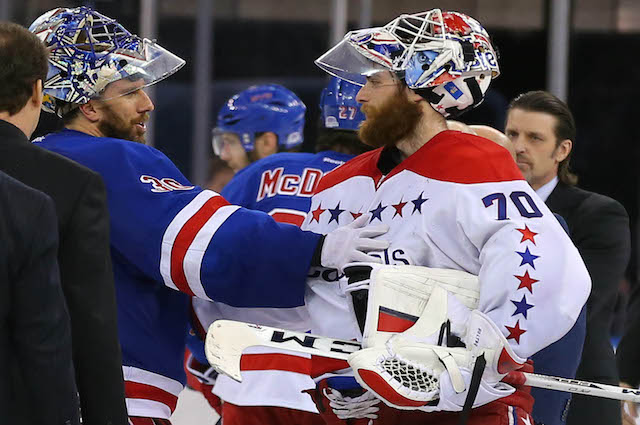
Goalies today are really, really good
And this is something that probably does not get enough attention when it comes to the decline in scoring, and that's unfortunate because it is probably the single biggest factor.
Not to mention the most obvious.
Is that 3 percent increase in shot blocking over the past 10 years really enough on its own to cut nearly two goals per game off of the NHL's pace? Probably not. Especially when the guys in the crease that are the last line of defense for their teams are better than ever before.
And they're not only better, they're also bigger. In every possible way.
Watch an NHL game from the 1980s or early 1990s and pay attention to the goalies. They're small, both when it comes to their size and their equipment. Their playing styles are different. The quality of play from the position is just ... bad.
There are very few bad (by NHL standards, anyway; everybody in the NHL is "good") goalies in the league today. Nearly every team in the NHL has at least competent goaltending and there is not much to separate them from one another. You have a couple of guys that are clearly at the top, a couple that are clearly at the bottom, and then probably 25 goalies in the middle that are all really, really good.
The league average save percentage in the NHL this season was .915, the highest it has ever been. Ten years ago there were only eight goalies in the league that finished with a save percentage of .915 or better. There were 22 in the NHL this season.
They're bigger physically, they're more athletic, they have better coaching specific to their position and their equipment is massive.
There simply isn't a lot of net to shoot at.
What are the solutions? Are there solutions?
Let's begin with everybody's favorite solution that might not even be one: bigger ice.
The thinking is more room on the ice will create a more free-flowing, wide-open game with more chances, more goals and a better product.
Every four years at the Olympics (and for a couple of weeks every May when we have a passing interest in the World Championships) this gets talked about so much that we actually start to believe this crap is real. It happened again on Sunday as Canada was scoring goals with ease against Russia in the gold-medal game of the World Championships.
It is the biggest myth in hockey.
Any increase in scoring that comes from international play on the larger ice surface is the result of two things.
1) Many of the teams are All-Star teams, made up of the best players from some of the best hockey countries on the planet. They are collections of talent that could never be assembled in the NHL for any number of reasons.
2) Those All-Star teams on occasion get to play against the likes of Latvia and Belarus and put up seven or eight goals against a team that might have one or two NHL players on it. If they are lucky.
That is where your increase comes from.
When the big-seven international teams (Canada, United States, Sweden, Finland, Russia, Czech Republic and Slovakia) play against each other, especially when the games really count in the medal round, there is an undeniable fact that always gets overlooked: They don't score! And not only do they not score, the games really aren't that interesting.
NHL players have been participating in the Olympics since 1998, and other than the 2010 Games in Vancouver, all of those tournaments have been played on the larger ice surface.
There have been 48 quarterfinal, semifinal and medal games played during those tournaments. The average goals per game in those games is 5.1. Keep in mind that the NHL averaged 5.46 goals per game during the 2014-15 regular season.
The aforementioned big-seven teams have played 63 games against each other (round-robin and medal round) during those Olympics. The average goals per game in their head-to-head meetings: 4.80.
That is worth repeating.
Four. Point. Eight. Zero.
The final scores of the gold-medal games in the five Olympics with NHL players have been 1-0, 5-2, 3-2, 3-2 and 3-0.
That is 4.2 goals per game.
Big ice isn't the answer, especially if the goalies and the target players are shooting at remain the same size. And if you don't like watching teams pack their defense around the net to clog shooting lanes, imagine what it looks like when they do the exact same thing on a larger ice surface and the perimeter shots are coming from even further away from the net and from worse angles.
So what is the answer?
For the NHL: Bring back the power play. We already examined this earlier this season when we looked at how teams are getting fewer power plays and, ultimately, scoring fewer goals. Enforce the interference that takes place through the neutral zone as players get tackled and hauled down when trying to make plays. The power plays lead to more chances and the threat of a penalty opens things up for more skill and creativity through the neutral zone. And if you're going to change the size of anything, look at goalie equipment or the area they are defending.
For the coaches: Trust your players. Please. If you have Max Pacioretty and P.K. Subban, don't ask them to chip the puck off the glass and play a safe game. Let them use their skill to make a difference.
And for general managers: Please -- please! -- continue to place a greater emphasis on skill and creativity over size and strength, especially when it comes to your "role" players. You're getting better. But there is still room to improve. The league gets blamed for a lot of the scoring woes right now, and the way obstruction has been allowed to creep back into the game definitely plays a role, but roster construction and coaching strategies are a significant issue as well.
Perhaps the biggest issue.