

What went wrong for the 2014-15 Sharks, and is there time to fix it?
The San Jose Sharks could miss the playoffs for the first time in 10 years. Where did it all go wrong?

By
Adam Gretz
•
4 min read
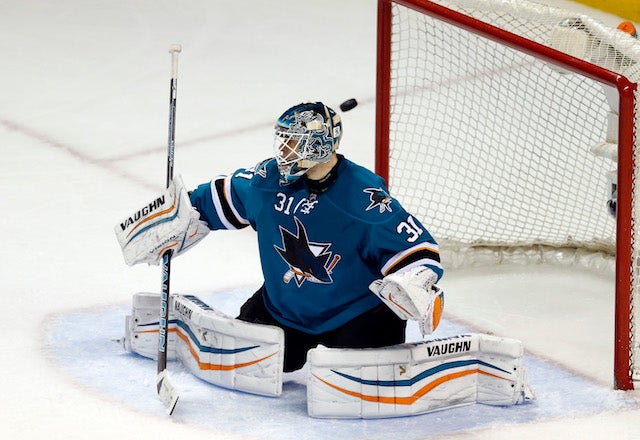
The San Jose Sharks have been a constant in the NHL playoffs for more than a decade, qualifying in 15 of the past 16 seasons, including each of the past 10.
Unless something drastic changes over the next month, that streak is going to end.
Entering Monday's game against Pittsburgh, the Sharks are five points out of a playoff spot and have to play 10 of their remaining 16 games on the road. The closest team that the Sharks can still catch at this point is the Calgary Flames for the third spot in the Pacific Division.
Calgary is on pace for roughly 96 points and has more regulation and overtime wins than the Sharks to own the first tiebreaker. So if you go with the assumption that San Jose needs 97 points to get in, that would require a 12-3-1 record the rest of the way. Given their schedule (not only the road games, but the fact their remaining schedule includes two games against Pittsburgh, and then one each against Nashville, Chicago, Montreal, Detroit, Winnipeg and Los Angeles) that seems like a nearly impossible task.
So where did it all go wrong for the Sharks, a team that still has plenty of star power and a core that should still be good enough to be, at minimum, a playoff team?
The Sharks have been a bizarre case since last season's first-round playoff loss to the Kings in which they allowed a 3-0 series lead to slip away, starting Los Angeles on its run to a second Stanley Cup title in three years. There were trade rumors involving their top two players (Joe Thornton and Patrick Marleau) for most of the season. Then they decided that Thornton would no longer be their captain following a quiet offseason. The Sharks' only moves of any consequence involved trading defenseman Brad Stuart for draft picks, signing enforcer John Scott and moving Brent Burns from forward back to defense, where he has struggled mightily at times in his own end of the ice, especially recently.
But even with what can be described as, at best, an unproductive offseason and a slow start, it still wasn't all bad for the Sharks. The Sharks won eight out of nine games in December to skyrocket up the standings. As recently as Feb. 1 San Jose was 27-17-6, the fifth best record in the Western Conference, and was in second place in the Pacific Division, comfortably in a playoff spot sitting six points ahead of the first non-playoff team.
Even if they weren't a top Stanley Cup contender, the Sharks seemed to be at the very least a lock for the postseason.
And then the past 16 games happened.
Since Feb. 1 the Sharks have managed to win just five games, falling five points out of a playoff spot, and have been passed by five teams (Vancouver, Calgary, Winnipeg, Minnesota and Los Angeles) in total points.
Anytime a team loses -- especially when it is a team like the Sharks -- the blame always finds a way of coming back to the top players on the roster, and a lot of times that is not always fair. And that is still somewhat true now because the big guys, especially Joe Pavelski and Thornton, are still creating offense (Pavelski has 18 points in his past 16 games, Thornton has 16).
In general, the Sharks are still scoring what should be enough goals to keep winning.
The biggest problem has been goal-prevention, where San Jose is 24th in the league since Feb. 1 (50 total goals against).
Part of that has to fall on their goaltending, where starter Antti Niemi has been only average at best and his backup, Alex Stalock, has completely fallen apart after a promising rookie season a year ago. We already know what type of impact goaltending can have, and the Sharks are starting to find out that themselves.
Another big part has to fall on the penalty kill -- a unit that lost a key member during the season when Jason Demers was traded to Dallas for Brenden Dillon -- which has killed off just 31 of its past 43 penalties, a success rate of just 72 percent. Keep in mind that the worst penalty-killing team in the NHL is Buffalo having killed off 74 percent its penalties. When it comes to team success the penalty kill is one of the most important factors that goes into whether a team wins or loses, and when the NHL is handing out only a handful of penalties per game (and goal-scoring is as low as it is) you simply can't be be giving teams goals in those situations.
And the Sharks have been. A lot of them.
The difference between the current penalty killing rate for the Sharks and even an above average penalty kill is probably only five or six goals over the past 16 games. But if you think that is not a big difference, just consider that during this current slump San Jose is 0-4-2 in one-goal games. Their PK allowed at least one goal in four of those losses and was only 78 percent in those six games as a whole.
All of these things, plus a little bit of bad luck, have played a role in what almost certainly seems to be the end of San Jose's run of playoff appearances.
And just as was the case after their postseason disappointment against the Kings, the intrigue will be in how the front office responds.
There is still a solid core in place here that should still be good enough to compete, and with better goaltending and some work around the edges (and maybe getting Burns back to forward, where he seems to be a better player at this point in his career) they could still be at that level.