

Why the Coyotes can survive and eventually thrive in Arizona
The Arizona Coyotes have had everything going against them this summer, but instead of seeing this as the beginning of the end, it could be the turning point the franchise needs.

By
Chris Peters
•
6 min read
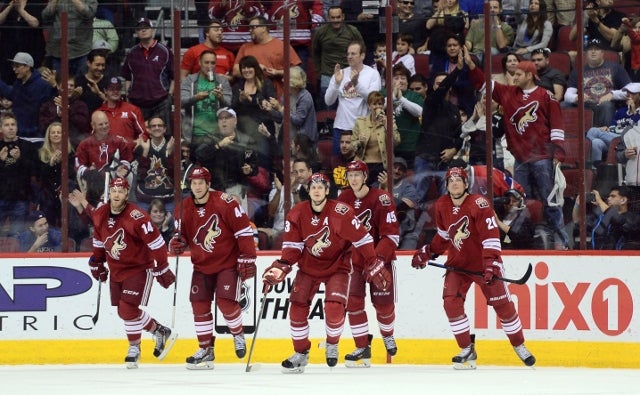
If you are an Arizona Coyotes fan, you deserve far more credit than you do ridicule. It means you’ve sat through seemingly constant uncertainty tied to a litany of failed ownership groups, continual diatribes from those outside of the market about how it doesn’t deserve a team and there’s also been some bad hockey with no playoff berths since 2012, and you're still standing.
On top of all that, the city of Glendale successfully voted to void the lease agreement with the Coyotes' ownership group earlier this summer. The two sides eventually settled out of court with a new two-year lease agreement that is much friendlier to the city than the previous deal.
All that happened this summer has only provided more fuel to the relocation speculation, and it’s hard not to understand that.
That said, Coyotes ownership has remained defiant. They are probably already blue in the face from repeating their strong desire to keep the team in Arizona.
Maybe they've repeated it enough times, or maybe it's naivety, but eventually people are going to start buying what they're saying.
Despite this being an incredibly tumultuous summer, this may end up being the long-awaited turning point for the franchise. Maybe that seems crazy to say, but there are two key reasons why the Coyotes can still work in Arizona amid so many trials and tribulations, and maybe eventually thrive.
1. An ownership group that remains committed to the market and is willing to fight for its continued existence.
When the City of Glendale voided its lease agreement with the Coyotes, it should have signified the end of hockey in the desert. The ownership could have potentially done a number of things to start the process to use this as their escape pod to another market.
Instead of setting wheels in motion on the caravan out of town, the executives of IceArizona – most visibly, Anthony LeBlanc – dug in.
They came to a compromise with the city on a new two-year agreement that was by no means perfect, but far less burdensome for a cash-strapped city than the previous agreement. The short-term nature of the new agreement doesn’t spark much confidence, but ownership continues to at least say all the right things.
In an interview with Josh Cooper of Yahoo’s Puck Daddy blog, LeBlanc maintained his steadfast belief that the market can support his hockey team and will, whether it be in Glendale or elsewhere in the Valley.
I think we’ve come through [the lease dispute] fine. There’s the mending of the relationship that needs to happen, but that began on the day of the vote a couple of weeks ago. I do think it works here, but look, it’s only a two-year deal. It would be foolish for us to not listen to expressions of interest of other potential spots in the Valley, but we do believe in Glendale. We always have. We think it’s a tremendous hockey arena. This is a great development.
…I can’t sit here and predict what the future is going to bring. I feel we have a group who wants to talk to us and make it work [in Glendale]. But we steadfastly believe in this. Arizona is a terrific hockey market. We hope it’s in Glendale, but we do feel that if it isn’t in Glendale, it’s definitely in the greater Valley.
No one is saying it’s a sure shot it will work, but this is a franchise that has had so many things going against it for so long. The biggest was ownership instability. That seems less and less the case with the current owners.
Maybe this is just lip service from LeBlanc, but actions speak louder than words and they fought to keep the team where it is. The previous deal with Glendale, which caused so much contentiousness, was really not that great a deal for the city. Instead of dragging out a long fight with Glendale, there was legitimate compromise.
All of the reasons that the NHL chose to move a team to Arizona -- the size of the TV market, the large metro population coupled with a large snowbird contingent -- are still there.
A more stable team, more efforts to reach out to the community and eventually a better product on the ice can give the market more reasons to spend its entertainment dollars on hockey. It's on ownership to give them an excuse to do that and LeBlanc certainly seems willing.
2. Hockey in Arizona has never been stronger. No, really.
The Coyotes had an incredibly rough season, but 2014-15 turned out to be a somewhat historic season for the rest of hockey in Arizona. It was historic enough to suggest that there is significant momentum for the sport in the Valley.
One of the most surprising developments during the 2014-15 season was the unprecedented boost in hockey participation in the state. According to USA Hockey, Arizona was the fastest growing state in terms of playing membership last season.
The organization’s membership statistics showed 7,329 registered hockey players for last season, an all-time high. That is up from 4,860 the year before. The large spike is due in part to an increased number of adult leagues registering with USA Hockey that hadn’t previously. However, the really encouraging thing is that participation among players aged 8 and under more than doubled, with 1,100-plus players registered in that age group last season.
It’s not approaching the numbers of more traditional hockey areas, of course, but there is legitimate and sustainable growth in Arizona.
There’s much more than that happening.
Arizona State shocked the college hockey world when it announced last winter that the school would be adding a full-fledged Division I men’s hockey team.
The Sun Devils will be playing as an independent in college hockey next season, with a schedule that features some of college hockey’s historic heavyweights. This isn’t competition for the Coyotes so much as it is supplementation. More hockey in the desert is a good thing when it comes to market penetration, especially when tied to a strong brand like ASU's.
Then there's one more thing, which is more a feather in Arizona’s cap than it is a sign of things to come (unless the draft lottery balls bounce the right way).
Auston Matthews, the projected No. 1 pick heading into the 2016 NHL Draft season, is a native of Scottsdale, Ariz. He was inspired to play the game after going to Coyotes games. It was just announced that the talented 17-year-old who missed this year’s draft by two days is headed to play professionally in Switzerland next year, an unprecedented move for a draft-eligible North American, but indicative of his immense talent.
The Coyotes are probably not going to be very good next year. They might even be bad enough to earn the No. 1 pick next season. Can you imagine the shot in the arm adding a homegrown No. 1 pick that the Coyotes are essentially responsible for getting into hockey? It's a marketing dream.
The big caveat to the potential long-term stability, of course, is that the Coyotes are essentially in a rebuilding situation right now in terms of on-ice product.
The fans that they do have are going to have to be patient and ownership is probably going to have to bite the bullet while the building remains empty for a time. The good news is that the Coyotes’ rebuilding process is well underway and they have some supremely talented prospects in their pipeline that should be making the jump soon.
The possibility of relocation will persist thanks to this short-term lease agreement. The derision from fans in "traditional" hockey markets will continue. Relief will not be immediate, but if ownership holds up its end of the deal and this momentum keeps building, the Coyotes have a chance to prove that all of those fights to keep hockey in the desert finally paid off.