The WNBA is undermining its own product again, but a perception-altering CBA is still within reach
WNBA players still feel like they're fighting for respect

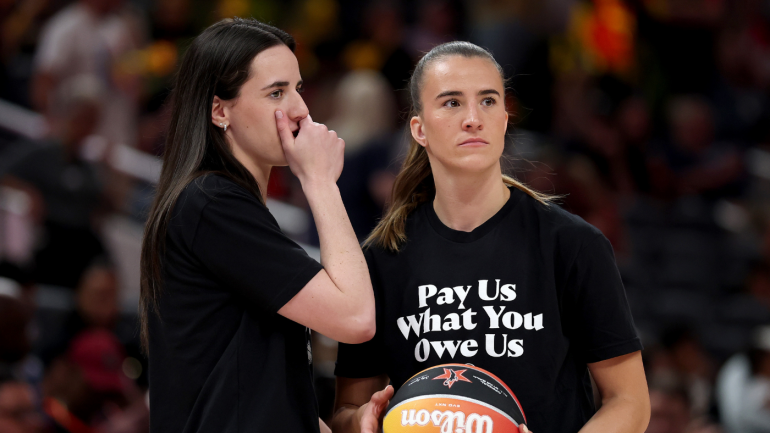
It's been 11 days since the WNBA and WNBPA announced that they agreed to a second extension of the CBA, this one a 40-day extension that moves the deadline, which was once Oct. 30, to Jan. 9. In the days since, both sides have taken their turns using the media as their messengers, turning up the volume on one of the most important negotiations in women's sports history.
The WNBA got the headlines first, with reports that their latest offer included, among other things, a $5 million salary cap, up from $1.5 million; $1 million base max salaries, that would go to $1.2 million with revenue sharing; and a salary structure that includes team and league revenue in the revenue share and yearly pay increases based on the growth of the business, something players have been asking for.
But quickly, the WNBPA let it be known that the WNBA's proposal came with some major downsides for players -- such as an end to housing subsidies and a possible March start to training camp -- and that even though the league was offering revenue sharing, the way they were structuring it would result in players receiving just 10 to 15% of projected league revenue.
This back-and-forth is to be expected in any high-stakes labor fight, and it's somewhat a relief to be finally getting concrete information out in the open after a year of mostly silence from both parties. But, as someone who has covered and studied labor negotiations in women's sports intensively over the last decade, there is something uniquely disheartening about these particular talks. Because it shows that even as the WNBA has grown to a place where billionaires are tripping over themselves to pay $250 million for an expansion franchise, team valuations are surpassing $500 million, there's a $2.2 billion television deal and revenue, and ratings, attendance and sponsorships are booming, the players at the heart of the WNBA are still battling the powers that be in the league for respect and decency.
"I don't feel like there's any cultivation of a culture of trust," WNBPA president and Seattle Storm forward Nneka Ogwumike told the Athletic last week. "We don't feel valued in these talks as they stand today. … I feel like we've been heard, but not listened to. And I'm hoping that that changes in this 40-day extension, because what we want to do is get a good deal done."
The biggest sticking point in this deal is still revenue sharing. WNBA players have always been paid fixed rates, meaning that the salary cap and salary tiers were set in the collective bargaining agreement and increased by a pre-determined fixed percentage year over year -- 3% in the current CBA. The players have been fighting for a different payment model, one that includes a revenue-sharing component that will allow players' salaries to grow, in real time, as the league grows.
The WNBA's current proposal does move in that direction, which is a good thing. But the main dispute now is over what the league is including in the revenue-sharing metric and how much the league is subtracting from the revenue-sharing metric for basic expenses, or what is considered "cost of revenue." It is normal for a small percentage of shared revenue to be withheld for expenses, but the players feel that the league is withholding far too high of a percentage. It is estimated that players will only be making an estimated 10 to 15% of league revenue in the first year of the deal, and that percentage could decrease over the lifetime of the contract. Currently, players make less than 10% of league revenue. In the NBA, players make close to 50% of league revenue.
The WNBA, of course, would point to the unprecedented raises they are offering -- more than quadrupling the max salary and raising the salary cap by $3.5 million -- as proof that they are valuing the players, and the compensation model that ties the salary cap to revenue growth as proof that they are listening. And these are important advancements. But it's easy to see why players are still feeling disrespected, especially when you look at the housing proposal.
Taking away team housing saves the owners very little money overall, but will serve to make life more complicated and costly for the players who should be focusing their energies on the court, not on securing month-to-month leases in crowded cities during an already jam-packed season. At a time when new leagues such as Project B and Unrivaled are popping out of the woodwork and rolling out the red carpet for players, making them feel like superstars, it feels punitive and petty for the league to take an accommodation away.
Despite the skyrocketing business of the WNBA, the league is still signaling that actually, the players aren't worth that much. This is, of course, nothing new. Since practically its inception, WNBA owners have spoken publicly about how much money the league is losing. That messaging has been a self-fulfilling prophecy, something Candace Parker alluded to when she was a guest on the "All the Smoke" podcast.
"Well, obviously, people respect people with zeros at the end of their checks. Let's just be honest. There's a respect element of things when you walk into a room if you have zeros behind your check," Parker said. "And so I feel like in order for the WNBA to be reputable and to be respected, you have to have zeros behind your check. ...And that has crossed the WNBA off the list for a number of years just because of that. That's been the running joke in the comments."
Parker is talking about the undeniable social capital and cultural power that comes with being well compensated, a currency that has been denied to most female athletes for far too long. It is understandable that owners would be fighting for a compensation model that they are comfortable with and that will allow them to continue to reinvest into the league, and it's natural that players will have to make some concessions in the negotiating process. Nobody is arguing for WNBA players to earn NBA money.
But, with this CBA, the WNBA had a chance to not only raise a salary cap, but to fundamentally shift the public perception around the value of female athletes and the business of women's sports in a way that will permanently boost the bottom line for everyone involved.
It's not too late to do just that.