Here's how it would work if MLB postseason was like the college football playoffs
Would the champion Cubs make the cut if a committee determined four teams to make the postseason?

By
Dayn Perry
•
5 min read
How about a meaningless thought experiment tied to the sports news cycle? Yes? So glad that's of interest to you!
Looming is of course the college football national championship game between Clemson and Alabama. The current structure, subject to change depending on sufficient outrage, is such that a field of four teams is determined by committee (this year, Ohio State and Washington have already been given the bum's rush). Via world championship PDF, here are a few notes on how those four teams are to be determined ...
The criteria to be provided to the selection committee must be aligned with the ideals of the commissioners, Presidents, athletic directors and coaches to honor regular season success while at the same time providing enough flexibility and discretion to select a non-champion or independent under circumstances where that particular non-champion or independent is unequivocally one of the four best teams in the country.When circumstances at the margins indicate that teams are comparable, then the following criteria must be considered:
- Championships won
- Strength of schedule
- Head-to-head competition (if it occurred)
- Comparative outcomes of common opponents (without incenting margin of victory)
There you have it. Obviously, these are more guidelines than hard-and-fast mandates, as the presence of non-Big Ten champs Ohio State in this year's four-squad hootenanny will attest.
This provides us the opportunity to ask a question that you yourself were almost certainly not asking: What if MLB structured its postseason in such a manner -- i.e., by using a committee to select four teams? Obviously, this would differ greatly from the actual format, in which six division champs and four wild-card entrants are determined by regular season record.
The initial matter at hand is how best to translate the criteria above to MLB terms. We'll save division titles -- the MLB variant of conference championships -- matter. Since we're in the era of the unbalanced schedule and interleague play, we get some divergence in terms of schedule strength, so that will count. Head-to-head competition can matter for some close calls for the final spot and perhaps for seeding. Comparative outcomes, meantime, is a bit too much of a thicket to wander into given the breadth of baseball's slate, so we'll pass on that one. In its place, we'll look at run differential. That's sort of like margin of victory, which the NCAA likes to pretend doesn't matter, but we all know it's a factor, as it should be. The bald reality is that dominating an opponent is more impressive than squeaking by, and this surely isn't lost on committee members. Also, we're not ensuring that each league is represented equally, so if it winds up as two NL teams and two AL teams that's not because of contrivance.
And now for the grand reveal, in order of seeding ...
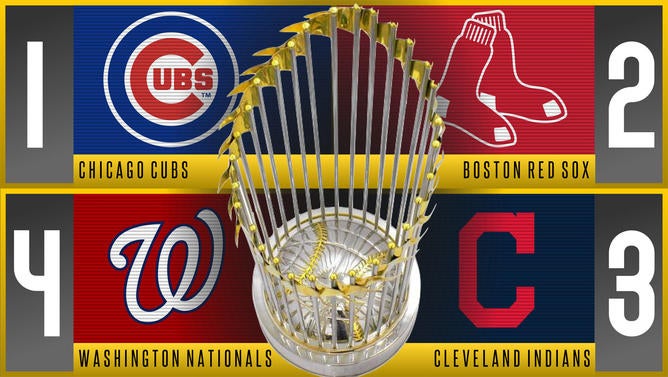
No. 1 seed: Chicago Cubs
Not shocking! The Cubs didn't not play a particularly difficult schedule, but they posted the best record in baseball by a full eight games over the Rangers and Nationals. To boot, the Cubs authored an incredible +252 run differential, which means that at the runs scored-runs allowed level, they played more like a 107-win team. That's dominance, and that helps secure them the top overall seed in our four-team playoff.
No. 2 seed: Boston Red Sox
The Red Sox won 93 games in 2016, which is "merely" good for fifth in MLB. However, their run differential was second to only the Cubs and scaled to a 100-win team. As well, the Sox played one of the toughest schedules of all, which is a function of toiling in a division that yielded three playoff teams and four winning teams. Given their tough slate, division title, and underlying strength, the Red Sox claim the two seed.
No. 3 seed: Cleveland Indians
Here things get tough. The Tribe won 94 games last season, but their opponents' average winning percentage ranked next-to-last among AL teams. As well, they slightly underplayed their record when it comes to run differential. Just nudging them ahead of the No. 4 seed is that they managed to win their division, which, as noted above, counts for something.
No. 4 seed: Washington Nationals
Yes, this is a controversial selection and one that's bound to earn our nonexistent committee some grief. For our final spot, the Jays, Orioles, Rangers, and Nationals are in contention. The Jays in 2016 played the sixth-toughest schedule in all of baseball, ahead of the Rangers (13th) and Nationals (23rd). They also won 89 games and had the run differential of a 92-win team. As well, they had winning records head-to-head against the Orioles and Rangers and out-scored them by a combined 34 runs in those games. The O's have the schedule in their favor (third-toughest), but they have the run differential of an 84-win team. As for the Rangers, the schedule doesn't compare favorably to the AL East teams of note, and their run differential was a modest +8 -- far from what a 95-win team should do.
The tough call is the Nats. They won 95 games and the division title, and their run differential is that of a 99-win team. While the schedule is not in their favor, consider the real difference: The Jays -- the runner-up -- on average played an 82-win team each game. The Nats, on average, played an 80-win team each game. That's not a huge difference. Such is the nature of MLB's schedule. On the other hand, you can frame it this way: The Nats played 60 games against teams .500 or better, while Toronto played 103 such contests. That certainly makes it sound like more of a demerit for the Nats. In the end, though, the Nats' record, run differential, and division title outweigh the schedule considerations that make Toronto's case. But it's close call.
Elsewhere, the other three NL playoff teams -- the Mets, Dodgers, and Giants -- get dinged for weak schedules and modest win totals (modest as playoff team go). The best case for a team that didn't make the postseason in real life? It's probably the Mariners. They ranked 12th in strength of schedule, had a +61 run differential, and just missed a wild-card berth.
So what do you, gentle reader, think about all of this? Specifically, if granted plenary powers to determine a four-team MLB playoff field for the season just behind us, which four teams would you choose? Yes, you've been given the correct answers above, but the freedom to be wrong is an important freedom.
Preemptive strike: Commenters inclined to say they just wasted x minutes of their lives consuming this piece of internet content should interrogate those lives and determine whether they would've otherwise done anything of note.