
Lou Henson, legendary former Illinois and New Mexico State basketball coach, dies at 88
Henson amassed nearly 800 career wins and led two programs to a Final Four

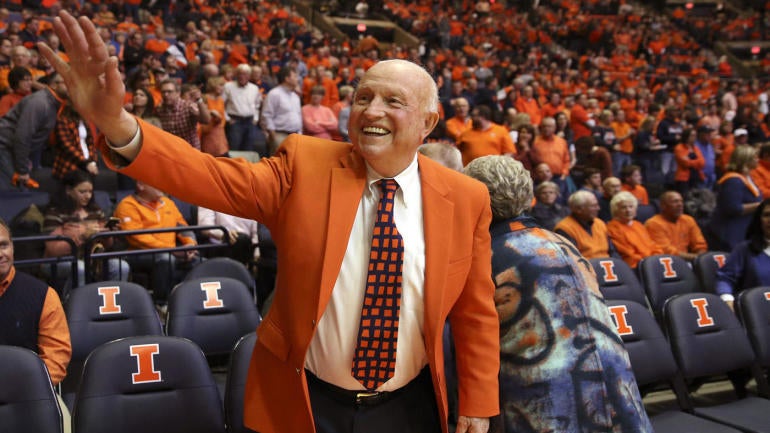
Hall of Fame basketball coach Lou Henson died at his home in Champaign, Illinois, on Saturday, July 25. He was 88 years old.
Henson retired in 2005 as the winningest coach in program history for both Illinois, where he coached from 1975-1996, and New Mexico State, where he coached from 1966-1975 and 1997-2005. His retirement in the midst of the 2004-05 season was prompted by a battle with non-Hodgkin's lymphoma.
Henson won 423 games with Illini and 289 with the Aggies, and he was enshrined in the College Basketball Hall of Fame in 2015. The basketball court at the Pan American Center at NMSU is named in his honor, as is the State Farm Center's floor at the University of Illinois.
"Our Orange and Blue hearts are heavy," Josh Whitman, the Illini's athletic director, said Tuesday. "We have lost an Illini icon. We have lost a role model, a friend, and a leader. We have lost our coach. Coach Henson may be gone, but the memories he provided us, and the legacy he created, will last forever."
Henson led the development of Illinois into a basketball powerhouse in the Big Ten, accumulating a 423-224 record that included a conference championship in 1984 and a Final Four appearance in 1989. He also led NMSU to a Final Four in 1970 and won a Big West regular season and postseason title in 1999 -- the season in which he most famously coached on a $1 per month salary after agreeing to return to the school as interim coach on the heels of Neil McCarthy's ouster. He earned back the job (and a more hefty salary) on a full-time basis after that season.
Henson was born and raised in Okay, Oklahoma, and began his college career as a player in 1951 for Connors Junior College in Warner, Oklahoma. He transferred to New Mexico State in 1953, then known as New Mexico A&M, where he finished his playing career. It's the same state where he jumpstarted his coaching career at Las Cruces High School before going on to coach at Hardin-Simmons, where he insisted that he would only take the job if the team he coached (and the university he thereby associated with) racially integrated itself.
"When I was contacted by Hardin-Simmons, I said no," Henson told the Champaign News-Gazette in 2010. "But eventually I agreed to meet with the board, and I told them I'd consider it if they would allow me to integrate the team. I told them there was no way we could be successful if we couldn't recruit Black players. The board met the next morning and agreed, and I took the job."
Henson coached at Hardin-Simmons from 1962-1966 before landing back at his alma mater New Mexico State.