Fantasy Baseball: Were expectations too high for Kyle Schwarber?
Kyle Schwarber has been a big disappointment in the early going. What's gone wrong for the Cubs' big slugger?

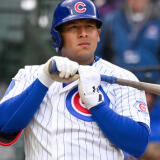
It took more than a month, but Kyle Schwarber finally got his first appearance at catcher Monday. He went behind the plate for two innings of Chicago's blowout loss to the Phillies -- with fellow catchers Miguel Montero and Wilson Contreras manning first and third base -- putting him on a path toward potentially receiving catcher eligibility at CBSSports.com.
Schwarber's potential eligibility behind the plate was viewed as a plus, but not a necessity to make him Fantasy relevant coming into the season, of course. Schwarber's bat was expected to play anywhere, so even if he was just outfield eligible all season, he should have been a solid value, with the potential for elite production if everything clicked. However, after a supremely disappointing start to the season, is it fair to wonder if Schwarber needs catcher eligibility to even be worth starting?


To date, Schwarber hasn't been worth starting as an outfielder, ranking 69th in Fantasy points at the position, and 95th in Rotisserie scoring. Neither of those rankings comes even close to being a starting-caliber player in standard Fantasy leagues, although he would rank sixth in Fantasy points at catcher. He would also rank 16th in Roto scoring at the position, making him a starter -- albeit hardly the star we hoped for. And, that's at a catcher position that has been hugely disappointing top to bottom, with the consensus top three of Buster Posey, Jonathan Lucroy and Gary Sanchez failing to live up to expectations so far.
Even hitting .196/.322/.330 with three homers in 25 games, Schwarber would still be better than most of the field at catcher. However, this was a player you were drafting as a no-doubt-about-it starting outfielder in the sixth round, on average, coming into the season. He needs to clear a much higher bar than "Better than Welington Castillo" to justify his draft position. Is there still hope for that moving forward, or were expectations just too high for Schwarber coming into the season?
There's no doubting Schwarber's talent with the bat, even while he's struggling. He has huge raw power and a good eye at the plate, evidenced by his 13.9 percent walk rate. When he makes contact, the ball tends to go a very long way; he ranks fourth in the majors in average home run distance so far. The issue is that he just isn't making enough contact, and hasn't been consistent in making good contact when he has.
Schwarber has struck out in 30.4 percent of his plate appearances to date, though that shouldn't come as much of a surprise. He struck out 28.2 percent of the time as a rookie in 2015. You can live with that when he hit 16 homers in 69 games, just like you can live with it when Giancarlo Stanton or Miguel Sano strike out that often. Strikeouts are always going to be a part of Schwarber's game, but he hasn't done enough so far to make up for them.
With the caveat that batted-ball data is more descriptive than predictive at this point in the season, there still isn't a whole lot promising to take out of Schwarber's production in the early going. He has just a 14.8 percent line drive rate and 29.0 percent hard-hit rate, putting him in a tie with teammate Ben Zobrist for 122nd in baseball. His Statcast data isn't much better because Schwarber's average exit velocity of 85.3 mph ranks 162nd out of 191 batters with at least 50 batted balls tracked.
One potential answer in the early going is Schwarber's batted ball distribution. He was a pull-heavy hitter as a rookie, with 46.8 percent of his batted balls hit to the pull side, compared to just 21.2 percent hit the other way. He has a more even distribution so far, with just a 35.5 percent pull rate, and it's fair to wonder if Schwarber is limiting his upside by changing his approach at the plate. Trying to beat the shift can be smart, but it can also be self-defeating if you make too much of an effort to go against what made you great in the first place. Trading singles to left field for doubles to right isn't going to make Schwarber the star hitter we expected.
Even beyond all of this, however, there is one much bigger concern for Schwarber, and it could be what ultimately sinks him -- his platoon splits. Schwarber has hit just .159/.266/.293 in 94 career plate appearances against left-handed pitching, with a whopping 40.4 percent strikeout rate. He has actually been a bit better against lefties so far this season than last, but it's just 33 plate appearances. And, he has struck out and swung-and-missed more often vs. LHP than righties, so I'm not sure that is a trend I would expect to continue.
At this point in his career, it remains fair to wonder if Schwarber is capable of being an everyday player without a platoon. That wouldn't be quite as a much of an issue if he was playing catcher -- or at least eligible for your Fantasy team there -- because off days are expected and priced in for most players. However, the bar is obviously quite a bit higher in the outfield.
You don't want to bet against a player with Schwarber's pedigree and talent after a slow start, because a good week could wind up changing the narrative entirely. However, the 115 plate appearances we've seen of him this season represent nearly 30 percent of Schwarber's career plate appearances, so we can't disregard it like we can with some other players.
Either way, it would obviously be a big help if he could get that catcher eligibility. Because, while you could justify keeping that bat in the lineup at that position, it's getting hard to justify Schwarber's place in your Fantasy lineup at this point. Of course, if he keeps hitting like this, the Cubs may not have much incentive to get his bat in the lineup, even at catcher. Let's hope he turns things around.