Rory McIlroy turns 33: Examining what could lie ahead using Tiger Woods, Phil Mickelson as blueprints
There still is much to accomplish going forward for the four-time major champion

By
Kyle Porter
•
5 min read
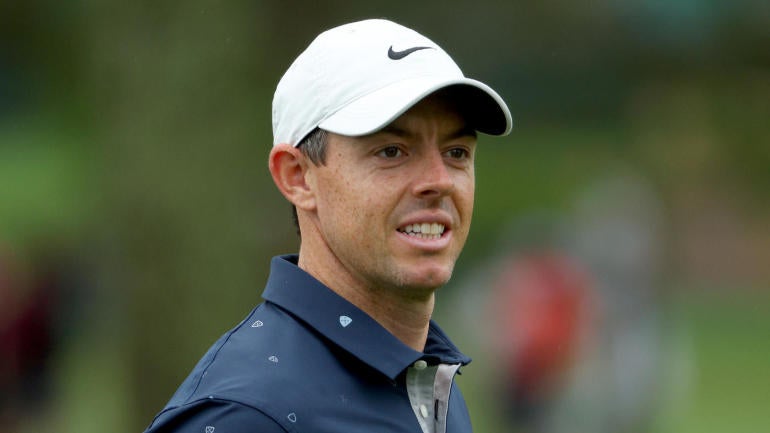
At the Wells Fargo Championship on Wednesday, Rory McIlroy sat down for his pre-tournament press conference as last year's champion and this year's favorite, and a reporter wished him happy birthday. "Thank you," said the now-33-year-old McIlroy with a smile. On Thursday, he'll tee it up at TPC Potomac looking for his 21st PGA Tour victory and, more importantly, he'll do the same in two weeks at Southern Hills seeking his fifth major championship.
We love to talk about majors in golf, so let's talk about Rory's majors. Four at the age of 33 is a haul, even if his eight-year drought makes it seem like it's not. Only 29 golfers have ever won at least four majors, and with how much parity there is in championship golf right now (12 different golfers have won the last 13 majors), that's not likely to change by a lot over the next few decades. The only active players who have more majors than McIlroy are both mononymous -- Tiger Woods has 15, Phil Mickelson has six. While McIlroy will likely never achieve the transcendence of Tiger or the longevity of Phil, both are still important harbingers for him because their 33rd birthdays represent a bifurcation of McIlroy's potential future.
When Mickelson turned 33 in the summer of 2003, he had yet to win a major. He had 17 top-10 finishes at the four big ones, including two runner-up showings at the U.S. Open and three straight thirds at the Masters, but his destiny at the time was anything but secure. Considered too cavalier with his chances and too impromptu with his choices to win a proper golf championship, there was existential doubt about whether he would ever get it done. Then he won two of the next three Masters and six majors total in the next 17 years. Only 11 golfers have ever won more.
When Tiger turned 33 just after Christmas 2008, it seemed like he had yet to lose a major. That was the year of his extraordinary playoff win over Rocco Mediate at the U.S. Open -- the one where he made it seem as if winning while healthy had become too easy, so he dialed up the degree of difficulty to a Simone Biles level just to prove his legacy. To that point in his professional career as a 33-year-old, he had played in 46 majors and won 14 of them. He had finished in the top 10 an astounding 29 times. He would go on to win just one more, though: his miraculous victory at the 2019 Masters.
These are obviously not the only two paths, but they are the most interesting. McIlroy is talented enough to win a handful of majors at 33 and beyond, though whether that's a Brian Harman-sized handful or a Brian Urlacher-sized handful remains to be seen. Golf has a way of getting complicated as you get older, and not just in the ways it got complicated for Tiger.
The spoils of major championship golf often go to the fearless, the unperturbed and those who are too naive to know not where trouble exists but rather that it exists at all. This week's Wells Fargo Championship is being played down the road from the site of McIlroy's first major win, the 2011 U.S. Open at Congressional. He was 22 then and impervious to the way life makes us more conservative as we get older and have much more to lose.
"I still to this day think it's the best week of golf I've ever played in my life," said McIlroy on Wednesday. "The ball was on a string that week and you wish you could bottle that every single week that you play. Unfortunately, that's not the case, but I think that's still the benchmark of how I can play. That's as good as I could play that week."
Rick Gehman is joined by Kyle Porter, Jonathan Coachman and Mark Immelman to preview the 2022 Wells Fargo Championship. Follow & listen to The First Cut on Apple Podcasts and Spotify.
It seems odd that the best McIlroy ever played came 11 years ago in what was just his 10th major start as a pro. Odd, but not unprecedented. Virtuosos seem to have small windows, perhaps even more so in golf. In some ways, this makes Phil's career seem more impressive than Tiger's. It's not, of course, but the sheer breadth of going 30 years between PGA Tour wins and sprinkling six majors throughout is preposterous.
There is very little left for McIlroy to accomplish, and each achievement has a "law of diminishing returns" feel when looking at the landscape of the best players ever. If Jon Rahm wins two more majors this year, he might rise 100 spots in a conversation about the best players of all time. If McIlroy wins two, he might rise just 10.
It's obviously an important 10 given the groundwork that's already been laid, but the more you win, the steeper Mount Rushmore becomes. McIlroy's 64 on Sunday at the Masters last month was fun as hell and a good reminder that when he's feeling it -- like, really feeling it -- there's perhaps no greater show in sports. Rory birdied the first three is essentially the same text message as Pedro struck out the first five or Steph hit his first six. It was a reminder that none of this is over, at least not yet.
Golf is unpredictable. McIlroy knows that better than most. If you would have told him on his 26th birthday that you would have the same number of major wins as he would over the next seven years, chuckles would have been had by all. But now it's true, and now the two historically great players who went before him have provided a vision for what's ahead.
Birthdays are nice because they provide measurable markers in time, and we feel in control of what we can measure, even if we don't totally understand what it means yet. It's always true that when talking about the legacy of still-active players in any sport, we don't understand what it means yet. We do know, however, that if on McIlroy's 63rd birthday we're talking about how he had Tiger's post-age 33 career, he'll still be among the best players of his generation. But if on that day we're talking about how he somehow had Phil's post-age 33 career, he'll be among the best players of all time.