2015 MLB First-Year Player Draft: First round complete results
The 2015 First-Year Player Draft started Monday night. Here's the first round in its entirety.
By
Eye on Baseball staff
•
20 min read
Major League Baseball's annual First-Year Player Draft draft is upon us! The draft began at 7pm ET and we've now completed the first round. The remaining 1,140 picks or so will take place Tuesday and Wednesday.
Below you'll find the draft order for the first round. In general, the picks run in reverse order of the 2014 standings. However, there are some wrinkles. For instance, teams lose picks for signing free agents who previously turned down qualifying offers from their former teams. By the same token, teams that make qualifying offers to free agents who subsequently turn down that offer and sign elsewhere receive a "compensation" pick at the back end of the first round.
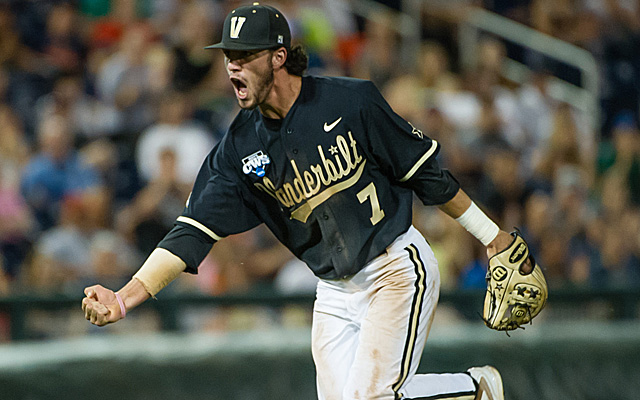
Arizona got things started with Vanderbilt's Dansby Swanson.
Below, the picks noted by an asterisk are those that deviate from the usual order. Here's a quick rundown of those ...
- Astros at No. 2: Compensation pick for failure to sign 2014 first rounder.
- Rockies at No. 27: Compensation pick for losing Michael Cuddyer to free agency.
- Braves at No. 28: Compensation pick for losing Ervin Santana to free agency.
- Blue Jays at No. 29: Compensation pick for losing Melky Cabrera to free agency.
- Yankees at No. 30: Compensation pick for losing David Robertson to free agency.
- Giants at No. 31: Compensation pick for losing Pablo Sandoval to free agency.
- Pirates at No. 32: Compensation pick for losing Russell Martin to free agency.
- Royals at No. 33: Compensation pick for losing James Shields to free agency.
- Tigers at No. 34: Compensation pick for losing Max Scherzer to free agency
- Dodgers at No. 35: Compensation pick for losing Hanley Ramirez to free agency.
- Orioles at No. 36: Compensation pick for losing Nelson Cruz to free agency.
| Team | Pick No. | Draftee |
|---|---|---|
 |
1 | SS Dansby Swanson, Vanderbilt |
| Analysis: He transitioned from second base to shortstop well enough to increase his already-high draft stock in the 2015 season. As a sophomore, Swanson was named the Most Outstanding Player in the College World Series. Some scouts project high doubles totals and 10-15 homer power with plus baserunning. This season, he’s hitting .348/.443/.656 with 22 doubles, six triples, 14 homers and 15 steals through 63 games. He hasn’t lacked clutch hitting chops, either, as he hit a walk-off home run to top Indiana in the regional round of the tournament. |
||
 |
2* | SS Alex Bregman, LSU |
| Analysis: Seasoned, high-floor draft prospect who’s been on the radar for years. At the plate, he has a steady, quick, repeatable line-drive stroke that should yield power to the gaps. It’s not certain whether he’ll be able to stick at shortstop at the highest level, mostly because of his average arm, but Bregman’s not a sure bet to be moved off of the position, either. He has some speed on the bases, and he’s an excellent leader. He doesn’t have any off-the-charts tools, but we’ve seen plenty of this kind of prototype -- the good-at-everything college middle infielder -- go on to much success in the bigs. |
||
 |
3 | SS Brendan Rodgers, Lake Mary HS (Fla.) |
| Analysis: Rodgers came into the spring as arguably the top prospect in the 2015 draft class and he didn’t do anything to hurt his stock. He raked against strong high school competition in Florida and is a quality two-way prospect who projects to remain at shortstop long-term. Rodgers is a very good athlete with good speed, a rocket arm, quick feet, and great instincts in the field. At the plate, his easy right-handed stroke produces line drive after line drive, which is why scouts expect Rodgers to hit for both average and power down the road. He’s as well-rounded as any high school shortstop since 2012 first overall pick and current Astros shortstop Carlos Correa. Rodgers is committed to Florida State. |
||
 |
4 | RHP Dillon Tate, UC Santa Barbara |
| Analysis: The 6-foot-2 right-hander can light up the radar gun, working up into the high-90s with a deceptive delivery to boot. Reports indicate he gets great sink as well, coaxing opponents into an above-average groundball rate. His secondary offering is a “slutter” -- hybrid slider/cutter -- with quick, late movement and the third pitch is a change with good potential. In 14 starts this season, Tate was 8-5 with a 2.26 ERA and 111 strikeouts in 103 1/3 innings. It was his first go-round as a starter, quieting some of the concerns that his stuff might better play out of the bullpen. |
||
|
5 | OF Kyle Tucker, H.B. Plant HS (Fla.) |
| Analysis: His older brother Preston Tucker has been playing well for the Houston Astros since being called up earlier this season, and scouts say Kyle is even better suited for the majors. Standing 6-foot-4 and weighing 175 pounds, Kyle Tucker seems likely to fill out a lanky frame, which might give him even more power than he’s shown so far. He’s got a pleasing left-handed stroke and right-handed arm strength that is said to be right-field ready, though he plays center right now. He signed with the University of Florida, but is expected by most to turn pro after he is drafted. Has batted .435 with a .589 on-base percentage and .903 slugging percentage -- including 28 home runs -- in 95 games tracked by MaxPreps over four seasons in high school. |
||
 |
6 | LHP Tyler Jay, Illinois |
| Analysis: The Illini closer has been a big part of the baseball renaissance in Champaign this season. The junior this year pitched to a 0.60 ERA with 70 strikeouts and just seven walks in 60 1/3 innings. He’s also not given up a home run. Jay’s slider may be the best breaking ball in the draft. Simplicity suggests that he’ll remain a reliever, but he has a deep enough repertoire to give starting detail a shot. |
||
 |
7 | OF Andrew Benintendi, Arkansas |
| Analysis: Because he will turn 21 within 45 days of the draft, Benintendi is draft-eligible as a sophomore this year. He hit .390/.491/.723 with 13 doubles, 18 home runs, 54 RBI, 22 stolen bases, 42 walks and 30 strikeouts in 60 games through the Regionals last week. Benintendi is a lefty hitter with a smooth swing who showed more power this spring than at any other point in his career. He also offers speed on the bases and strong defensive chops in center field. |
||
 |
8 | RHP Carson Fulmer, Vanderbilt |
| Analysis: Considered by many evaluators to be the best healthy college arm in the draft, Fulmer throws three pitches for strikes: a fastball that sits mid-90s, hammer curve and promising changeup. That’s a good repertoire, but Fulmer has a max-effort delivery. That delivery in tandem with his smaller frame (small for right-handers, anyway) may mean a future in the bullpen. Much, of course, will depend on how well he’s able to make mechanical refinements as a pro. He certainly has upside, though. |
||
 |
9 | OF Ian Happ, Cincinnati |
| Analysis: A switch-hitter who figures to show the ability to hit for average with solid power from both sides of the plate, Happ’s been a steady producer. He’s also thrived using wood bats in two Cape Cod League stints. Defensively, things are less certain. He’s played all over as a collegian, but his likely landing spot will be an outfield corner or second base. If he’s to man the middle infield, then Happ will need to show some skills growth in the minors. He also has some speed on the bases. |
||
 |
10 | SS Cornelius Randolph, Griffin HS (Ga.) |
| Analysis: Simply put, Randolph is a pure hitter with great bat speed and plate coverage from the left side of the dish. He has an excellent offensive approach and sprays the ball to all parts of the field. Randolph has one of the highest offensive upsides in the draft class and projects to hit for both average and power down the road. Defensively, the 6-foot-1, 190-pounder is a shortstop in name only -- he is expected to move to third base as a pro because he lacks the first step and range for short. His arm is strong enough for the hot corner, though Randolph did battle a biceps issue this spring that limited his throwing. He’s committed to Clemson. |
||
 |
11 | C Tyler Stephenson, Kennesaw Mountain HS (Ga.) |
| Analysis: Stephenson is something of a “pop-up guy,” meaning he went from good draft prospect to great draft prospect thanks to some strong showings this spring. It helps that this draft is shallow at catcher. Stephenson is as good as it gets behind the plate at the high school level, with a rocket arm -- he sat low-90s on the mound as a junior -- and strong hands and wrists, allowing him to receive the ball and frame pitches well. He’s also quite mobile despite standing 6-foot-4 and 210 pounds. At the plate, Stephenson has big time raw power from the right side, but there is some loopiness in his swing that has some questioning his ability to hit advanced pitching at the pro level. He’s committed to Georgia Tech. |
||
 |
12 | 1B Josh Naylor, St. Joan of Arc HS (Ont.) |
| Analysis: Naylor is a big boy (6-foot-1 and 225 lbs.) and he has arguably the most power potential in the draft class. He makes consistent loud contact from the left side of the plate, though the concern right now is that he isn't discplined enough and will swing at bad pitches. That will have to improve so he can tap into his power at the next level. Naylor is a decent athlete but he doesn't really have a defensive home. It's first base by default. |
||
 |
13 | OF Garrett Whitley, Niskayuna HS (N.Y.) |
| Analysis: Was said to be a candidate for the Diamondbacks as the first overall choice. Part of the reason interest in Whitley has been delayed is because he’s from New York, and sometimes players from cold weather states aren’t as widely scouted. An example: Mike Trout, who went in the first round but not until the 25th overall pick in 2009. Whitley has great bat speed and leg speed that is just as imposing, frequently beating out otherwise routine infield grounders. He’s seen as a center fielder in the majors. Whitley batted .356, going 21 for 59, with three home runs, three doubles, a triple and 13 walks during his senior year. He’s also hit a ball that was measured by a scout at 497 feet. |
||
 |
14 | LHP Kolby Allard, San Clemente HS (Calif.) |
| Analysis: Coming into the spring, Allard was arguably the top left-handed pitching prospect in the draft, but a stress reaction in his back sidelined him for several weeks. It’s not expected to be a long-term issue, though it did limit his exposure to scouts. Allard, who stands 6-foot-0 and 190 lbs., will pitch at 91-94 mph consistently and showcase a hard curveball with tight spin. His changeup is a work in progress and his delivery is smooth and easy, allowing him to throw strikes consistently. Allard is committed to UCLA. | ||
 |
15 | OF Trenton Clark, Richland HS (Texas) |
| Analysis: Clark has a steady record of success with the bat and boasts excellent speed, and he’s a true center fielder who’s sure to stick at the position. He won’t hit for much home run power, but he’ll gap it often enough. Clark has an advanced approach at the plate and should flash good on-base skills as a pro. A Texas Tech commit, he may be the best leadoff-type in the draft. |
||
 |
16 | RHP James Kaprielian, UCLA |
| Analysis: The righty is a lanky 6-foot-4 and is coming off a season in which he was 10-4 with a 2.03 ERA. He struck out 114 hitters in 106 2/3 innings while holding opponents to a .226 batting average. He threw the first no-hitter in school history (no small feat from a school that produced Gerrit Cole and Trevor Bauer, among many other big-leaguers) this season, too. He long sat in the 89-91 range with his fastball, but earlier in the spring started to ramp it up to the 93-94 range, per reports. Some scouts also love his secondary offerings, which include a curve, slider and change. | ||
 |
17 | LHP Brady Aiken, IMG Academy (Fla.) |
| Analysis: Aiken was the first overall pick in the 2014 draft out of a San Diego high school, but his $6.5 million deal with the Astros fell apart after the team found something scary in his elbow during their pre-signing physical. Aiken declined to sign for a reduced bonus and opted to attend IMG Academy rather than a four-year college so he could re-enter the draft in 2015. Unfortunately, his elbow did indeed become an issue this spring -- the 6-foot-3 and 210 lb. Aiken had Tommy John surgery in April. When healthy, Aiken has the stuff and command typically found in a first overall pick. He sits 92-94 with his fastball and will touch 97, his changeup is a legitimate out-pitch, and his curveball is very good as well. His makeup and work ethic draw rave reviews. Aiken has top of the draft ability but will be out of action until mid-2016. |
||
 |
18 | RHP Phil Bickford, College of Southern Nevada |
| Analysis: The Blue Jays selected Bickford with the 10th overall pick in 2013 draft out of a California high school, but he rejected a below-slot bonus offer and instead headed to Cal State Fullerton. He transferred to the College of Southern Nevada this year -- since it’s a two-year institution, Bickford can re-enter the draft this summer -- and put up a 1.45 ERA with a gaudy 166/21 K/BB in 86 2/3 innings this spring. Bickford’s fastball has settled into the 92-96 mph range this spring after wavering between mid-90s and upper-80s the last few years. His slider is a strong secondary pitch but his changeup is a work in progress. Bickford has good size (6-foot-4 and 205 lbs.) and will get a chance to start long-term, but it’s possible he’ll end up in the bullpen with a dominant fastball/slider combination. |
||
 |
19 | SS Kevin Newman, Arizona |
| Analysis: Despite hitting .370/.426/.489 with 19 doubles, two home runs, 22 stolen bases and more walks (20) than strikeouts (15) in 55 games this spring, Newman was often overlooked this spring because this draft class is deep in high-end college middle infielders. The scrappy 6-foot-1, 180-pounder has the innate ability to get the fat part of the bat on the ball, allowing him to spray line drives all over the field. He doesn’t have much power or speed, and he puts the ball in play so easily that he doesn’t draw many walks, so scouts on split on whether Newman will develop into a big league leadoff hitter. Newman’s quick fit and instincts serve him well at short. |
||
 |
20 | SS Richie Martin, Florida |
| Analysis: Martin projects to be a true two-way shortstop. The 6-foot-0, 185-pounder has a compact right-handed swing, though his .292/.392/.554 batting line with nine doubles, five homers, 20 steals, 33 walks and 34 strikeouts won’t wow anyone by top college hitter standards. Martin has a ton of range and plenty of arm for short, though he gets himself into trouble because he tries to be flashy and ends up making plays more difficult than they need to be. | ||
 |
21 | RHP Ashe Russell, Cathedral HS (Ind.) |
| Analysis: Russell has one of the livest arms in the draft class. He slings the ball from a low three-quarters arm slot and gets a ton of movement on both his mid-90s fastball and low-80s slider, which darts down and away from right-handed hitters at the last moment. Like many high school pitchers, Russell doesn’t have much of a changeup because he never needed one. The concern is that Russell will struggle against left-handed hitters at the next level because he lacks a changeup and has that low arm slot, a la Justin Masterson. He stands 6-foot-4 and 195 lbs., is a very good athlete, and is committed to Texas A&M. |
||
 |
22 | RHP Beau Burrows, Weatherford HS (Texas) |
| Analysis: Burrows’ signature pitch is a fastball that touches the upper 90s. He adds to it a plus a curve and a changeup with which he’s made much progress. It’s that third pitch that gives him a ceiling as a major-league starter. Questions? His mechanics, while improved, still aren’t ideal, and some organizations still hold a bias against undersized right-handers. He’s committed to Texas A&M. |
||
 |
23 | OF Nick Plummer, Brother Rice HS (Mich.) |
| Analysis: Plummer is the first player from the state of Michigan to be drafted in the first round since David Parrish in 2000. He has one of the best pure hit tools in the draft class thanks to a sweet left-handed swing and an exceptional approach -- Plummer consistently works himself into good hitter’s counts and has excellent pitch recognition for a high school player. His swing is geared more for line-to-line contact than power, and his stocky 5-foot-11, 190 lbs. doesn’t have much more room for muscle. Plummer has decent speed and an okay arm. He’s fine in center field right now, but, in likelihood, he is destined for left field down the line. Plummer is a Kentucky commit. |
||
 |
24 | RHP Walker Buehler, Vanderbilt |
| Analysis: Buehler has command of four pitches -- something of a rarity for an amateur -- and he touches the mid-90s with his fastball. On the downside, he battled elbow soreness earlier this year, and some question how well he’ll be able to limit hard contact in the majors, thanks in part to a lack of life on his four-seamer. This past season for Vandy, Buehler logged an ERA of 2.97 in 78 2/3 innings. Over that span, he struck out 81, walked 25 and allowed 78 hits. |
||
 |
25 | OF D.J. Stewart, Florida State |
| Analysis: The 2014 ACC Player of the Year got on base more than half the time this season, hitting .322/.509/.580 with 13 homers in 62 games for the Seminoles. At 6-foot-0, 230 pounds he possesses plus raw power, but he’s still mostly a line drive hitter, as evidenced by the slugging percentage being south of .600. He’s a left-handed hitter with great bat speed. The concern here is the potential for weight to become an issue down the road, but Baseball America reports that his mother is a fitness instructor. That can’t hurt. He does have a below average arm, which means he’s ticketed for left field -- with a possible move to first base down the road. |
||
 |
26 | C Taylor Ward, Fresno State |
| Analysis: Wade is an excellent defensive catcher with great catch-and-throw skills, which is always in demand on draft day. His offense lags behind his glove, though Wade does show some power from the right side of the plate. Wade draws raves for his makeup and leadership skills as well. |
||
|
27* | RHP Mike Nikorak, Stroudsburg HS (Pa.) |
| Analysis: Nikorak was arguably the top high school pitcher in the draft class coming into the spring because he hit the weight room hard last fall and added muscle to his slight frame, assuaging some concerns about his durability. He stands a solid 6-foot-5 and 205 lbs. now. Nikorak struggled with his control this spring -- he walked 20 batters in 29 2/3 innings against generally weak competition -- after never showing strike-throwing problems in the past. He sits 93-96 mph with his fastball on his best days and will bump 98 on occasion. A hammer curveball is Nikorak’s put-away pitch and one of the best benders in the draft class. He also throws a changeup. As a cold weather state player, Nikorak doesn’t have as many innings on his arm as most top prep hurlers. He is an excellent athlete and scouts believe he has a chance to refine his delivery, improve his command, and see his stuff jump a tick or two once he gets more reps under pro instruction. Nikorak is committed to Alabama. |
||
|
28* | RHP Mike Soroka, Bishop Carroll HS (Calgary) |
| Analysis: At 6-foot-4 and 200 lbs., Soroka has the type of frame scouts love. He throws a fastball in the 92-94 mph range and both his curveball and changeup show great potential, though they are works in progress. With impressive stuff, good command, and a solid delivery, Soroka is a very well-rounded prep hurler. |
||
 |
29* | RHP Jon Harris, Missouri State |
| Analysis: Harris throws four pitches for strikes and sits in the low 90s with his fastball, which also shows good movement. There’s also some projectability when it comes to his 6-foot-4 frame. The question is whether Harris as a pro can move beyond being a deep-repertoire command guy and cultivate the kind of stuff that will allow him to be a true frontline starter. As pitchers go, though, he’s got a high floor. |
||
|
30* | SS Kyle Holder, San Diego |
| Analysis: Holder is arguably the best defensive player in the entire draft. He's got tremendous range, soft hands, a great arm, and strong instincts at short. The question is whether he's going to hit. He doesn't have much power and his hit tool is up for debate. No-doubt shortstops are always in demand on draft day. |
||
|
31* | 1B Chris Shaw, Boston College |
| Analysis: Shaw is listed at 6-foot-3 and 248 lbs., and a year ago he led the prestigious Cape Cod League in home runs. He can be overly aggressive from the left side of the plate but does a good job of making adjustments and driving the ball a long way when he connects. Shaw has played both first base and the corner outfield in college (the Giants announced him as a first baseman) and is capable in both spots. Either way, Shaw's value lies in his hard to find power. |
||
|
32* | 3B Ke’Bryan Hayes, Concordia Lutheran HS (Tx.) |
| Analysis: The son of long-time big leaguer Charlie Hayes, Ke’Bryan is an advanced prep hitter with an easy right-handed swing geared for hard contact to all fields. His 6-foot-1, 207 lb. frame suggests he’ll grow into some power down the road. Hayes is not particularly fast but he has good reflexes and a strong arm at third, which should allow him to stay there long-term. He’s committed to Tennessee. | ||
|
33* | RHP Nolan Watson, Lawrence North HS (Ind.) |
| Analysis: Watson is a big and physical right-hander at 6-foot-2 and lbs., and he holds his 92-95 mph velocity deep into games. He also throws a solid slider and has shown the ability to spin a curveball and throw a changeup without sacrificing arm speed. Watson has a very simple delivery he repeats well, allowing him to fill the strike zone regularly. He’s committed to Vanderbilt and could be a tough sign. |
||
|
34* | OF Christin Stewart, Tennessee |
| Analysis: Stewart is more of a slugger than a hitter -- there is some swing-and-miss in his game, but he has good bat speed from the left side and hits a lot of line drives. He'll have to focus on getting more loft on the ball to really tap into his power. Stewart is a good athlete but he won't be much of a defensive asset in the outfield or contribute on the bases. |
||
|
35* |
RHP Kyle Funkhouser, Louisville |
| Analysis: A number one overall hopeful entering the season, Funkhouser’s stock has fallen greatly after seeing his ERA go from 2.14 as a freshman to 1.94 as the ace of a College World Series team his sophomore year to 3.25 this season. His strikeout rate (99 in 105 1/3 innings this season) has fallen a bit, too. At his best, Funkhouser sat 92-94 with the fastball and could get up to 96. He also uses a plus slider and average-type change. If he reverts to form, this could prove a bargain, but there’s obviously some risk here. |
||
|
36* | SS Ryan Mountcastle, Winter Springs HS (Fla.) |
| Analysis: Mountcastle stands out more for his bat than his glove. He has some of the best bat speed in the draft class and has no trouble making contact. The expectation is he will hit for power and average down the road. Mountcastle is unlikely to stick at shortstop because he doesn't have the range for the position, but he could settle in at third base or a corner outfield spot. |
||