MLB Free Agent Stock Watch: Changeup has Jake Arrieta on the rise, Brian Dozier struggling to make hard contact
The best center fielder of the 2019-20 free-agent class is off to a nice start this season as well

By
Mike Axisa
•
8 min read
At this point in the season, not much can change the upcoming free-agent class in a meaningful way other than extensions and injuries. Several impending free agents signed long-term extensions that took them off the market in recent weeks. Injuries are beginning to rear their ugly head as well.
The 2019 regular season is three weeks old, and three weeks is not enough time for the small sample statistical weirdness to fade away. There are still six players hitting over .400 with enough plate appearances to qualify for the batting title, for example. That sort of stuff still has to work itself out.
That said, three weeks is enough time to begin picking up on individual player trends. Players are constantly changing and, after three weeks, we can at least pick up on some things that are worth monitoring going forward. Some are good, some are bad, and some could have an impact on the player's free-agent stock.
We're going to keep tabs on the 2019-20 free-agent class with these weekly stock watch posts throughout the season, and once a month we'll update our top free-agent rankings as well. Here is this week's stock watch.
Stock Up


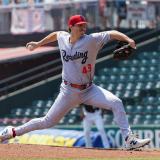
His terminator days with the Cubs are long gone, but, thanks in part to renewed emphasis on his changeup, Jake Arrieta is enjoying a resurgence in his second season with the Phillies. Wednesday afternoon he limited the Mets to two runs in eight innings and allowed only seven of the 29 batters he faced to hit the ball out of the infield. He was dominant.
Arrieta threw 21 changeups among his 105 pitches Wednesday, or 21.0 percent. That's after throwing 17.4 percent changeups in his first three starts of the season. Prior to this season, only four times in his career did Arrieta throw as many as 10.0 percent changes in a single month. Now he's closing in on 20.0 percent. This is certainly a new approach.
While Arrieta will always remain a sinker/breaking ball pitcher first and foremost, the changeup does give him a new wrinkle, and also something to better combat left-handed hitters. They torched him pretty good last season:
- vs. RHB: .234/.290/.367
- vs. LHB: .281/.353/.459
In the early going this season Arrieta is holding lefties to a .200/.294/.333 batting line (righties are at .241/.333/.315), and the changeup gives us a tangible reason to believe the improvement may be legitimate. That doesn't mean it definitely is not a small sample size fluke, because it certainly could be, but this is worth monitoring. A veteran pitcher making an adjustment always is.
Arrieta's contract is very unique. It was the first of those Scott Boras "swellopt" contracts -- the "swellopt" name isn't good, but the contract structure is becoming increasingly popular -- and both the Phillies and Arrieta will have some a decision to make after the season. Here's the simplest way to put it:
- The Phillies can exercise a three-year, $60 million club option covering 2020-22.
- If the club option is declined, Arrieta has a one-year player option worth $20 million for 2020.
One of three things will happen: Arrieta picks up his player option, the Phillies pick up their three-year club option, or both sides decline their options and he becomes a free agent. My hunch right now, on April 18, is the Phillies will decline their club option and Arrieta will pick up his player option. It's hard to pass up $20 million guaranteed in this market, especially since Arrieta will be 34 on Opening Day 2020.
The club option is out of Arrieta's hands. If it's picked up, he'll be $60 million richer, and hey, that ain't bad. If it is declined, he (and Boras) will have to determine whether they can beat a $20 million guarantee in free agency. Arrieta doesn't have to beat that annually, just overall. Could he get, say, the J.A. Happ contract (two years and $34 million with a vesting option)? If this new changeup approach proves to be a difference-maker, he very well might.


I can't imagine how good the start to this season must feel for Leonys Martin. Last season, shortly after being traded from the Tigers to the Indians, he came down with a life-threatening bacterial infection that hospitalized him for several weeks. Martin is fully recovered now, thankfully, and he has picked up right where he left off before the illness.
Last season's breakout .255/.323/.425 batting line -- Martin went into last year as a career .247/.300/.360 hitter -- was fueled by improved plate discipline. Martin has always posted strong hard contact rates. He just got himself out too frequently by chasing bad pitches out of the zone. His chase rate is getting better and better though:
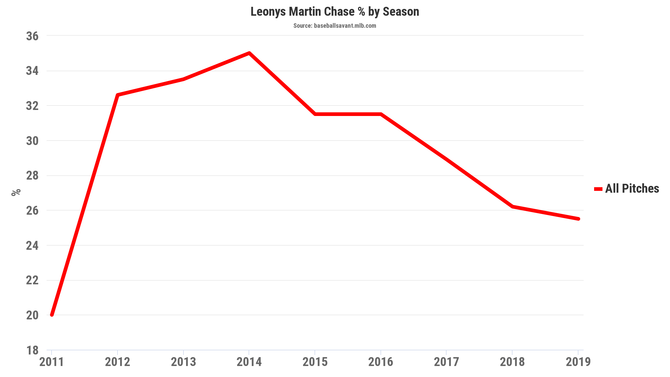
Martin turned only 31 last month, and the results and process so far this season indicate last year's success is sustainable. Also, Martin is healthy. It can be cringey to talk about something as serious as a life-threatening bacterial infection in baseball terms, but it something teams must consider. Martin is healthy and over the illness, and it has not had an impact on his play on the field. That is wonderful news all around.
The upcoming free-agent market is extremely thin at center field. With Aaron Hicks having signed an extension with the Yankees, and the Pirates extremely likely to pick up Starling Marte's $11.5 million club option for 2020, Martin would be the best center fielder in a free-agent class that will include 35-year-old Jarrod Dyson and the light-hitting Billy Hamilton and Juan Lagares, assuming their club options are declined.
With a solid and healthy season, Martin has a chance to go into free agency as the only center fielder who is at least average on both sides of the ball (he's quite a bit better than average defensively, it should be noted). In fact, I'd say Martin is a candidate to be one of the few free agents who exceeds contract projections this winter, with something like two years at $8 million annually possible.
Stock Down


Injuries have decimated the Yankees this season -- they have an MLB high 12 players on the injured list -- and they've lost core players too. Not only role players. Four of their five projected starting position players are on the injured list (Hicks, Miguel Andujar, Didi Gregorius, Gary Sanchez, Giancarlo Stanton) as is projected Opening Day starter Luis Severino.
Also on the injured list: Dellin Betances. New York's ace setup man was shut down with shoulder inflammation in spring training and, last week, he suffered a setback that required a cortisone shot. Betances will be shut down at least an additional four weeks. Here's what Betances told reporters, including NJ.com's Brendan Kuty, about his setback earlier this week:
"I just felt like I wasn't getting better. That's pretty much what it was. I wasn't getting better and I kind of know myself and I thought it was best to speak up," he said, standing in the clubhouse at Yankee Stadium on Tuesday afternoon.
...
"It's been difficult just because I love to play and I'm not pitching right now," Betances said. "I love to compete. It's been a little hard. But at the same time, for me, you've got to look at being ready for the team when i'm ready and try to help them with the playoff push and beyond that."
Betances led all full-time relievers in innings (373 1/3) and was fifth in appearances (349) from 2014-18, so he was an All-Star caliber performer and supremely durable. Even with the free-agent market slowing down, elite relievers are still being paid well, and Betances was poised to cash in big as a free agent after the season.
Instead, Betances will not return until late May in the best case scenario. Sometime in June is more likely. Even if he comes back and pitches well in the final few months of the regular season (and potentially the postseason), teams will undoubtedly hold the shoulder injury against him, and his free-agent payday may not be as significant as expected coming into the year.
To use two fellow Yankees as an example, Betances may have to settle for Adam Ottavino money (three years, $27 million) rather than Zack Britton money (three years, $39 million). And, if the shoulder injury lingers, Betances could be looking at a much smaller contract as well.
Brian Dozier
2B
BA.170
R5
HR1
RBI1
SB0
All things considered, taking a one-year flier at $9 million on Brian Dozier was a sensible move for the Nationals. They had an opening at second base and rolled the dice on a veteran upside play. Expecting Dozier to slug 42 home runs like he did in 2016 would not have been unrealistic. Twenty homers and good defense though? Yeah, that was unreasonable.
Thus far, the early returns have been dreadful. Dozier had a pinch-hit single on Wednesday to raise his season batting line to .170/.235/.234. Beyond the poor results, the process isn't great either. Dozier is swinging and missing more than any other point his career, his ground ball rate is through the roof, and his soft contact rate has spiked. To wit:
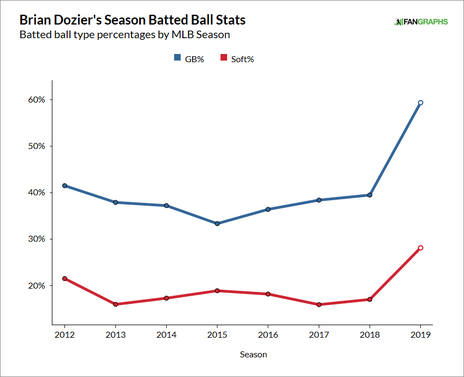
Not coincidentally, Dozier ranks in the bottom 10 percent of the league in expected batting average and expected weighted on-base average. He is making very poor contact and the ghastly batting line is deserved, not a fluke.
Dozier at his best is an extreme fly ball hitter -- an extreme pull hitter who gets the ball airborne, to be more precise -- with above-average hard contact rates. That is most definitely not the player we're seeing right now. Dozier can't get the ball elevated and he's not hitting it all that hard either. As a result, he's been one of the worst hitters in baseball in the early going in 2019..
There is a lot of season remaining -- a lot -- which gives Dozier plenty of time to turn things around. The thing is, he had trouble finding work last offseason, and any further slip in the skills that made him one of the game's best second basemen for a three- or four-year period will only hurt his free-agent stock. This is not the start Dozier needed going into free agency again.