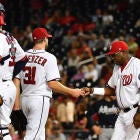
Nats explain why they worked Scherzer deeper than needed in a meaningless game
Scherzer feels like he needs to still be humming up to 120 pitches for the playoffs

By
Matt Snyder
•
4 min read

I can see the uninformed overreaction from miles away. The math is oh-so-easy. Let's take a look.
- Max Scherzer Wednesday night took his third start since returning from the disabled list.
- The Nationals were tied, 2-2, with the Braves through six innings.
- Scherzer had thrown 97 pitches through six.
- The Nationals have already clinched the NL East and are unlikely to move from the No. 2 seed in the NL.
- Scherzer took the hill for the seventh. He allowed three walks and a single before the Nats elected to intentionally walk a hitter and remove him from the game, now with 116 pitches. The runners Scherzer left behind would score, by the way, so he ended up allowing six earned runs in six innings, officially.
- The Nationals manager is Dusty Baker.
Yes, here we go. Dusty Baker is trying to ruin an arm by overworking it in a meaningless game! That's probably what people will say.
It's so easy to pile on without any real thought process or context behind what was actually going on and that's surely what many people would do.
What actually happened was a good move by Scherzer and Baker. On MASN Sports, reporter Mark Zuckerman lays out the gameplan all night was to work Scherzer up into the 110-120 pitch range, regardless of how the game was going. The eyes are on the postseason, not winning individual games right now. As it should be. The whole article is worth the time of anyone with keen interest on the Nationals. but here are two quotes that really stood out:
"That was the gameplan," said manager Dusty Baker, who heard some boos from the crowd of 24,830 when he finally removed Scherzer from the game. "We wanted to take him out, but you gotta stick with the gameplan. We were thinking long run vs. short run."
-----
"I thought that would help benefit me going forward, and then looking ahead into the postseason, to pitch with some extra fatigue," [Scherzer] said. "Usually I've been able to do that in the past. But because of all the little injuries I've been dealing with, I haven't really been able to get past 100 pitches for quite a while. So I knew it was important for me, going into that start tonight, to be able to get to that level."
On preparing for the playoffs instead of winning regular season games, that's pretty simple stuff. We know the Nationals' 2017 season isn't going to be remembered for winning the NL East title. They've now done that in four of the last seven years. They've also never won a playoff series. This season comes down to how the Nats fare in the postseason and Scherzer is the type of playoff ace who can put a team on his back.
In order for a deep playoff run to happen, the Nationals most likely need the Scherzer that can work beyond seven innings with his best stuff.
That's where stretching him out comes in.
When Scherzer is truly firing on all cylinders, working relatively high pitch counts is the norm. From June 11-21, Scherzer made three starts in which he allowed just three earned runs in 23 1/3 innings. He struck out 31 while walking just four. His pitch counts in those games: 109, 118, 121. Remember his 20-strikeout game last season? He threw 119 pitches that game. In 2015, Scherzer threw a one-hit shutout with 16 strikeouts in which he needed 119 pitches and that came on the heels of a 116-pitch game. He closed that season with a 17-strikeout no-hitter (109 pitches) that followed outings with 122 and 113 pitches, respectively.
We could keep going, but the point here is clear. Scherzer is a pitcher that has a track record showing the ability to work very successfully past 110 pitches in an outing and doing so several consecutive outings.
Only three starts removed from a short stint on the disabled list, Scherzer wants to get back to that point in time for October. He's not there yet, as his command was totally off in the seventh inning Wednesday night. From his perspective, he needs to keep working up into that pitch-count range until he gets right and hopefully that happens before the playoffs begin. I see no issue here, in fact, I love the gameplan.
Any arm fatigue is, frankly, of little concern. Scherzer and obviously the Nationals medical staff believe the arm can handle this. The track record says as much, too.
Not all arms are created equal. Scherzer has shown through his prime that his arm can handle 115-pitch outings on a regular basis. The "Dusty ruins arms" ship should have sailed long ago. He oversees arm injuries now just about the same rate as every other manager. It's a narrative that has no place in any Scherzer discussion. This is all about getting the team ready for a run never before seen for the franchise.
As Baker said, they are looking "long run vs. short run."
Further, Scherzer is clearly putting the team ahead of personal gain. His ERA has gone from 2.19 to 2.54 in his last two starts and it's possible that seeing those four runs tacked on without getting an out Wednesday night down the road cost him his third -- and second consecutive -- Cy Young award. It's likely to be hotly contested against Clayton Kershaw as things stand, so four extra runs could well make the difference.
Scherzer is more worried about the playoffs than his stats and personal hardware, though.
Don't fall victim to the easy narrative. Praise is in order here for both Scherzer and Baker on this approach. Their true season begins in a few weeks.