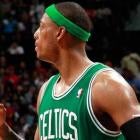
As Paul Pierce retires, it's on us to make sure no one forgets the legacy of 'The Truth'
The Hall of Famer's legacy can't be described in stats or highlight reels

By
Matt Moore
•
4 min read

Listen, if we're going to keep the truth about Paul Pierce alive, we're going to have to fight for it.
I'm for advanced metrics as much as anyone; I want as much information about the game as we can muster. I'm for film breakdowns and plus-minus and on-off and PER and everything else. I want to know everything before making a decision on how to evaluate a player in the short, long or historical term. But the numbers are never going to do Paul Pierce justice. His game wasn't maximized for efficiency, wasn't built to translate his gifts into how they would be received by formulas today.
This is similar to the fact that Larry Bird's 3-point numbers don't reflect what kind of shooter he was. The 3-point shot just wasn't used when Bird played. It was a fringe element, a novelty of sorts. And when Pierce played, it was the grandest era of hero ball. Low motion, low ball movement basketball reigned, and that drags down efficiency.
And still, if we remember Pierce for one thing, it should be that he could take the game over as few in its history could.
Everyone who watched Pierce has their time that belongs to them. For some it's the 2008 run with Boston. For some, it's even those later years with Washington. But for many, it's this earlier era, when Pierce dragged a flawed and suspect 2002-03 Celtics team so far as to make you think they were a legit threat. Tony Delk was the third-highest scorer on that team. J.R. Bremer was fifth. Boston was 24th in offensive rating, only eighth in defense, and pushed Indiana to six games in the second round, almost entirely because of Pierce.
This was kind of the story of Pierce's career, and it carried through all the way to his days in Brooklyn. Pierce's teams would look sluggish, ugly and inefficient, you would bury them and forget about them. Then spring would come, and in the playoff environment, it would become possession basketball. And when it was possession basketball, you had to deal with this:
Pierce's step-back strikes right to the heart of what makes basketball an offensive game now and forever, no matter how much defense wins championships. In a one-on-one environment, if you're good enough, you can get to your spot and it's all muscle memory from there.
It's somehow fitting that Pierce's last game came Sunday with the Clippers in a loss to the Jazz. The conversations will be about Chris Paul, or Gordon Hayward, or Blake Griffin, but the difference in that first-round series was Joe Johnson, whose performance was straight out of the vintage Pierce playbook. Possession basketball, tight game late, get to your spot, drain the shots you know you can make. And the Jazz took two games that would have gone to the Clippers otherwise with that formula, regardless of the Jazz's defense, Hayward, Rudy Gobert or anyone else.
Johnson eliminated Pierce, his one-time Nets teammate, with a Pierce-esque performance, draining the life from the opponent with shots you could do nothing but tip your cap to.
If Pierce's prime had come today, he would be playing a lot of small-ball four. His game would be predicated on his ability to make plays out of the switch in the pick and pop, and he would have shot more 3-pointers. He also would be great. But his legend would not be. You wouldn't have as many moments that define him. And Boston wouldn't love him the way it does.
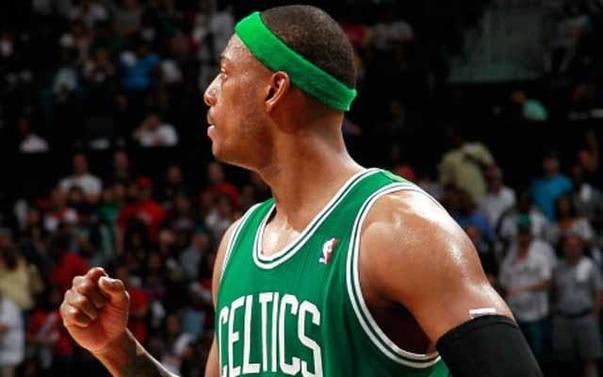
Pierce's game was 100 percent destroyer of worlds. When Pierce beat your team, it wasn't a Chris Paul "25-10-5 on 48 percent shooting." It was inefficient and sloppy, and yet it felt like Pierce reached into your chest and pulled your heart out, then tossed it in the garbage. The man must be responsible for hundreds of anti-anxiety prescriptions in the Greater New York area over the past 15 years.
But Pierce was also the athlete fans want. He was gracious and humble. He was close to losing his mind in 2006 and yet stuck with Boston, and was rewarded with Kevin Garnett. He didn't bristle at the formation of the Big Three or try and set things on his terms; he took his corner and focused on defense and winning. He adapted. He embraced Rajon Rondo and almost won a second title that way. He was gracious and grateful to Boston when he was traded, and will retire a Celtic with nothing but open arms despite having been gone for four years.
Pierce walked away from the game, saying after the Clippers' loss that he "had no regrets." It will be easy in the coming years, when fans who didn't see him in 2002 or '03 or '08 try using his Basketball Reference page as a guideline for minimizing his accomplishments. But those that saw him should fight against this. You need to talk about that moment when you saw Paul Pierce take over a game and win, whether it was a random February game in New York or the NBA Finals. You need to make sure that you do your part to let those who doubt know how bad of a man Paul Pierce was on the floor.
Paul Pierce's career is over. The legacy of The Truth belongs to us now.