Do Raptors view Jonas Valanciunas worthy of max extension?
The situation for the Raptors' big man is complicated. Here's a look at his relative value.

By
Matt Moore
•
4 min read
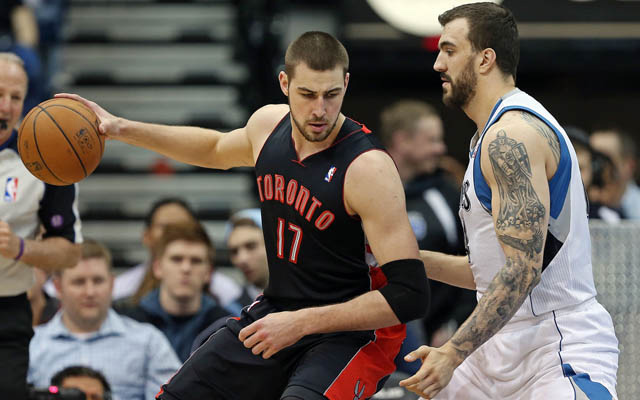
In a wide-ranging piece on next year's extension candidates coming off their rookie contracts, Zach Lowe of Grantland.com describes the situation the Raptors face with center Jonas Valanciunas. In a nutshell, Valanciunas isn't worth a max contract -- at least in Toronto's eyes -- but in the current market, he's assured to get one. From Grantland:
Valanciunas is a lock to demand a max-level extension. Large humans get paid, and this large human shot 51 percent on post-ups as a 22-year-old banging against the world’s toughest bigs, per Synergy Sports. He’s a beast on the offensive glass, shoots almost 80 percent from the line, and should develop as a pick-and-roll finisher — both at the rim, and with a soft midrange jumper.
He has also been an odd, underused fit in a Drakes offense dominated by gunner guards who prefer clear driving lanes — a problem that could persist, and harm his value, if Dwane Casey is serious about playing smaller. He’s a potent enough post scorer to draw double-teams but laughably bad at passing out of them. Building him into a plus defender, both at the rim and in open space, will be arduous. If the Raptors can’t convince Valanciunas that securing money now is worth bending a bit on annual salary, what’s really in it for them?
Source: Welcome to Extensionville: The NBA’s Next Big-Money Community «.
Valanciunas is a fascinating debate. He has the body and mentality to be a good defender, but the results are contrary to that. Individually, he's very good, in the 79th percentile as a post-up defender. In motion, though, he struggles as he's in the 38th percentile among pick-and-roll defenders. More concerning: The Raptors were 7.6 points per 100 possessions worse with Valanciunas on the floor last season, and 1.6 points worse on defense.
Compare him to Andrew Bogut three seasons in:
Bogut was a better passer and defender, but Valanciunas has been better as a scoring weapon. He also has a higher PER than Bogut did. Yet, the Bucks were 2.5 points worse with Bogut on the bench vs. the Raptors being 7.6 points per 100 possessions better with Valanciunas on the pine. Raptors fans were boggled by Dwane Casey's decision not to have Valanciunas on the floor in the fourth quarter often, yet the numbers revealed it as a smart choice. Valanciunas is still just 23, and can improve. You usually hope big men reach their defensive potential by around 27, so there's still time. If Valanciunas makes the leap, he's going to be a steal if they sign him to an extension under the current cap. If he continues to be a defensive drain, he could wind up overpriced.
Greg Monroe became a max player this summer from the Milwaukee Bucks. The Thunder gave Enes Kanter the four-year max. Players who do not fit the qualification of "superstar" are getting them. Consider this from Ken Berger's excellent piece on the max contract this summer:
As a result, the max contract also has ushered in the era of the $30 million backup center who couldn't play (Jerome James), the $30 million third-string point guard (Cory Joseph) and the role player who gets the max (Gordon Hayward) because of leverage rather than accomplishment."
Gordon Hayward's a very good basketball player," an agent who doesn't represent him said. "But the max? Really?"
In the NBA's alternate universe, leverage for a max deal often is dictated by a small window of performance and the simple economics of supply and demand (loads of cap space, not enough stars).
"Sometimes, it's purely fortuitous," said the agent, who spoke on condition of anonymity. "You're coming off a good year and the team is saying, 'All right, what the [expletive], let's try it.' "
Source: Max money explained: For every Anthony Davis, there's a Greg Monroe - CBSSports.com.
That has to make you feel good about your team's GM, that there's a possibility his decision-making process on a deal upwards of $80 million dollars is "let's try it."
Valanciunas would definitely receive "let's try it" offers next summer. As I wrote about with Enes Kanter, much of this comes to subjective, or investor value. Valanciunas is worth the max to a team like Portland next summer, or Dallas, desperate to get back into contention and in need of a good center. For Toronto? With a guard-heavy system and without the tangible defensive benefits that should come with a stalwart, physical big man? It becomes more complicated.
Ultimately, Valanciunas hasn't produced enough to warrant that kind of contract, but his potential may very well reach it. His improvement isn't guaranteed, nor is it doubtful. It's a coin flip. That's the real decision Masai Ujiri and the Raptors will have to suss out when it comes to a max extension.
It should be noted that when presented with losing JaVale McGee in Denver, with all his warts which were much greater than Valanciunas', Ujiri signed McGee to a four-year, $44 million deal. Ujiri is aware that big men tend to get better as they get older.
Whether the McGee experience changed Ujiri's thinking on such matters could impact Valanciunas -- despite JV being better on both ends than McGee, not to mention being less of a locker room distraction -- or not, we'll see what Toronto decides.