Five ways the Pelicans could have handled the Derik Queen trade better
Queen looks like he could be a great NBA player and a steal at No. 13 in the draft, but the Pels still botched the deal to get him

By
Sam Quinn
•
16 min read
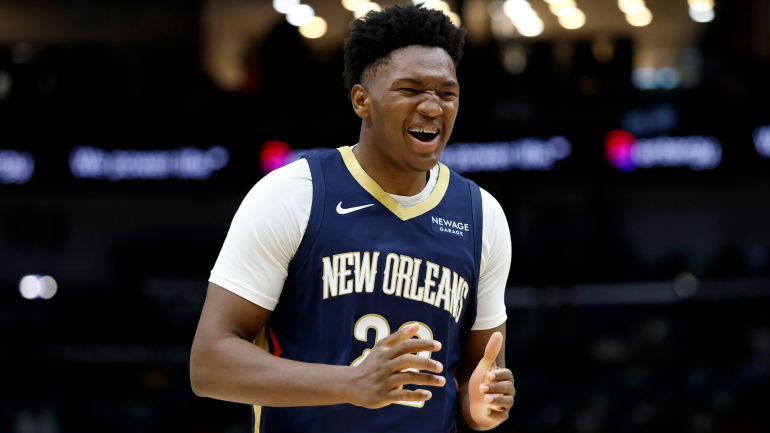
The New Orleans Pelicans became the laughingstock of the NBA in June when they traded the single most valuable outlying draft pick in the NBA, their own unprotected 2026 pick with swap rights attached to Milwaukee, in order to land Derik Queen after already drafting Jeremiah Fears at No. 7. The laughter has slowed in recent weeks. Queen has emerged as one of the best rookies in absolutely loaded draft class. On Monday, he posted a 33-point triple-double. He has all but played Zion Williamson out of New Orleans and appears certain to be a building block for the Pelicans moving forward. Purely from a scouting perspective, it seems as though Joe Dumars and Troy Weaver were at least right about the player.
The tone of the criticism has since shifted. It still very much exists, but it's far more specific. The Pelicans were right about the player, most observers can concede, but wrong about the trade. Getting Queen in a vacuum was a good decision. The process that got them there, and the damage it could do over the long haul, was the problem. And that damage is potentially significant. The Pelicans, as of this writing, have the worst record in the NBA heading into one of the best draft classes in years. The Hawks may well land a future superstar through New Orleans' exuberance for Queen.
Dumars attempted to defend the trade to ESPN on Wednesday. "I get it. So much of today's NBA narrative is around picks and different things like that," Dumars said. "I'm trying to build culture here with some really good young players, and I gave up some draft capital to do that. And I love the two young players we have. I hope that doesn't get lost in all of this."
Again, the two young players themselves aren't really at issue here. It's how they got them. So we're going to play a little game of front office hindsight. New Orleans wanted Queen. Fine. There were a number of things they could have done differently in the process of getting him that would have made the process a bit more palatable and hurt them loss in the long haul. Five immediately come to mind.
1. Just draft Derik Queen No. 7
There was a very simple solution to all of this. The Pelicans had the No. 7 overall pick. They used it on Jeremiah Fears. Yet the price they paid Atlanta for the Queen pick was worth far more than the No. 7 overall pick. That suggests that they viewed Queen as a potential star. And if they viewed Queen as a potential star... why not just take him at No. 7?
Their answer would have to be, and likely was, that they also viewed Fears as a star. That's not crazy. The general draft consensus on Fears was relatively high, though not quite at that level. Fears has by and large impressed as a rookie. He should be a good NBA player, maybe even a great one.
But by mere outcome, we can say that the NBA did not view either Queen or Fears as a top-five prospect in their own class. The Pelicans valuing both as a potential stars should have drawn a bit more internal reflection. What do we see that the rest of the league doesn't? Perhaps more importantly, why should we trust our own evaluation more than the league's as a whole? Restraint is a critical component of running a franchise.
Most teams like multiple players when they make high draft picks. If they made a habit of always trading up for the second player using future draft capital, well, we'd see a lot more teams in the position the Pelicans are in now. Most teams have the sense to make the hard choice and take the player they like most, even if it means passing up someone else they really love, knowing, in the simplest terms, that you can't always get what you want if you're trying to build a sustainable franchise. It's sort of like explaining to children why they can't have ice cream for every meal. Yes, it might be delicious right now, but it will have consequences later.
By drafting Fears over Queen, the Pelicans implicitly declared that they preferred him. Again, not an unreasonable declaration. But if they went into the 2025 draft loving two prospects this much, it probably would have been worth debating not just their merit as prospects, but their value as assets. Look around the NBA as a whole right now. How many star point guards are seemingly available for trades? Ja Morant, Trae Young, LaMelo Ball. De'Aaron Fox and Luka Dončić got moved last season. There are more high-level guards coming in next year's class. The position is oversaturated. That doesn't mean point guards aren't valuable. It means, on a relative basis, that they're pretty easy to get. Point guards, to put it plainly, are plentiful.
Heck, the Pelicans just got one. Remember Dejounte Murray? New Orleans traded a bundle for him in the 2024 offseason. Now, granted, he played badly, tore his Achilles and criticized the organization, but he's still on the books for another two years after this one at around $30 million per season. Wouldn't it have made more sense to see if he could be salvaged before making such an enormous expenditure at his position?
There's nothing wrong with the Fears pick in a vacuum. He wasn't even the highest drafted point guard in his class, and again, he's played well. But the decision to trade what they did for Queen put pressure on both of them. The fact that the Pelicans could have simply drafted Queen at No. 7 means that both have to live up to the enormous price they paid for No. 13. Realistically, that's a pretty tall order. Potential star bigs, like Queen, are far harder to find than guards. If they liked Queen that much, the sensible decision probably would have been to just pick him seventh and figure out point guard later.
2. Protect the pick
It seems so obvious, doesn't it? Surely the Pelicans would have protected the pick if they could have, right? Well, we're not quite sure about that. Joe Cowley of the Chicago Sun-Times has reported that Dumars did indeed call other teams picking between No. 8 and No. 12 trying to make this trade and was rebuffed, perhaps suggesting to him that the pick had to be unprotected in order to get across the finish line. However, Shamit Dua's reporting after the fact suggested that the Hawks likely would have made the deal with some measure of protection. "When one Pelicans executive made the call to Atlanta, the Hawks couldn't believe what was actually being offered," Dua wrote. "Atlanta asked for clarification multiple times to confirm the unprotected pick was indeed part of the deal. It got to the point where Hawks General Manager, Onsi Saleh, called Joe Dumars directly to confirm for himself."
That certainly sounds like a team that would have been open-minded about protections, or at least understood just what a steal the deal was. The Hawks also would have been uniquely positioned to benefit from allowing the Pelicans to protect that pick. Why? Because they already control a first-round pick from the Pelicans. They will get the lesser of New Orleans' pick in 2027 or Milwaukee's, so long as both land outside of the top four, thanks to the Murray trade from last year, with the Milwaukee pick coming all the way back in the 2020 Jrue Holiday deal.
So what could that have meant for a trade like this? Well, normally, when a valuable protected pick lands in the protected range, it rolls over into the next year with the same or altered protections. As Atlanta already owns some measure of draft control over New Orleans in 2027, though, they could have negotiated a potentially mutually beneficial alteration of the existing protections on that pick. As an example: the Pelicans theoretically could have asked for a top-four protection on their 2026 pick going to Atlanta, but if the pick landed in that protected range, they would give the Hawks both their own 2027 first-round pick and Milwaukee's completely unprotected, rather than the existing arrangement in which the Hawks get the worse of those two picks, and only with a top-four protection. This would have allowed the Pelicans a year to get their act together before handing Atlanta a pick, but the Hawks still almost certainly would have jumped at it for the chance at getting Milwaukee's 2027 pick unprotected after Giannis Antetokounmpo potentially asks out.
That's just one possibility. There are countless others. One team having any degree of draft control over another opens up a lot of interesting trade doors, and the Hawks had draft control over the Pelicans even before the Queen trade. In other words, there surely would have been some way the Pelicans could have protected this pick and gotten Derik Queen. You could argue that negotiating such protections on the clock would be difficult. I would counter that the Pelicans knew of their interest in Queen before the draft began and should therefore have begun the process of seeking and negotiating a trade for him earlier.
3. Try to trade Herb Jones for a pick to select Queen
Say the Pelicans wanted Queen, wanted Fears, and could not, for whatever reason, manage to protect their 2026 pick in the deal. OK. That 2026 first-round pick was not the only trade asset the Pelicans had. The Bucks pick in 2027 we've already covered has tremendous value. Frankly, given the low opinion most of the league seems to have for the Pelicans, their own future picks would have as well. But draft picks are mystery boxes, and it's hard to say how much other teams would value them. With players, it tends to be easier. The Pelicans have at least two players that probably could have been the centerpiece of a trade that landed them Queen.
The first is Herb Jones. We exist in an NBA in which Mikal Bridges recently netted five first-round picks in a trade. Jones isn't as good offensively, but he's a recent First Team All-Defense wing at a far below-market contract. There is plenty of precedent for someone like him getting traded for a late lottery pick. As recently as 2024, the Portland Trail Blazers traded the No. 14 overall pick for Deni Avdija and even included another future first-round pick in the deal. It's hard to imagine that Avdija, coming off of his first full season as a starter, had more trade value in 2024 than Jones did in the summer of 2025.
We'll likely have a better idea of what exactly Jones is worth on the trade market in the coming weeks. He is one of the most widely rumored names on the market right now. If he nets multiple first-round picks, or perhaps a single pick with swaps or a good young player attached, that probably would have been enough to get into range for Queen one way or another.
Another thing to keep in mind here is that, if absolutely necessary, the Pelicans probably didn't need to trade quite as far up as they did to get Queen, at least not in a single move. Remember, the Portland Trail Blazers traded down from No. 11 to No. 16, ostensibly with an eye on Yang Hansen. If the Pelicans could have traded Jones in a package for even a mid-first-round pick, they presumably could have looped Portland in as a third team and offered them more future value than Memphis did (one future Orlando pick, which would certainly be less valuable than a future New Orleans pick) to get up to No. 11.
So this raises the question of whether or not Derik Queen would have been worth giving up Herb Jones? The answer, given where the Pelicans are as a franchise, is probably yes. Jones is 27. He will probably never be more valuable than he is over the next few years. High-end defensive wings are a luxury for a rebuilding team. He would offer more value to someone capable of winning now than he would the Pelicans. By the time Queen and Fears are good enough to start winning at a high level, it's possible and perhaps probable that Jones, even if he is still good, will be past his prime.
If nothing else, the wider league would almost certainly rather have that unprotected 2026 Pelicans pick than Jones. After all, the Hawks have that pick and reportedly aren't eager to trade it for Giannis Antetokounmpo. So this would have been a path for New Orleans to consider that fell more in line with where it actually sat in its organizational timeline. Dumars and Weaver, to put it simply, jumped the gun by holding onto a veteran and giving away such a great pick.
4. Try to trade Trey Murphy for a pick to select Queen
The Pelicans could charitably argue that there was no path to trading Jones for a pick that could have netted Queen. That's debatable, but there's almost no way to come to a firm answer. Given the overwhelming league-wide interest there would be in Trey Murphy, though, the notion that he couldn't have gotten them Queen feels almost completely farfetched.
Murphy is practically everything teams look for on the trade market. He's still only 25 years old. His size and shooting means he could fit onto basically any team at several positions. He improved significantly last season, so there's obvious room to grow, and teams love trading for young players off of bad teams because they believe their superior coaching and developmental infrastructures can squeeze even more value out of those players. Oh, and he's locked into a very team-friendly rookie extension. He'll make between 16 and 17% of the projected salary cap every year through 2029.
If the Pelicans had shopped Murphy before the draft, they would have gotten a dozen offers. Some would have included 2025 lottery picks that could have included Queen, but the total value in such a package would have been even greater. Murphy is so good that he's been touted as a slightly cheaper alternative for teams potentially interested in Lauri Markkanen. He may not land the monster haul that the Jazz have sought for an All-Star like Markkanen, but multiple first-round picks and/or young players would be the starting point.
There was even an analogue for this exact line of thinking in the 2025 offseason. The Grizzlies had a player in Desmond Bane who was quite similar to Murphy. He's a bit older (27), but was similarly versatile and about as good as a player can be without having made an All-Star Team. Memphis was very interested in a player available in the 2025 lottery: Cedric Coward. So when Orlando offered them a haul for Bane, they took it, and then flipped two of the picks they got from the Magic, No. 16 and a future selection, to get Coward at No. 11 while still holding onto the rest of the trade package they received for Bane. This is an example of how a well-regarded front office would have approached a similar dilemma.
Should the Pelicans have traded Murphy with an eye on getting Queen? The answer is probably no, at least based on the information we had at the time. Murphy is young enough and has a versatile enough skill set to potentially be a part of the next winning Pelicans team. That cheap contract means everything to one of the NBA's thriftiest franchises. You could argue that Queen has since proven he has trade value similar to Murphy's, but at that moment, the Pelicans would have been entirely justified in thinking "we are not trading Trey Murphy, he is a core player for us."
But again, that isn't really the question. For our purposes, the question is whether Murphy is more or less valuable than the pick they gave away. To certain teams, he might be. If Murphy were the No. 3 or No. 4 option on a contender facing apron issues, yes, the certainty of his production might mean more than the upside of the pick. But if you're building a franchise from scratch, as the Pelicans more or less were, the chance at getting a potential future superstar with four years of cost control is just more valuable than a very good starter on a good contract. Again, it isn't clear that the Hawks would trade that pick for a two-time MVP. If you're dead set on acquiring the Queen pick, there were alternatives to getting it they should have more seriously explored.
5. At least hold onto Indiana's 2026 first-round pick
We're at the end of our rope here. Say the Pelicans are hellbent on acquiring Derik Queen without sacrificing Jeremiah Fears, Herb Jones or Trey Murphy or paying some future price to protect the 2026 pick. There's one other element of this exchange we haven't really covered. The Pelicans didn't just give away their own 2026 pick to get Queen. They gave away the No. 23 pick, Asa Newell. That in itself is already an overpay, but we have to step back even further and consider how they got the No. 23 pick.
At the 2025 trade deadline, David Griffin, who was still running the Pelicans at the time, traded Brandon Ingram for top-four protected 2026 first-round pick. That pick happened to belong to the Indiana Pacers. During the NBA Finals, the Pacers managed to exchange their own 2025 pick, No. 23 overall, to the Pelicans for that 2026 pick. In the moment, it didn't look as though the Pacers would have an especially valuable 2026 first-round pick. They were in the Finals, after all. Days later, Tyrese Haliburton tore his Achilles and that changed.
But it was too late. The trade was already done. Which begs the question... what on Earth did the Pelicans have to gain by finalizing that trade during the NBA Finals? Doing so only added risk, even if it seemed minimal at the time. Either the Pacers still would have made the trade after the Finals, at which point the Pelicans wouldn't have been subject to that extra risk, or they wouldn't have been, at which point, the Pelicans should have sensed that there was some reason the Pacers were so eager to move quickly and potentially backed off themselves. Whether that reason was the calf strain Haliburton was playing through during the Finals, we'll never know, but Indiana managed to convince New Orleans to make an all-risk, no-reward trade.
The Pelicans shouldn't have had to add anything to their own unprotected 2026 pick to get No. 13. Given Atlanta's reported reaction to the offer, there's no way the Hawks would have made the pick that became Asa Newell a sticking point. But imagine a world in which New Orleans goes into draft night with the Indiana pick in tow, knowing that Haliburton was already hurt. One of two things happens: either New Orleans trades its own 2026 pick pick for Queen, either alone or with some other, lesser asset, and keeps the Indiana pick for itself, or Dumars and Weaver potentially convince the Hawks to accept an offer built around that seemingly valuable Pacers pick. Either scenario is better for New Orleans than what played out in reality. Either way, the Pelicans would have at least had one valuable 2026 pick, instead of turning two of them into one 2026 prospect, Queen.
That's a big part of why the trade got hammered so hard. It wasn't just one bad trade. It was two. The second could potentially be justified if Queen becomes an All-NBA player or the Hawks have a disappointing lottery night. But there was absolutely no justification for the first. The Pelicans went to the roulette table with their life savings, bet half on red and half on black, and then were stunned to remember that those stubborn green zeros exist.
In the end, Queen (and Fears... and Jones... and Murphy) now have to live up to not only the Hawks pick, but the Pacers pick as well. When we criticize the Pelicans for bad process, that's largely what we mean. There were so many ways the Pelicans could have gone about their pursuit of Queen in a more responsible way. Even if he does turn into a very good player, and that's where we're trending right now, that doesn't excuse the shortsighted measures the Pelicans took to get him.