High-tech NBA Replay Center pursues league's focus on transparency
President of Basketball Operations Rod Thorn talks about the impact of the new Replay Center and what it brings to the review process.

By
Matt Moore
•
6 min read
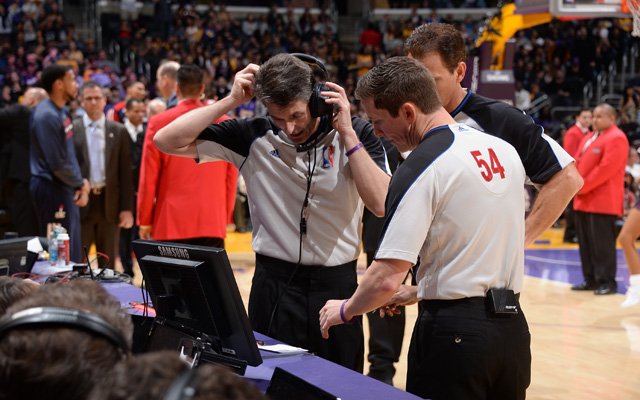
The idea for sports leagues regarding instant replay is to walk a line between fans' frustration with missed calls and the pursuit of fair play, and fans' frustration with games taking a long time, since it would consume more hours that could be spend inevitably arguing about the sports game they just watched online. But that's actually a myth. There's no line to walk. Fans will either walk away livid at key calls being assessed wrong, or moaning from having to spend a few minutes more watching a game.
They're not wrong, fans have a right for the money that's involved with being a sports fan these days to have the game fit within whatever their arbitrary demands are. It's just not possible to satisfy everyone. It's like my dad always said: You can't please everyone, so ... I don't know, I forgot because it was from an Eagles a Ricky Nelson song.
But the NBA's serious about two things: cutting down on game time and transparency about its officiating. Transparency has been a huge keyword for Adam Silver since he took over. And so it is that the NBA built a new facility this season to handle off-site review for instant replay.
Within the last three years, the NBA started formulating the plan for the new Replay Center, around the same time that Major League Baseball began to consider a similar process.
The stats:
• The NBA Replay Center in Secaucus, New Jersey features 94 monitors showing all games playing that night. Each game is managed by a replay operator who is devoted to that game. The facility has the capacity to import 300 billion bits per second, which seems like a lot. On a busy night, they'll process over 28 terabytes of data. Again, that's a lot.
• When a call is made that triggers a replay, the official signals that they want the review. The replay operator notifies the replay manager (there are up to three on duty and they basically oversee the process) and pull the relevant camera angles. The replay operator can pull from any camera feed available to the broadcast crew and show it to the officials reviewing the play. At this time, the NBA's SportVU cameras which track movement, aren't available (and the complex nature of the SportVu cameras may not make them helpful anyway).
• Previously, the officials would only have access to one view at a time. Now they can have a split screen of two angles to compare an event from multiple views.
It's a lot of information power tied into figuring out who the ball went off of or whether a foul was clear path or not. So is the purpose more driven to get the call right or to cut down on the time of replays?
"I don't think (there's an emphasis one way or the other)," NBA President of Basketball Operations Rod Thorn told CBSSports.com this week. "I think it was a combination of both. As we get more triggers for instant replay that's going to add some time. The idea that you can be more expeditious about having pertinent views when officials get to the sideline, making sure those are already available to them, that should help. The officials should make more good calls. There's a transparency issue here that the NBA's committed to."
Empowering the officials to do their job to the best of their ability is a huge part of this new process, Thorn says. And that's in part why the ultimate decision rests with the crew chief, and not with the replay center. But that doesn't mean the NBA hasn't considered giving final call authority to the Replay Managers in Secaucus.
"The views are so concise, so clear, it should be relatively easy to make whatever decision you end up making," Thorn says. "There was a conversation about (giving call authority to the Replay Center), and in fact, that may happen at some point in time.
"But our feeling was this is our first year, and our feeling was strong that the final decision should be in the hands of the crew and the crew chief. Down the road making that decision, who knows, you might see a day when a ref might have a chip in his ear, and he raises his hand to indicate that he didn't know if it was a 2 or a 3, and Secaucus might say it's a two, and you wouldn't have to stop anything."
The Replay Center was within the NBA's rights to institute according to Thorn, and wasn't collectively bargained with the officials' union, but a large part of this process was designed to help the refs.
"We did talk to the officials about it because it does alter to some extent their job descriptions," Thorn says.
So... is this thing actually working? It's too early to tell with way too small of a sample. But Thorn says the league is encouraged by the early results.
"Very much so. We don't have a big enough sample, but it's worked very well and we expect to do so. As you've heard Adam say, we look at everything we do, on a regular basis to make sure we're state of the art and to make sure it's done as well as we possibly can."
However, Thorn did reveal one interesting early trend. The average time of a replay last season was 90 seconds. In the first three days of the season, that number was cut to 49 seconds, a substantial decrease when you consider how many replays occur in a night to night basis for the audience.
Of course, that was before Saturday night's Wizards-Bucks game which by itself may have risen the average back to 2013 levels. OK, that's an exaggeration, but it does point to a trend that anecdotally factors in here. Fans aren't tracking how long a replay takes, they're only going to notice when one takes a long time. So while the overall process may net a reduction, perhaps even a significant or dramatic one in amount of time spent waiting on replays, as long as the crew chief is still in charge of the decision, it will feel the same way.
Would removing the decision from the crew chief take too much of the game out of the officials' hands? Is that a good thing? Would it reduce the time since the replay managers aren't physically in the arena dealing with the participants? Would the players be comfortable with someone who isn't officiating the game making calls that could decide the contest?
For right now, the NBA's just getting the program off the ground. What this does open the door for is an increase in replay triggers. And if you believe that those aren't necessary, keep in mind that on Sunday night, a key blown five-second call against the Hornets may have cost them a win against the Knicks. Getting those calls right matters for keeping the game as pure as the league can, it can impact standings playoffs, matchups, and in turn, contracts, job security, and revenue. There's a butterfly effect in play here, and beyond all that, the league under Adam Silver has a major commitment to transparency, a far cry from the more shadowy David Stern era.
"We want to help our referees which we believe are the best in the business to provide them the tools to enhance their performance," Thorn says.
Even if fans don't notice it, the league's put its money where its mouth is when it comes to accuracy, transparency, and maybe, saving you more time to yell about your favorite team online.