
How Russell Westbrook inadvertently allowed the Clippers to rediscover their defense by going small
The Clippers played their best defense in months against the Grizzlies by going small

By
Sam Quinn
•
7 min read
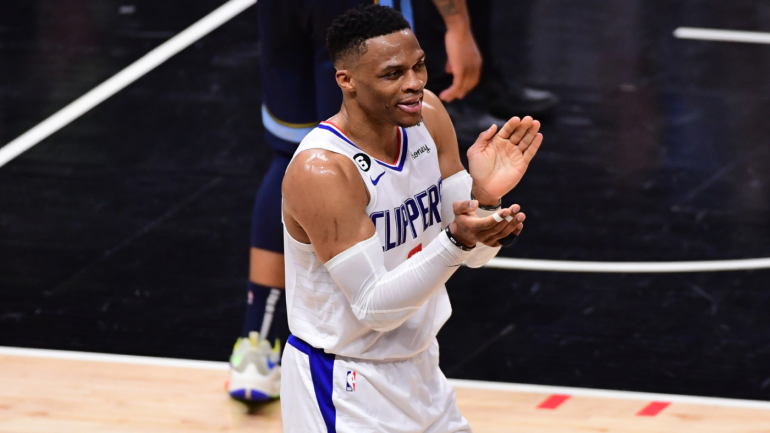
There is no shortage of candidates for the worst loss of the Kawhi Leonard-Paul George era in Clippers history. This team blew a 3-1 lead in the bubble. It suffered a 51-point home loss to the Dallas Mavericks months later, proceeded to lose three straight home playoff games to those same Mavericks, and this season, managed to blow a 14-point lead and allow 176 points in a loss to the Sacramento Kings. There are plenty of bad losses on this team's resume, but Sunday's game against the Memphis Grizzlies almost took the cake.
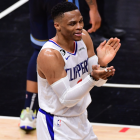
The Clippers took a bold step by not only signing Russell Westbrook after the trade deadline, but immediately breaking up a thriving lineup to insert him into the starting five. That decision yielded five straight losses. A sixth would have not only knocked the Clippers below .500, but tied them in the loss column with the hated Lakers, who got rid of Westbrook in the first place. They were at home playing a Memphis team missing four of its best players, including All-NBA guard Ja Morant. They led by double digits in the second quarter. And then they allowed 51 points in the third.
With roughly nine minutes remaining in the fourth quarter, the Clippers trailed the Grizzlies by 14. In a desperation measure, they removed Mason Plumlee from the game and played the remainder of the fourth quarter without a big man. They proceeded to outscore the Grizzlies by 20 points in the final nine minutes to win the game, 135-129.
I know what you're thinking: going small must have helped the Clippers properly space the floor around Westbrook, whose non-shooting is so problematic that teams guard him like this:
Draymond Green not even guarding Russell Westbrook 😳
— ClutchPoints (@ClutchPointsApp) March 3, 2023
Russ finished the 1st with 6 points and 3 assists.pic.twitter.com/6SYACLUuqX
There is some truth to that. The Clippers couldn't have won this game without an electrifying offensive performance down the stretch. Going small makes life easier on offense. The Grizzlies couldn't, say, trap Kawhi Leonard with Westbrook's man every time down the floor to force the ball out of his hands like the Kings did in Westbrook's debut because Westbrook still would have had three shooters to pass the ball to on the short-roll. But many of the shots the Clippers were making weren't exactly your typical small-ball shots. Leonard and Paul George made tough, contested jumpers to win the game for the Clippers. That's not what teams envision when they go small.
Besides, scoring largely hasn't been a problem for the Clippers lately. Even with Westbrook on the floor, they've scored 118.4 points per 100 possessions, which is just behind what the Kings, who have the NBA's No. 1 ranked offense, have scored for the season (118.6). No, the problem has come defensively, where the Clippers rank 24th since New Year's Day and have allowed 119 points per 100 possessions with Westbrook on the floor. The Clippers have lost games with Westbrook largely because they've failed to get any stops.
NBA dogma suggests that going small hurts your defense for the sake of your offense. That's often true. But one of Westbrook's former teams drew up a blueprint for defensive survival without a center. In 2020, the Houston Rockets eschewed the center position entirely by trading Clint Capela for Robert Covington. In some ways, they paid the price for it. They grabbed only 44.8 percent of total rebounds from that point on, worst in the NBA by such a margin that the gap between No. 29 Washington was closer to No. 16 Portland than Houston.
Yet if you look at the overall defensive numbers, Houston was just fine. They ranked ninth in defense once they acquired Covington, and despite their lack of size, eight teams allowed more shots in the restricted area than they did from that point on. So how did they do it?
- They generated the second-most turnovers in the NBA.
- They had the third most deflections.
- They switched everything defensively, allowing them to limit opposing 3-point attempts and induce inefficient post-ups.
- They doubled aggressively, especially near the basket, trusting that they had enough speed to rotate back into place.
It was a calculated tradeoff. In exchange for rebounds and shots near the rim, the Rockets took away high-value 3-pointers and generated more transition opportunities through turnovers. Considering the offensive benefits of playing small, it worked in their favor. Intentionally or not, the Clippers saw similar benefits when they went small on Sunday. Between the 8:59 and the 1:27 marks of the fourth quarter, the Clippers allowed only two total points. They did it largely by taking a page out of Houston's old playbook.
Memphis consistently tried to get to the basket in that seven-and-a-half minute stretch, but whenever the Grizzlies did, they were stymied by the extra help. Paul George's double here is what draws the offensive foul out of Jaren Jackson Jr.
Xavier Tillman, whom Memphis wanted to get the ball to because he was being guarded by the far smaller Eric Gordon, travels on this play after after George gets switched onto him.
Something similar played out a few possessions later. The Grizzlies considered Tillman inside against Leonard a mismatch. George came and doubled. Tillman missed.
On all three plays, the Clippers bet that the Grizzlies would force the issue down low due to perceived mismatches. When Memphis did so, the Clippers forced turnovers. When you're that small, you have the speed to help if those mismatches prove problematic. That speed came in handy on this next clip. Leonard starts the play on Tyus Jones, but after Marcus Morris got switched onto him, George jumped over to hedge, Westbrook rotated over to Bane, and Leonard, knowing where Bane would see the pass, played free safety and nabbed an interception.
Westbrook picks up a similar steal soon after. Memphis swings the ball around once Leonard stays in to help on a Bane drive, but the Clippers rotate effectively enough to generate a turnover the moment the Grizzlies have a misstep. In this case, David Roddy expects Morris to stick on Jackson in the corner. He doesn't, and Westbrook picks off the pass back to the corner as he was rotating over to Jackson.
The Grizzlies attempted 34 3-pointers for the game, but in this key seven-and-a-half minute stretch, they took only four. It's not hard to figure out why once you look to the tape. The Clippers, especially Westbrook, made an effort to run the Grizzlies off the line. On this play, Westbrook closes out hard on Luke Kennard, but gladly concedes the baseline for a drive because he trusts the defense behind him. When Kennard passes it to Jackson in the other corner, George is able to provide a better contest.
Westbrook again concedes the baseline on this Kennard look because he knows George is behind him. This time, however, Kennard settles for a mid-range jumper and misses it.
This variety of defense is hardly fool-proof. The lone basket Memphis scored in this stretch of evidence of what can go wrong. Gordon clearly expects Leonard to switch onto Bane here, but instead, Leonard takes Tillman and Morris sticks with Tyus Jones. That gives Bane a clean driving lane to the basket.
But for almost eight minutes on Sunday, the Clippers had seemingly landed on a defensive approach that could work. When all five of their players are locked in, they are long enough, fast enough and strong enough to successfully execute this aggressive variety of small-ball defense.
Does that mean they are going to adopt it full-time as the Rockets did? Probably not. Zubac is a strong defender when healthy, and Westbrook is an excellent dump-off passer to big men when he drives. Perhaps more pressingly, this style is incredibly taxing, especially on the wings who wind up guarding big men. The Clippers know this from experience, because they played a version of it against the Mavericks in the 2021 postseason.
But defense has been a problem for the Clippers for months now. Offense might become one when the postseason arrives and opponents game-plan more aggressively against Westbrook. Small-ball can theoretically solve both problems, and the Clippers have the personnel to play it frequently. Their best small-ball center, Nic Batum, wasn't even on the floor for this stretch. Neither was Covington, who was a critical component of the success Houston had in 2020 and is now glued to Ty Lue's bench. It's not going to be a cure-all, but in their biggest game of the regular season, it saved the Clippers from what would have been a humiliating loss to the Grizzlies.