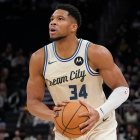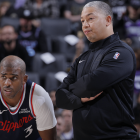

Mired in mediocrity, is this the end of the road for Stan Van Gundy's Pistons?
A look at how Detroit got in this mess and how it could get back on the right track

•
7 min read
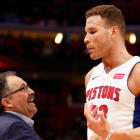
The Detroit Pistons are stuck in the NBA's Bad Place: The middle of the pack. While there are three weeks left in the regular season, the ninth-place Pistons' campaign is effectively over. They are 11-14 with Blake Griffin in the lineup, a serious disappointment after the four-game winning streak that kicked off his Detroit career. This team will miss the playoffs for the third time in president and coach Stan Van Gundy's four-year tenure, and, thanks to the Griffin trade, its fans cannot even look forward to the draft.
The good news: They are capped out, with a combined $74.6 million tied up in Griffin, Andre Drummond and Reggie Jackson next season. Wait, no, that's not good news at all!
This state of affairs has led to rumors swirling about the future of Van Gundy, who has handled all this with the breezy confidence of someone who has worked in the NBA for decades and doesn't need to work another day of his life. From The Athletic, back on March 10:
"Look, I've said before, if I'm not here next year, I'm not chasing jobs anywhere else. You can come look for me on my lake in the summer here, or on my porch in Florida in the winter.
…
"I absolutely have no worries about [my job] whatsoever. What I worry about, and what keeps me up at night, is the fact that we lost 10 of 12 coming into tonight. That bugs the crap out of me. That drives me nuts. What decision [owner Tom Gores is] going to make at the end of the year, that doesn't worry me even a little bit."
The Pistons have now won four of five, but the wins have come against the Bulls, Suns, Kings and Lakers. Their most encouraging recent game was might have actually been their loss to the Rockets last Thursday, which went to overtime and saw Detroit slow down the league's best offense like few have done this season. Can this core get over the hump? Will Van Gundy have to make major changes in order to save his job? Let's take a look at how the Pistons got here and where they might be going.
Where did Van Gundy (the executive) go wrong?
Some would say this all started when Jackson signed a five-year, $80 million deal in July 2015. In the first season of that deal, though, a healthy Jackson averaged 18.8 points and 6.2 assists and Detroit made the playoffs with its entire offense revolving around him and Drummond running pick-and-rolls. Others have scoffed at the risky move for Griffin, which sacrificed any semblance of financial flexibility. I contend that the smaller moves had bigger consequences.
Since the summer of 2014, when Van Gundy and general manager Jeff Bower took over the front office, the Pistons have signed useful, but replaceable free agents and failed to hit home runs in the draft. There are no cap-crippling moves like paying $72 million for four years of Luol Deng here, but in this climate teams will have a hard time competing by simply signing players to fair contracts -- they need favorable contracts. Here are some key transactions:
- July 2014: Signed Jodie Meeks for three years and $19.5 million. Meeks fit terrifically in the 60 games when he was healthy in Van Gundy's first season, but missed all but three games in 2015-16 and was dumped to the Magic in 2016.
- July 2015: Signed Aron Baynes for three years and $20 million. Baynes was a solid backup for two seasons, but declined his third-year option and took less money to sign with the Celtics last summer.
- July 2016: Signed Ish Smith for three years and $18 million; signed Jon Leuer for four years and $42 million; signed Boban Marjanovic for three years and $21 million. Smith is still kicking around; Leuer played just eight games this season before having ankle surgery; Marjanovic appeared in only 54 games in two seasons before being included in the Griffin trade.
- July 2017: Signed Langston Galloway to three-year, $21 million deal. He has shot just 37.8 percent this season and is currently out of the rotation.
Taken individually, there is not a deal here that is extremely harmful. Together, though, they point toward a bigger theme: Making mostly safe bets on role players with limited upside. There has also been poor injury luck.
The draft has been similarly underwhelming for Detroit, but Henry Ellenson, picked No. 18 in 2016, is the only selection that looks outright bad right now. Can you blame the Pistons for taking Luke Kennard -- a wing who is having a fine rookie season, shooting 40 percent from deep -- one spot ahead of Donovan Mitchell when a bunch of other teams missed on Mitchell, too? Is it totally fair to say Detroit made a mistake by taking Stanley Johnson with Devin Booker on the board? Maybe not, but it looks like the best pick they've made in the Van Gundy era was nabbing Spencer Dinwiddie at No. 38 in 2014 ... only to waste it by trading him to the Bulls after two seasons in which Dinwiddie was given few opportunities to play.
The Pistons deserve some credit for getting Marcus Morris and Reggie Bullock for almost nothing in the summer of 2015 and Tobias Harris for spare parts in February 2016. The Jackson trade and the Anthony Tolliver acquisition were nice moves, too. They have desperately needed another above-average creator when Jackson has been hurt over the past two seasons, though, and it is impossible to argue that they have allocated their resources correctly.
If Van Gundy sticks around, what can he do to right the ship?
As Van Gundy tells it, Detroit's roster is better than the standings would indicate.
"I've said this before, whether we see it or not this year, with a combo of Reggie, Blake and Andre, and Bullock and Luke coming on, we can be a really good team," Van Gundy said after Monday's 112-106 win over the Lakers, via The Athletic's James L. Edwards III.
Jackson recently returned from an ankle injury and has played only 47 minutes with Griffin. The other four players have still only played 61 minutes together, but, for what it's worth, the Pistons have outscored opponents by 13.2 points per 100 possessions in that time, per NBA.com. This makes sense: Bullock has made an absurd 44.2 percent of his 3s this season; and Kennard has consistently made teammates better as a rookie. Theoretically, I can get behind this unit -- and lineups with Johnson -- helping Detroit get back in the playoff picture next season.
The problem is the rest of the roster. Leuer can sop up some minutes, but he's not changing the trajectory of the franchise. Tolliver will be a free agent in July. The Pistons desperately need internal improvement, but it's not clear where that improvement is supposed to come from. All they have to work with in the offseason is a $7 million trade exception and the $5.3 million taxpayer mid-level exception. It is in this context that ESPN's Zach Lowe suggested they could trade Drummond as he is coming off the best season of his career.
If Drummond isn't traded, Van Gundy isn't fired and this core gets another chance, the most fascinating player in Detroit will be Griffin. A few years ago, he was seen as an MVP candidate; now, his flaws -- he does not protect the rim, he does not really stretch the floor -- are discussed about as much as his strengths. These are genuine concerns for a big man in the modern NBA, and Van Gundy might have to convince him to change his game in order to get the most out of him.
This season, Griffin has made 63.8 percent of his shots in the restricted area, but his floaters and jumpers have been off the mark, per NBA.com. He has taken 173 shots in the paint but outside the restricted area and made just 34.1 percent of them. He has taken 161 midrange shots and made just 30.4 percent of them. As uncomfortable as it might be, in order to reclaim his place as a superstar he either needs to get way better in those areas or come back with a drastically different approach.
Griffin and Drummond can work together as long as they don't let opposing teams off the hook by playing an antiquated style. They must bully people in the paint and facilitate open looks for their shooters. They must dominate the glass and beat other big men down the floor in transition. As teams like the Raptors and Jazz have shown this season, you can get away with two-big lineups if you are creative about it. Detroit has outscored opponents by three points per 100 possessions with the two of them together this season, and that number could rise in a couple of different ways. One is for the supporting cast to get a bit better; another is for Griffin to evolve within Van Gundy's system. If neither of these things happen, then the Pistons will likely remain in the NBA's messy, mediocre middle.