NBA Finals: Cavs living dangerously with strategy to push the pace in Game 2
Should Cleveland slow it down or go right at high-scoring Golden State?

By
Matt Moore
•
4 min read

OAKLAND, Calif. -- On the surface, it appears that the Cleveland Cavaliers have lost their minds.
Two days after being torn to shreds by Golden State's transition attack -- the Warriors piled up 27 fast-break points in their 113-91 victory in Game 1 of the NBA Finals -- the Cavaliers insisted Saturday that they plan to try and push the pace more in Game 2. Such a strategy would seems to play into the hands of the Warriors' chaotic brand of attack.
"You can't play with pace when you turn the ball over," LeBron James said. "That's one thing we did in Game 1 that we're going to be very conscious about going into Game 2, especially on their home floor. We're a team that plays with pace. We know that. And in order for us to be as good as we can be offensively, we have to play with pace. But we have to control the ball as well."
The Cavaliers were seventh in pace this season, which measures possessions per game, and tied for ninth in fast-break points per game, while Golden State led the league. However, and this is where it gets interesting, in last year's Finals the Cavaliers outscored the Warriors 115-66 in fast-break points. This means that on one level, the Cavs' assertion is correct, they've had success pushing the ball vs. the Warriors. On the other, it means that the Warriors had 40 percent of their fast-break point total from last year's Finals in Game 1.
There's no way to remove this component from the turnovers, with the Cavs giving up 21 points on 20 turnovers in Game 1. But the overall question of pace is vital for this series. If the Cavaliers are wrong that they should push the pace and not slow the game down, they may not realize that until this series is already out of hand. If they're correct, on the other hand, it means that the Cavaliers have a game plan in mind that has some evidence based in their historic comeback.
"Not at all," Cavs forward Richard Jefferson said when asked if the Cavaliers should pump the brakes. "We have the best downhill guy in the NBA. When you combine that with Kyrie and his ability to finish in transition, when we get out in transition, it allows guys like JR and guys like Kyle Korver to hit open shots. So we don't want to slow up the pace, but we're going to have to turn them over more than we did. I would say in the half court we have better one-on-one players, but in the half court they probably have a little better system"
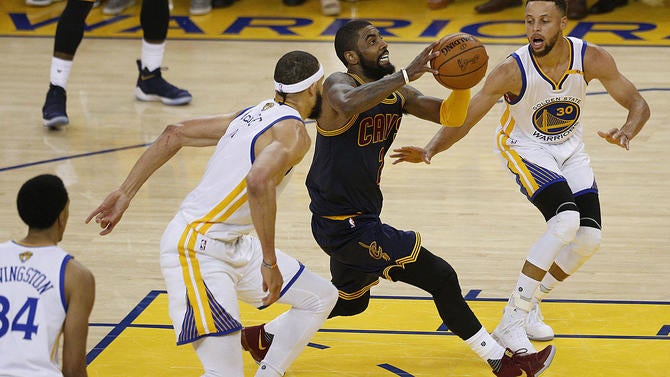
There's a note in these comments better exemplified in what coach Tyronn Lue said. Playing with pace for the Cavaliers does engage some of their individual talent. But there's also this: Going into the teeth of the Warriors' set defense is a nightmare and they have to create easy looks, and transition is about the only way to do that.
"When we get stops, we have to get out," Lue said. "We have to play with pace. We've got to play in transition. They're a great team in the half court, as far as loading up and taking away what they want to take away. So when we get stops, we have to get out and run and play with pace."
The stops part is obviously key, but it speaks to a more subtle dynamic. Some teams genuinely want an up-and-down game. The Warriors are one. They feel confident in their ability to get stops in transition, and if not, they want to push the energy and spread the floor which engage those massive gameplan-imploding runs they can go on. Other teams, like Mike D'Antoni's Rockets or Suns, after which the Warriors have borrowed heavily, are willing to just trade baskets with you, up-and-down.
This is not what the Cavs want. They want to create fast-break opportunities and slow Golden State down. They want to run, selectively, and with purpose, to make it a one-sided affair. Some of this is modeled after success the Thunder had vs. the Warriors last year. They flipped the script on Golden State, attacking them in this area they're supposedly so good at, the transition play, and it worked.
The Cavs, likewise, had a 1.099 points per possession mark on transition plays in last year's Finals, the Warriors had just a 0.90 mark. It wasn't just the volume of opportunities, (Cleveland had 124 transition possessions to the Warriors' 100, via Synergy Sports), it's that the Cavs were considerably more efficient in those possessions.
The problem with this line of thinking, of course, is that this Warriors team is not last season's Warriors team. That Thunder team that attacked them in transition did so in part with the very player now playing forward for the Warriors, Kevin Durant. And this year's Warriors team has a better defensive rating (98.3) in the playoffs than last season's team. Their regular-season mark was up only slightly, despite most defensive ratings being way up for teams this year in an offensively explosive season.
If the Warriors are simply too powerful, too overloaded, the Cavaliers might need to revert to the tactics they used in 2015 which did feature more attempts at slowing down Golden State. But on the other hand, the Cavs would undoubtedly suggest that simply not giving the ball to the Warriors on run-out situations over and over again would probably help.
Either way, this philosophy from the Cavaliers will be put to the test, and if it fails in Game 2, it may set up a breaking point in Game 3 where they have to decide whether to abandon that approach entirely and regroup, or go down with what they feel is the best plan of attack they feel they have.
Game 2 of the NBA Finals is Sunday in Oakland.