NBA Playoffs 2017: Five things to know about the Clippers-Jazz series
This is the closest series to call, despite the Clippers' edge in experience

•
5 min read

We didn't know who would have home-court advantage in the Los Angeles Clippers vs. Utah Jazz series until the last night of the regular season, and that feels right because it's incredibly difficult to figure out which team should be seen as the favorite. They both overcame significant injuries and finished with identical 51-31 records, with the Jazz finishing fifth in net rating (+4.7) and the Clippers finishing sixth (+4.5). Before Game 1 on Saturday night, here are five things to know about what could be the best first-round series of them all:
The Clippers have been inconsistent but …
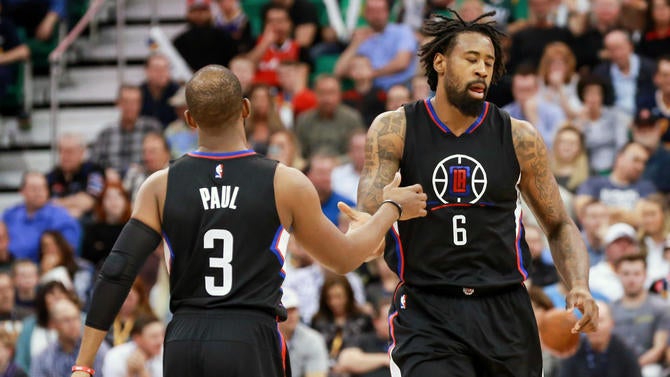
You shouldn't let the wild variations in their play distract you from the fact that this is still an excellent team built on a formidable foundation. Los Angeles had the league's fourth-best offense and sixth-best net rating despite all its ups and downs, and, even if you believe the front office needs to shake this team up, you must acknowledge that it would be messing with something special. The Clippers' starting five of Chris Paul, J.J. Redick, Luc Richard Mbah a Moute and DeAndre Jordan outscored opponents by 15.8 points per 100 possessions, which is down a little from 19.4 per 100 last season but still a fantastic mark.
It's not completely crazy to doubt the Clippers because of how out of sync they've looked at times this season, the uncertain futures of Paul, Griffin and Redick hanging over their heads and the ghosts of playoffs past haunting them. I hesitate to ascribe too much meaning to any of it, though, as they have still been one of the better teams in the league on balance. Also, if you were paying attention to the way they were clicking in the first month of the season, you know that they are capable of being elite on both ends of the court. Not many teams can say that.
One last argument for the Clippers' legitimacy: If you believe in momentum, then you have to be encouraged by the way they closed the regular season. They won 11 of their last 13 games, with the best net rating outside of the Bay Area and an even better offensive rating than the Warriors during that stretch.
The Jazz's offense is the big variable
Aesthetically, you have to like what the Jazz do. They pass the ball like crazy, they make opponents guard multiple pick-and-rolls in the same possession and they attack in a variety ways. Gordon Hayward is their No. 1 option, but Rudy Gobert has developed into one of the most dangerous offensive big men in the league by being a lot like Jordan -- he's an excellent roller, finisher and offensive rebounder. All of their wings can run pick-and-rolls, and when Joe Johnson is playing power forward or Boris Diaw is on the court, both veterans can either go to the post or play on the perimeter.
There's a ton of versatility here, which is very 2017 and also very good. The issue is that Utah likes to slow the pace to a crawl, which is perfect for its half-court defense, but can put the team in late-shot clock situations on the other end. They finished 12th in offensive efficiency in the regular season, and they were 21st in turnover percentage because, if you're constantly whipping the ball around, you are at greater risk of turning it over. If you're like me, you might find yourself yelling at your television to pick up the pace and be more decisive, especially if the Clippers are as locked in as I assume they will be.
The funny and frustrating thing about Utah is it is the most effective transition team in the league. Per Synergy Sports, it averages 1.217 points per possession in transition. It also only used 9 percent of its possessions that way, which is less than every team in the NBA aside from the extremely deliberate Dallas Mavericks (8.8 percent). As a point of reference, the Warriors finished second at 1.207 PPP, but they were in transition a league-high 18.5 percent of the time.
Get ready to hear a lot about experience
Announcers are going to talk about how George Hill, Johnson and Diaw have transformed the Jazz, not just because they're deeper now but because they've all played deep into the playoffs. Utah hasn't made the postseason since being swept by the Spurs in 2012, though, and Hayward and Favors were second-year players then.
The Jazz's pieces seem to fit well, but Hill only played 49 games this season and many of them were with other starters injured. There's an easy contrast to be drawn with the Clippers, whose best players know each other's games as well as they possibly can. Los Angeles' starting five might have the highest collective basketball IQ of any lineup in the league, and while its edge over Utah's might be smaller than people think when it comes to talent, it has a massive advantage in familiarity, especially in high-pressure situations.
The pick-and-roll dance
Given its ubiquity, it seems redundant to say the pick-and-roll is a thing to pay attention to, but hear me out: This particular matchup features two of the best defensive pick-and-roll tandems in the league: Paul and Jordan, and Hill and Gobert. Since the point guards are difficult to take out of the play and the centers can drop back and defend two players at the same time, the other three players rarely have to help.
On the other end, Paul is the Clippers' pick-and-roll maestro, manipulating defenders and using all sorts of misdirection and sorcery to create good looks. The Jazz don't exactly have a maestro, but that's part of what makes them who they are. Hayward, Hill, Hood and Johnson might be able to tire Los Angeles' top-heavy roster out by routinely making them defend for close to 24 seconds at a time and contend with pick-and-rolls on both sides of the court. It'll be interesting to see how this works and how much switching both teams do.

Playoff Speights!
You might see Mbah a Moute's 3-point shooting or Favors' health as the X-factor here. That's fair, but I'm more interested in what happens when Marreese Speights is on the floor. The point of using him in this series is to draw Gobert away from the basket to account for Speights' 3-point shooting. It worked for the Clippers in 21 minutes during the regular season, but you can be sure Utah will try to take advantage of Speights' defensive deficiencies whenever the Clippers throw him out there.