
Pacers must maximize Paul George's prime as they forge new identity
As the Indiana Pacers adapt to a new identity and style of play, there should be concern about whether or not it wastes great years of Paul George on the court.

By
Zach Harper
•
4 min read

The tricky part of trying to build a winner is balancing sustainability and maximizing your strengths. It's something every general manager and president of basketball operations struggle to do. They try to win now as well as build long-term, title-contending teams while managing the business side of the salary cap and luxury tax penalty. These pressure-filled tasks are all interwoven constantly.
That's what makes the decision by the Indiana Pacers after last season to move away from "Bully Ball" and become a faster, smaller team so fascinating. On the surface, everything is working out great so far. The Pacers have been a nice surprise so far this season, posting a 9-5 record while taking very little time to get a good balance on the court with their new style of play.
Concerns over a big man rotation of Ian Mahinmi, Jordan Hill, Lavoy Allen and rookie Myles Turner haven't come to fruition on the court. Frank Vogel's willingness to be adaptable with his lineups has helped yield positive results as the team. The Pacers have had a below average strength of schedule so far, but ranking 17th isn't exactly an indictment on who they've had to play thus far, either.
The move to embrace the modernity of the NBA has been hard for some to accept and now something other teams are hoping to copy. And the backlash to those copying efforts is already out there because just playing small isn't the solution to adopting this new style. You need to have the correct personnel to be able to play this way and you have to have those smaller players willing to accept the brutality of playing a position typically dominated by bigger, stronger guys.
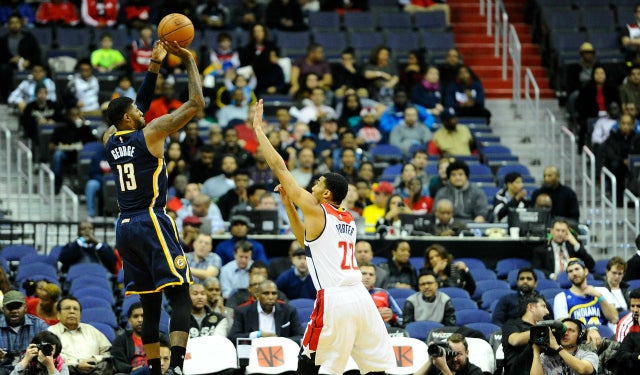
There was hesitancy with Paul George playing the stretch-4 position before and at the start of the season. As he fully returned from the broken leg he suffered in the previous year, George was going to have to endure more punishment as a 4 than he normally would as a wing. That's a tough sell to a lot of wing players because being able to sustain your play on the court and remain healthy can be the difference between being an elite player and being someone who doesn't realize their full potential.
George has excelled so far this season, posting averages of 25.9 points, 8.4 rebounds, and 4.8 assists with a true shooting percentage of 59.7. Those are absurd numbers. Here is the list of players who have accomplished that in a season. It is exclusive and impressive:
My concern over putting George at the 4 or the Pacers just generally changing their style of play so suddenly is about wasting their star's prime years. Because sustainability is so difficult to procure in such a chaotic and volatile league that almost promotes turnover with their current collective bargaining agreement, carving out a new identity for your team may not be an instant thing. While the current state of the Pacers looks promising, we don't know how successful this season will end up being by April.
If it only takes a year for Larry Bird to work his magic and by the end of next summer the team looks set moving forward with their new style, then you've put yourself far ahead of the game. That may take a certain level of luck either in drafting, free agency, or even working trade angles. However, what if it takes three years to get the Pacers where they want this ship to be? Is there an unavoidable risk in essentially sacrificing George's incredible play from 25-28 years old in order to build the team into a more modern style of play?
Or is that too dramatic of a concern to have as the Pacers not only look to catch up with the current brand of basketball winning around the league, but eventually try to get ahead of it by having such an elite talent like George to push them to another level?
At a certain point, the defense of this style of small ball, dribble hand-offs being impossible to defend, and spreading the floor in a dynamic fashion will have arrived. The greatest new thing in basketball eventually gets solved defensively, either by brilliant strategists or a rule change that brings about a new wrinkle to everybody's attack. Some people around the league wonder if there will eventually be a way to counter it with "Bully Ball," which could be an ironic shift regarding Indiana since it abandoned this identity in search of something much more uniform.
In the meantime, George may just be so good that they're able to stay afloat and even surge ahead with whatever identity they're attempting to carve out for themselves. And in that sense, the concern about wasting these next couple of seasons while they put the right pieces in place becomes null.
The key to it all will be smart personnel decisions, great coaching from Vogel and a little bit of luck with injuries that prevent any medical derailments of what they're trying to accomplish. The copycat league still very much exists and that can always leave certain franchises chasing what others are doing instead of setting the next trend that is being chased. George is so good that you would hate to see them always chasing with him, instead of allowing his dynamic play set the standard for what their opponents are trying to reach.
They have the strength to maximize figured out with getting George to be their superstar few others can match. Now how do the Pacers build that sustainability around him? And how long will that truly take? That's the tricky part.