Russell Westbrook-Chris Paul trade: Unpacking all angles from a stunning Rockets-Thunder blockbuster
Did the Rockets just mortgage the future to get worse?

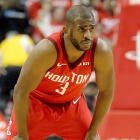
The NBA needs to get some rest. This isn't healthy. Just as the wildest free agency period in history was starting to settle down, the Houston Rockets have reportedly acquired Russell Westbrook from the Oklahoma City Thunder in exchange for Chris Paul and another slew of draft picks to add to OKC's suddenly overflowing trove of assets.
The Oklahoma City Thunder have agreed to trade Russell Westbrook to the Houston Rockets for Chris Paul, first-round picks in 2024 and 2026, pick swaps in 2021 and 2025, league sources tell ESPN.
— Adrian Wojnarowski (@wojespn) July 12, 2019
Here are five quick takeaways in the early hours of this deal.
1. Who won this deal?
This is obviously the first question we need to ask, and there is an equally obvious answer: The Thunder. They basically get two first-round picks and two pick swaps for free. Chris Paul, all things considered, is arguably better than Westbrook to begin with (clearly not on the stat sheet, but in terms of overall impact on winning), and he has one less year left on his contract, so he'll either come off the books sooner if the Thunder keep him, or arguably be even easier to move in a subsequent trade for even more assets.
For anyone arguing that Paul doesn't effect winning more than Westbrook, consider that out SportsLine projections, which are based on 10,000 neutral-court simulations, have the Thunder gaining almost five wins with Paul flipped in for Westbrook, and their playoff chances go up almost 40 percent.
Oklahoma City | Win | Win% | Playoff | Seed | Conference | Championship |
Before trade | 41.4 | 50.5% | 38.8% | #9 | 0.5% | 0.1% |
After trade | 46.1 | 56.2% | 75.9% | #7 | 0.8% | 0.2% |
Difference | 4.7 | 5.7% | 37.1% | +2 | 0.3% | 0.1% |
Numbers aren't everything and basketball isn't played inside a calculator, but that's notable. As for Houston ...
2. How does Westbrook help the Rockets?
Shortly after this deal went down, I sent the following text to a Western Conference exec: "I feel like the Rockets just traded a bunch of picks to get worse." The exec texted back: "I cannot disagree."
Again, numbers aren't everything, but our SportsLine projections indeed have the Rockets getting slightly worse after this trade.
Houston | Win | Win% | Playoff | Seed | Conference | Championship |
Before trade | 50.1 | 61.1% | 95.8% | #5 | 9.2% | 4.4% |
After trade | 49.8 | 60.7% | 95.1% | #5 | 8.6% | 4.0% |
Difference | -0.3 | -0.4% | -0.7% | -- | -0.6% | -0.4% |
The old "there's only one ball" argument gets overused; stars find ways to make it work all over this league now. But Westbrook and James Harden feels like a special case. Westbrook is just not an off-ball player. And he's a terrible 3-point shooter -- 29 percent from deep the past two seasons. Given Houston's obsession with Harden playing one-on-one and everyone else shooting 3s, for real, how does this work?
I get the trade-off routine. One possession Harden, next possession Westbrook, and in general Westbrook has become too derided. He's a great player in a vacuum. But in this case, it feels like Daryl Morey was looking more at the name than the game. The Rockets love their stars, bottom line.
"New dynamics and energy for Houston," an NBA exec told CBS Sports. "I worry about the spacing, and what pace to they play at?"
It's true. The Rockets play a very methodical game of matchup-hunting and one-on-one exploitation. Westbrook is clearly at his best getting out in the open floor and charging his way to the rim at full speed. In the half-court, he's a pull-up mid-range enthusiast, the exact opposite of Houston's analytical beliefs.
To me, this says two things: Chris Paul, despite his denial of the situation, did not want to be in Houston any longer. And the Rockets feel desperate, when I'm not sure they need to be. The only team that got in the way of the Paul-Harden Rockets was the Kevin Durant Warriors, and they're not the Durant Warriors anymore.
Two years ago the Rockets traded Patrick Beverley, Lou Williams and Montrezl Harrell (all three really good players), plus a first-round pick to the Clippers for Paul, and they were a fingernail from probably winning a title. Now they're trading four first-round picks to flip Paul for an arguably worse player with over $170 million left on his contact.
We'll see.
3. Will OKC keep Paul?
My initial thought when this deal went down is that OKC likely has the intention of moving Paul for a whole new package of even more assets, and it still might do that. But for now, Sam Presti reportedly did this deal with the intention of keeping Paul.
For those wondering, source tells @TheAthletic that OKC does this deal with full anticipation that Chris Paul will be part of a good team that now has a treasure trove of future assets. Gallinari, SGA, Adams, Roberson, Noel core, and EIGHT new 1st rounders, as @Travonne noted.
— Sam Amick (@sam_amick) July 12, 2019
Presti has a huge opportunity here, if he wants, to basically do this deal twice -- trade Westbrook for a ton, then trade Paul for some more. ESPN's Adrian Wojnarowski is reporting that Houston tried to involve a third team in the deal that was a more preferable destination for Paul, but that now it's up to OKC whether it wants to facilitate another move.
Houston hoped to find third-team destination preferable to Chris Paul, but ultimately leaves it OKC to execute next step once Presti confers w/ CP3 agent Leon Rose. Miami remains possibility for Paul (3 years, $124M) -- and OKC obviously has picks to incentivize deal, if needed.
— Adrian Wojnarowski (@wojespn) July 12, 2019
To Wojnarowksi's point, the Thunder are loaded with first-round picks to attach to Paul if they really want to get aggressive for younger talent more in line with a rebuild. They could still move Danilo Gallinari, who is on an expiring deal and would help a lot of teams in win-now mode.
If the Thunder keep Paul, it's true, they still look like a pretty decent team. But in the West, a pretty decent team -- in fact, a few of them -- are going to miss the playoffs. This situation feels ultra fluid, regardless of what Presti says about keeping Paul.
4. Where does this put Houston in the West?
Honestly, roughly the same place it was in before the deal -- arguably top four. The ceiling feels the same: Everything goes right, Westbrook has a career shooting year, Harden dominates again, the defense holds its own, the Rockets can make the conference finals and take their chances from there.
But Westbrook and Harden feels like it has a lower floor that Harden and Paul, even considering it appears they were sick of playing with one another. Westbrook could have huge problems playing off ball and end up frustrated and take a bunch of bad shots and this thing could go south in a hurry.
Look at it like this: Westbrook and Paul George, with some pretty good players around them, couldn't get out of the first round. Harden is probably better than George, but not by much. How are Harden and Westbrook going to be significantly better than George and Westbrook? Houston does have a bit better peripheral shooting than OKC did, namely in the form of Eric Gordon. Paul is a way better defender than Westbrook. In the end, for Houston, it sure feels like a lot of risk without the incentive of significant reward.
5. Is OKC a playoff team as it stands?
Borderline. I had the Thunder out after George left, so now that I think they're closer to getting in tells you I think Paul is better than Westbrook. The Spurs are the only team I can see falling out in favor of this iteration of the Thunder. The West is just brutal. Oklahoma City in the East could be playing for a 5-seed. If I had to bet, I wouldn't be very comfortable saying they'll make it in the West, which is why I see Chris Paul eventually being moved as a real possibility.