The Cavaliers' problems are difficult to identify, and even harder to correct
A look at the Cavs' myriad X's and O's issues in the wake of LeBron James' recent complaints and discord.

By
Matt Moore
•
7 min read

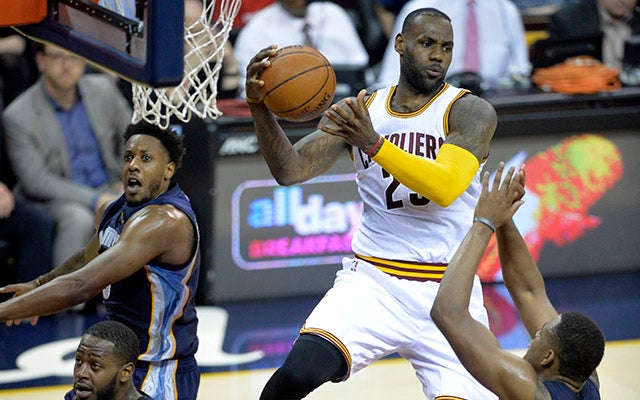
The Cleveland Cavaliers are a mess right now, which is an impressive feat when you're 44-17 and the presumptive favorite to represent the Eastern Conference in the NBA Finals. There's plenty to dissect about LeBron James' cryptic tweets, the reports of discord between James and Kyrie Irving, and the possibility that James could leave in free agency. You know, again.
However, buried somewhere in the funk, and the turmoil, there are actual basketball problems, and they deserve some examination.
The issue, like everything with the Cavaliers, is trying to find actual evidence for what the Cavs' problems are, because any surface examination of the Cavaliers yields nothing to which you can directly point. Their resume checks out, with quality wins over the Spurs, Clippers, and Thunder. Their advanced metrics check out, with a top-five offense and a top-10 defense per 100 possessions. They have superstar talent, unlike the Celtics. They have experience winning playoff series, unlike Toronto. You can pore over every piece of available evidence and not come up with a conclusive argument that says anything but the Cavs are a great team that will make the Finals and their only problem is not being better than the Warriors.
And yet, something is off. Maybe it's just the way we see the Cavs -- or the way we want to see the Cavs. Let's look at the situation independently. Throw out all bias. All expectations. A little double-blind study.
THE "TEAM A" HYPOTHESIS
Let's say that Team A has a series of problems:
Its biggest, glaring issue is that its best individual player, an admittedly otherworldly talent that can play at an All-Star level at any position on the floor, needs to play at power forward. That's the lineup formation that produces both the best results and makes the most sense for the surrounding players. Problem is, playing said player at power forward takes up minutes for the team's third-best player. Having these two players who both need to play power forward means that you have a huge, glaring inefficiency that the team is constantly trying to work around. Basically, they have more talent for a position than they have minutes. And that's just the offensive problems. On the other end, you can hardly afford to even play those two players together because the defense falls apart like a stick tent in a hurricane.
Speaking of the defense, that's Team A's biggest problem. While they should have a strong capability for it, and even have some defensive metrics that suggest it could be a strength, it's very clearly an area of concern. It's not just personnel, it's scheme and mental approach. Unless Team A can discover that kind of approach to balance out its incredible offensive firepower, a championship isn't happening.
The roster itself has a lot of things that just don't make sense. Redundancies, players who need more time having to come off the bench, and a massive center whose plus/minus is such a disaster that you almost can't play him, despite the need to pair that previously mentioned best player mentioned previously with a strong rim protector.
It seemed apparent that to get where they need to go, they needed to change coaches. Despite the success they had with their previous coach, there were enough Xs and Os issues to suggest they'd be better with a replacement. Unfortunately, the new coach has only exacerbated their issues.
For all of these problems, you can't just give up on the team completely, because they win enough games to keep them within the range of the championship conversation, and their offense is so good that you're left thinking they still have a chance based on that talent alone. Still, when you look at the overall makeup and "vibe" of the team, it's hard not to consider them a disappointment.
"Team A" is, of course, the New Orleans Pelicans.
BIG, GIANT, HUGE, YOU-NEED-TO-READ-THIS-WHICH-IS-WHY-THIS-PART-IS-IN-BOLD CAVEAT: The Cavaliers are obviously not the freaking Pelicans. New Orleans is basically donezo for the playoffs, their defense isn't anywhere close to being as good as Cleveland's, LeBron James has been far superior to Anthony Davis, the list goes on and on. The point of this exercise is not to say that the Cavaliers are basically a souped-up version of the Pelicans. Positional roster redundancy is not indemic to only the Cavs and Pelicans; that problem is shared by several teams.
The Cavaliers have won 20 more games this season than the Pelicans, and no conversation about the process is going to get around the fact that the Cavaliers have won more games and that is not based solely on injuries or schedule. (Though New Orleans has had terrible injury luck, as it seems to every year.)
The point is that if you look at the specific profiles, there are issues with the Cavaliers' "basketball DNA" that look a lot like what's going on with New Orleans, the problems are just much more severe because of what we expect out of Cleveland. The Cavaliers' defensive numbers look really good, but there's still a concern that they don't have a formula to attack top-tier teams the way the best defensive squads do. The Cavs are left to try and outscore teams in a lot of situations, which they can do in most regular season matchups. But the playoffs are a different animal.
Of course, in last year's playoffs, this entire formula switched, which is why there's been so little panic about this year's squad. That leads to a significant problem the Cavs face: How are they supposed to create the kind of urgency that James has been clamoring for, and that the team admits it lacks, when they're A.) the best team in the East, B.) better than every other contender in their conference, and C.) turned it on last year to such a degree that they became a dominant squad that looked nothing like the regular season version of itself.
That playoff run is so hard to figure into the equation, too. Their defense flipped in Round 2 when Kevin Love went down, and took on an even grittier style when Kyrie Irving was injured vs. the Hawks and eventually was out completely after Game 1 of the Finals. The Cavaliers were a different team when those two were out. It's not, however, as simple as saying "those two are the problem" -- it's about team dynamics, personnel, and how the team functions as a whole. It's all messy. Which is why I was always skeptical of any confidence that adding those two to the formula would keep the same dynamic.
The Cavaliers played like the team they need to be in the playoffs last year, without Love and Irving, but they need Love and Irving to win a title. They traded the No. 1 pick which became Andrew Wiggins to insert Kevin Love, but they can't play Kevin Love at the only position they need to play him at because they need to play LeBron James there. The Cavaliers are almost definitely going to make the NBA Finals (especially given Toronto's recent defensive fall), but they're not nearly good enough to take four out of seven games from the Warriors (or Spurs) under any argument except "you never know" or "that's why they play the games."
That's the stress that James seems to be struggling with, and the Cavs' comfort from their success seems to be a huge impediment. How do you get Kyrie Irving to shift to being more of a game manager and playmaker and less of an isolation scorer when he's so good and the Cavs (statistically) are so good with him in his natural role? How do you get J.R. Smith to not show up 45 minutes late for their biggest game of the season vs. the Warriors when James has embraced him as his favorite wing? How do you get Timofey Mozgov to be the kind of contributor he was last season, which helped the Cavs so much, when he receives all the blistering criticism and none of the supportive pats on the back, and when he's not a player that responds to that type of, shall we say, nudging?
Basically, how do you get a team that's great to realize it's not great enough?