Thunder need new strategy when it comes to guarding LaMarcus Aldridge
The Thunder got worked over in Game 1 with LaMarcus Aldridge in the pick and pop. How can they adjust to try and save themselves in Game 2?

By
Matt Moore
•
5 min read

The Oklahoma City Thunder need basically everything that happened in their 124-92 loss to the San Antonio Spurs in Game 1 to reverse itself in Game 2. There just isn't much to really take away in terms of positives. The Thunder couldn't score, missed layups, played poor defense, lost shooters, didn't play with energy and basically for all intents and purposes stunk up the joint.
There's a lot to work on in Game 2. The good news is that it cannot get worse, in terms of basketball execution. (If there's anything the Grizzlies, Clippers and Rockets taught us this season, it's that "it can always get worse.") The bad news is that they face some big fixes before Game 2. The biggest thing that starts with is trying to slow down the LaMarcus Aldridge pick and pop.
OKC TERRORIZED BY THE PICK AND POP WITH LAMARCUS ALDRIDGE
"We have to do a little better job of running out on the pick and pop action, and be more physical." -- Kevin Durant at practice, Sunday, May 1.
"A little bit better job" is right. This action was the start of the slide for the Thunder when their coverage unraveled against the Spurs' designed set. This unraveled OKC's entire defensive approach, and it began on the second San Antonio possession of the game.
If you were wondering throughout the game how the Thunder kept leaving Aldridge wide open on all these plays, the example above is as good as any to start with OKC's issues. First, you have to understand the basic tenets of the Thunder's pick-and-roll coverage. It's personnel dependent, which is a change from previous years when they would always aggressively bring the big up to hedge and try and contain the ball-handler until his man could recover. They changed that and now it depends on who is guarding and who they are guarding. So Enes Kanter drops a lot more, with Serge Ibaka they show a lot more unless it's a poor shooter.
Against the Spurs, however, the Thunder went right back to hedging every time. They brought the big over on every single play, which meant that the big often had to drop two to three steps back to contain Parker and then try and get out to cover Aldridge on the pick and pop, and with how tall he is, it's just not survivable.
How this first play really starts is Russell Westbrook trying to jump the screen. You'll notice Westbrook try and wedge himself between Parker and the pick from Aldridge.
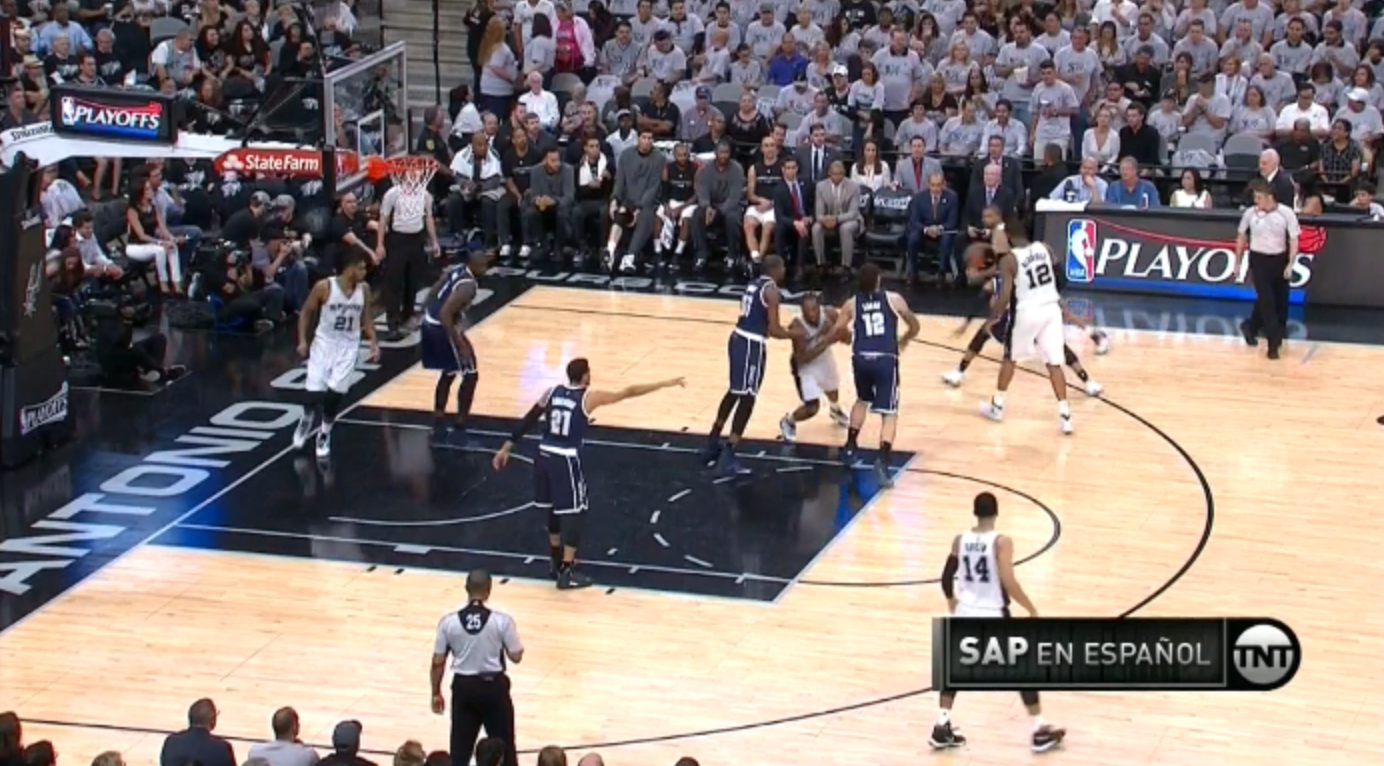
If Steven Adams is up in that situation, you can trap, but he's caught up, which means that Parker just goes away from the screen and to the baseline. The minute Westbrook finds himself out of position, the possession is lost. Here's the entire sequence of tough decisions they face.
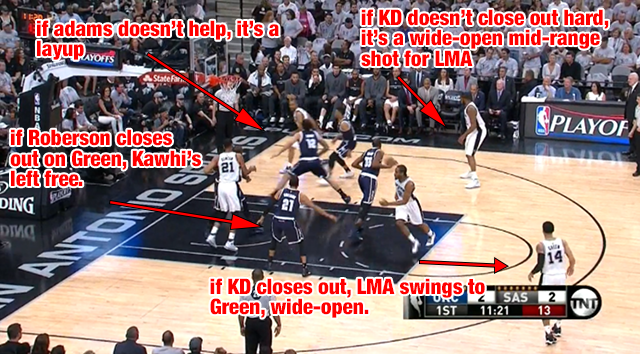
This play is now over. It's done. There are no good options. You're either surrendering a quality rhythm shot to arguably the best mid-range shooting power forward in the league, a wide open 3-pointer to Danny Green, or a wide open corner 3 or backcut to All-Star Kawhi Leonard. You are doomed, at this point.
"We need to do a better job. I don't know if there's any adjustment we need to make," Billy Donovan said Sunday. "He scored a lot around the elbow, but it wasn't all there."
The Thunder's whole take on the situation was that they essentially just have to close out harder on those. Here's the problem. If you're hedging with that big, and then asking the big to then recover and close out, you're asking a slower, less coordinated and less nimble defender to recover and get back in time, and if you don't do it perfectly ... this happens:
The Spurs went back to this time ...
... and time again.
On that last one, you notice that Kanter is guarding Parker all the way under the basket, which results in this:
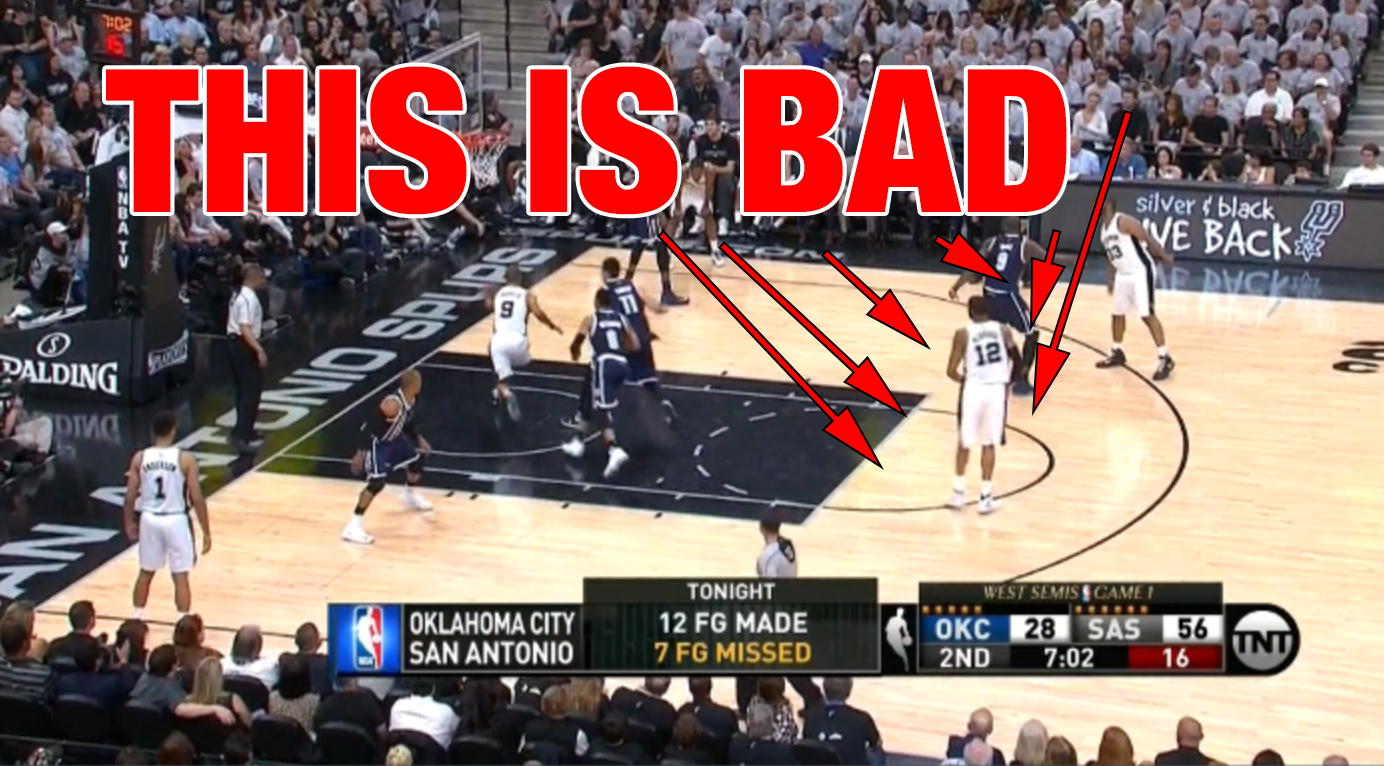
Helping on Parker makes sense on the surface, but it's when you get into this kind of situation that you might want to reevaluate what's going on:
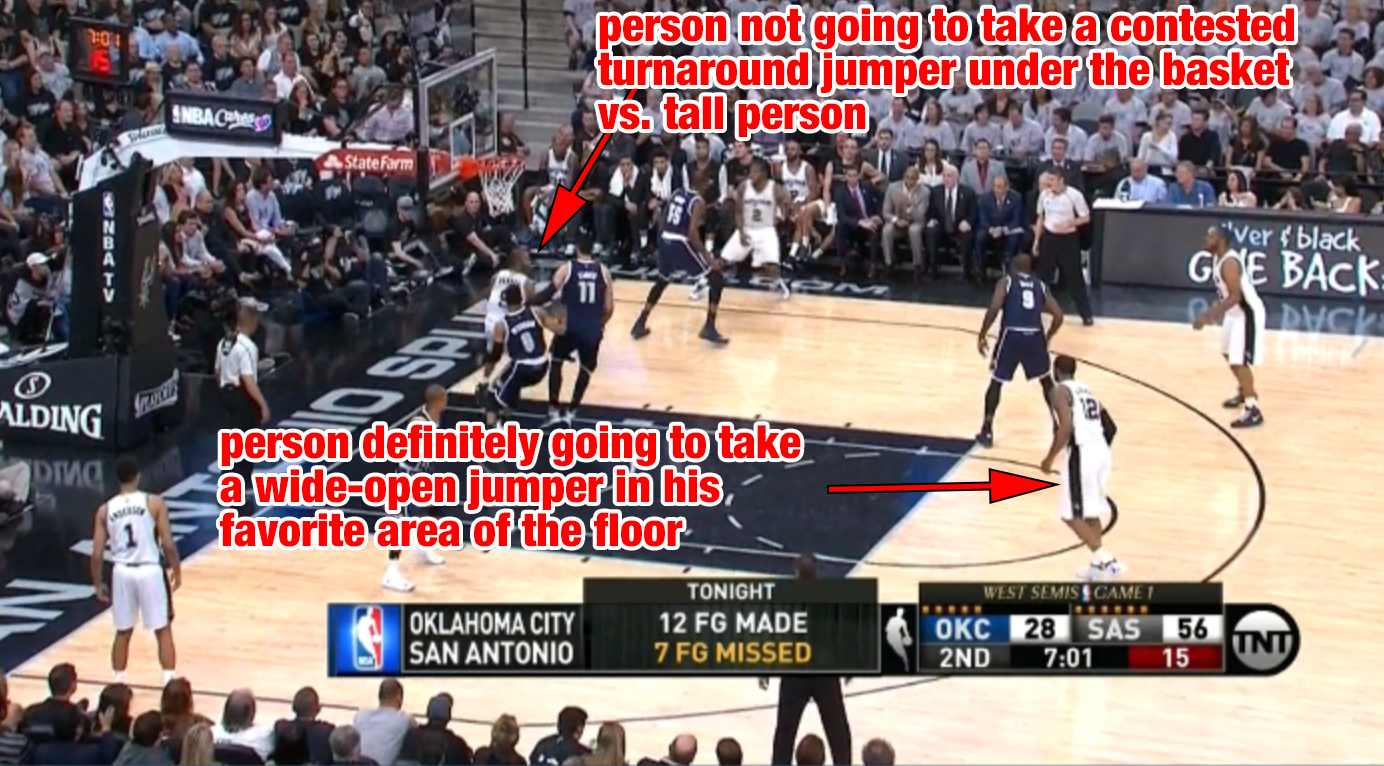
OK, so leaving Aldridge alone is probably not a good idea, considering he shot 13-of-15 on mid-range shots in this game. So why not bring help from somewhere else. Help the helper, right?
Here's why. Danny Green:
That moment, that play right there, when it went from a six-point lead to a nine-point lead, and the problem went from the Spurs' typical weapons to now all of their weapons at once ... that is where things got out of hand for OKC. Green has struggled with his shot this year. But when Roberson went to try and throw a hand up and left his man wide open in the corner, that got Green going. Now everything is clicking. Now you are totally doomed.
So you cannot bring help from elsewhere. So what do you do?
LET PARKER GO OFF
Tony Parker has had a nice bounce-back season. He's still an exceptionally dangerous and brilliant point guard, as shown by the kinds of passes he threw in this game. But the one thing he is not anymore is a 40-point scorer. The Thunder might consider switching entirely, putting the big on Parker on the drive and daring him to go off. If he wants to take mid-range jumpshots off the dribble all day, let him. If he wants to drive into the paint, where the Thunder help defense is good, let him. If the Spurs try and beat OKC with Tony Parker going off in points, that's fine. They should take that any day of the week than the Leonard/Aldridge death machine.
The Thunder need to contain that pick and pop no matter what. If you switch, there's a good chance that Aldridge posts up the big. But if he pops out, there will be time to find a switch back defensively or to bring help. Much of this comes down to recognizing what the Spurs will do and calling it out ahead of time. Adams told reporters Sunday that the Thunder had communication problems on account of the crowd noise and the coverage just wasn't getting relayed to the guards.
Better communication, better defense from Westbrook and a shift away from this kind of pick-and-roll coverage could help the Thunder at least corral Aldridge to a degree.
Then all you have to worry about is Kawhi Leonard. As I said, the Thunder have a lot of things to worry about.