
Warriors granted $9.3 million Disabled Player Exception after injury to Klay Thompson, per report
The exception can be used on a trade or in free agency

By
Sam Quinn
•
3 min read

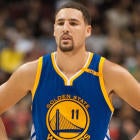
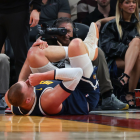
The Golden State Warriors have been granted a $9.3 million Disabled Player Exception, the maximum allowable amount, after the season-ending injury to Klay Thompson, The Athletic's Shams Charania reports. Teams are free to apply for such exceptions if one of their players is expected to miss the entire season, or the rest of an existing season if it comes early enough. That exception won't be able to land them a player like Thompson, but it can help them find a replacement they otherwise wouldn't have access to. The exception can be used in one of three ways:
- To sign a free agent to a one-year contract worth up to $9.3 million.
- To claim a player on waivers with one year remaining on his contract at no more than $9.3 million.
- To trade for a player with one year remaining on his contract at no more than $9.3 million.
The exception cannot be divided amongst multiple players, and it expires on April 19. Obviously, the Warriors would have preferred to have it earlier in free agency, when more players warranted such a salary, but there is no guarantee that they even use it. The Warriors still have not spent their $5.7 million taxpayer mid-level exception in free agency, and with so few impact players remaining, they may choose not to use it at all. Now, they have both exceptions in their back pocket, though they cannot be combined.
In theory, the Warriors could use the exception to trade for a player on an expiring contract, and then re-sign that player in the offseason using Bird Rights that they otherwise could not have gained. That is a silver lining to Thompson's injury. If the Warriors choose to use this exception through trade, it opens the door for them to add someone who could help them win for the long haul. A particularly devious use would be to acquire a player on an expiring contract now using that exception, and then turning around and trading that player later, possibly as little more than salary filler for another deal in exchange for a player on a longer contract. In theory, the Warriors could fill both of their available exceptions and then combine their salaries in a bigger trade down the line, when free agents can be dealt and the 60-day aggregation wait passes.
But such maneuvers are fairly rare. The most common use of this exception comes in the buyout market, and if the Warriors choose to go that route, they have a major advantage over the rest of the field. Why? Because Disabled Player Exceptions don't pro-rate. It is worth $9.3 million now, but even as time in the season passes, it remains frozen at that figure. The mid-level exception and minimum salary exception both pro-rate. They are worth less the later into the season they are signed. If Golden State wielded this exception fully on the buyout market, it would be able to dwarf any offer another team could make financially.
The true cost to the Warriors would be far greater than $9.3 million, though. At this moment, the Warriors have over $165 million in committed salaries. That's over $32 million beyond the luxury tax line. Calculating their exact payment right now isn't possible because we don't know how large the Basketball-Related Income adjustment will prove to be, but it's safe to say that it will approach $100 million before factoring in any new players. Adding another substantial salary would create an overwhelming financial burden based on how the tax formula is structured. The higher a team goes into the tax, the higher its marginal tax rate becomes. Put simply, tax rates rise exponentially, not linearly.
The Warriors have always been willing to spend whatever it takes to win, but the 2020-21 season offers unique obstacles to doing so. The primary driver of Golden State's revenue comes from its new arena, the Chase Center. Its local television deal, relative to its recent performance, is old and fairly small, but Chase Center projects to be one of the most profitable stadiums in all of professional sports. The problem is that we don't yet know how many fans, if any, will be able to attend games. The Warriors hope to reach 50 percent capacity next season, but that will obviously be difficult and subject to both coronavirus developments and the law.
The Warriors would not have applied for this exception if they didn't think there was at least the possibility that they might use it. It might come down to the same thought process that dictated their decision to acquire Kelly Oubre Jr. with their Andre Iguodala trade exception: if it's the right opportunity, they'll use it. If that opportunity doesn't present itself, they won't.