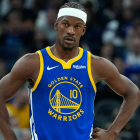

The sub-.500 Warriors aren't getting enough from Jimmy Butler, and once again there's an excuse
This time it's Steve Kerr's fault for not putting him in the proper positions

The Golden State Warriors entered this season with a clear goal: Don't wind up in the same situation they were in last year where they had to fight for their lives down the stretch of the regular season just to make the Play-In Tournament.
It's not looking so good.
Through one-third of the regular season, the Warriors are 13-14 with a bottom-10 offense. If the postseason were to start today they would again have to win a play-in game just to make the playoffs, and even that's dicey. Golden State is tied in the loss column with No. 9 Memphis and is two losses from the lottery. Utah has just one more defeat on its ledger. Portland two. The Mavericks, a recent punchline of the league, have only lost three more games than the Warriors. Think about that.
There is no shortage of reasons for Golden State's early season scuffles. They're old, and it shows. They're slow and lack any semblance of athletic force with Jonathan Kuminga yet again removed from the rotation. The defense looks good on paper (currently No. 5) but even that feels deceiving. A team that can have this much trouble containing penetration that also doesn't have traditional rim protection is set up for scramble drills. When it really gets down to it, the Warriors aren't that hard to score on. They're 5-9 in clutch games with the league's seventh-worst defense in the highest-leverage minutes. They're small, sometimes so far as tiny. They get killed on the glass. As is basically a matter of corporate policy, they turn the ball over like crazy.
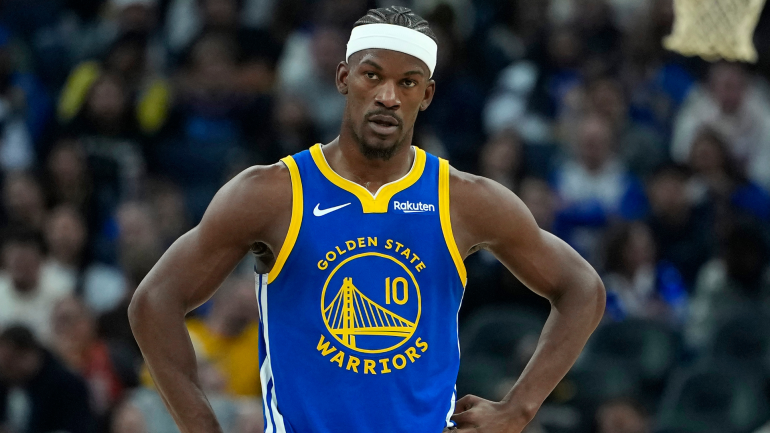
And then there's the matter of Jimmy Butler, who, much like the defense, looks beyond reproach on paper. Butler is averaging 19 PPG on what is basically a career-high true-shooting percentage and what is, by far, a career-high 44% 3-point clip. He's one of five players in the league adding five assists, five rebounds and 1.5 steals to that sheet. The Warriors are 12.5 points better per 100 possessions when he's on the floor, the best mark on the team, per Cleaning the Glass, where you'll also find that his 129.2 points per 100 shots is another career high. His drives, paint touches, usage and free-throw rates are all basically identical to last season.
You would think, with numbers like this, you would feel Butler's impact all over games. But you don't. Yes, he does a lot of little things well that aren't going to grab headlines. We know he's smart. Competitive. He calms a chaotic offense. But the bottom line is for a guy making $54 million this season, Butler isn't doing enough. Steve Kerr knows it, and he's taking the blame.
"I'm not doing my job well this year," Kerr told reporters following Golden State's loss to the Blazers on Sunday. He was speaking generally here. The turnovers. Maybe the ongoing Kuminga debacle. But then Kerr addressed, specifically, the production of Butler, who made three shots against the Blazers, hasn't reached the 20-point mark in two weeks, and is averaging just 11 shots per game for the season.
"I've got to find a way to get him more into the groove of the game," Kerr said. "I don't really consider Jimmy's game to be dependent on how many shots he gets, but we do need his scoring. We do need his playmaking.
"I thought we did a better job last year putting [Butler] in position to attack and create shots for people. We need to get back to that type of control of the game where we are going to him in the half court. We've had a few moments during the season, but we're not able to consistently put the ball in Jimmy's hands and let him control games at the end of last year."
Kerr made particular mention of a four-possession stretch against the Timberwolves, when Curry was off the floor, in which Butler didn't touch the ball one time.
"That's on me," Kerr said. "But that's also on our players to understand. I can't call a play every time. Nor do I want to. We have to find a way in collaboration to make sure we are playing through Jimmy."
Kerr says he needs to prioritize running a more traditional, intentional offense through Butler when Curry is on the bench rather than sticking with the "random flow" on which they rely so heavily with Curry out there. Butler agrees. Last month he told ESPN that if you're "trying to run the Steph stuff" when Steph isn't in the game, "it's not going to work."
The numbers support this hypothesis. When Curry sits, the Warriors go from an offensive rating that would rank No. 6 to the worst offensive in the league, per CTG. Kerr is correct that he is the one with his hand on the switch, and if he wants Butler running more pick-and-roll and iso offense when Curry isn't on the floor, it's his job to make that happen.
But there's also an element of responsibility that falls on Butler, and Heat fans know all too well what this means. The masses remember the Jimmy Buckets playoff runs, which were legendary, but as his time in Miami wound down, and even to some degree during some of the prime times, he was frustratingly, even maddeningly unwilling to commit himself to the Buckets part of his moniker.
There's a fine line between patience and passive, and Butler's lean toward the latter has been a talking point from the time he arrived in Golden State. The Warriors acquired Butler in February, and by March reporters who clearly hadn't watched these habits in Miami were already asking about his reluctance to take basically any shot that either didn't appear at the end of a red carpet or he wasn't forced into by a dwindling shot clock.
"When it's my time [to score], you'll know it's my time," Butler said.
Then that time came in the second round of the playoffs when Curry got hurt early in Game 1. From that point forward, the Warriors had one path to winning even one game against the Timberwolves, which was all they needed to do to extend the series long enough for Curry to get back on the floor: Butler had to flip the scoring switch. He did if for one game, not coincidentally the one the Warriors had a real chance to win, but even then he didn't score a single point over the game's final eight minutes.
Other than that, he spent that entire series as the Michael Jordan of jump stops and head fakes that lead to "here you take it" kick-out passes to less capable, if not entirely incapable, creators. Butler was passing up restricted-area shots to toss grenades out to Kevon Looney behind the 3-point line. When Golden State needed an alpha, it wasn't Butler who stepped up. It was Kuminga.
Of course, there's always been a excuse. When Butler first showed up, he was, as he explained it, deferring by choice -- prioritizing his new teammates until it was "his time." Then when it was his time and he turned into the invisible man against the Timberwolves, he was hurt. Now this year he's making $54 million to take 11 shots and score fewer points per game than Nickeil Alexander-Walker, and it's Kerr's fault for not putting him in proper positions?
Here's an idea: Put yourself in the proper positions. Yes, the Warriors play with flow and it sounds like Kerr hasn't explicitly said "let's run more pick and roll for Jimmy." But anyone who watches the Warriors with an objective eye knows he has plenty of opportunities to assert himself. Plenty.
And this isn't just when Curry isn't on the floor with him. Butler, who has openly talked about how Golden State can't keep expecting Curry to bail them out with superhero scoring runs, is the guy who's supposed to make Curry's job easier, not just chew up the few minutes he's resting.
Again, it looks like Butler is doing all he can on paper. The catch-all advanced metrics slot him as one of the league's most impactful players. But if you think Butler's high-efficiency marks are solely indicative of a guy having a good shooting season, you're wrong. When you only take premium shots while passing out of just about anything even halfway contested under the guise of "right play" basketball, your efficiency numbers are going to look great.
Butler is too happy to operate, particularly in the half court, just like every other part of the Steph support staff, cutting into the space that Curry's movement creates, thriving in the cracks, et cetera. To truly lighten Curry's load, he has to actually create offense for himself, and more, actually finish that offense rather than dipping his toe into the water and quickly deciding its too cold to take the plunge. The Warriors rank dead last in paint points per game, a deficiency that Butler was supposed to specifically address.
I once had a scout describe Butler as one of the league's most "careful" superstars and I've never thought of a better way to describe it. If you only look for the safe shots, you're not going to find very many. Which is fine for a role player. But Butler is supposed to be a star. He's certainly being paid like one.
Kerr can be the fall guy here if he wants, and it's not to suggest he can't get pretty stubborn in his approach in his own right. But Butler needs to take the bulk of the blame for a problem you would never even know is there if you were to just look at the stats.